
- 100% accuracy of data
- 24/7 scientific support
- 0% tolerance in quality of product
Stock Locations
- New Jersey, USA
- Czech Republic, EUIn stock
* Stock subject to availability.
Documentation
Includes: HPLC, MASS/LC-MS, 1H NMR, FT-IR, Potency, Structure Elucidation Report (SER), and additional analytical data depending on the product.
97143-65-2
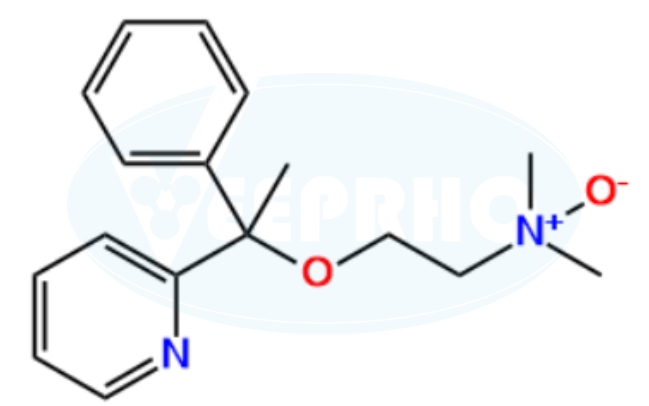
Doxylamine N-Oxide
● In Stock
| Catalogue No.: | VL38005 |
|---|---|
| CAS No.: | 97143-65-2 |
| Mol. Formula: | C17H22N2O2 |
| Mol. Weight: | 286.37g/mol |
For laboratory use only: analytical, development and regulatory purposes. Supplied in mg quantities. Not for human or veterinary use.
Additional information on CAS 97143-65-2
| Parent drug | Doxylamine |
|---|---|
| Product type | Impurity standards |
| IUPAC name | N,N-Dimethyl-2-[1-phenyl-1-(pyridin-2-yl)ethoxy]ethan-1-amine oxide |
| Other Synonyms | Doxylamine Ethylamine N-Oxide;N,N-dimethyl-2-(1-phenyl-1-pyridin-2-ylethoxy)ethanamine oxide |
| SMILES | CC(C1=NC=CC=C1)(C2=CC=CC=C2)OCC[N+](C)([O-])C |
| InChI | InChI=1S/C17H22N2O2/c1-17(15-9-5-4-6-10-15,16-11-7-8-12-18-16)21-14-13-19(2,3)20/h4-12H,13-14H2,1-3H3 |
| InChIKey | SSGKPGKMFJONCR-UHFFFAOYSA-N |
| CHNS Ratio (%) (calculated) | C 71.30 · H 7.74 · N 9.78 · S 0.00 |
| References | 'Friedman | H. | et al. 'Clearance of the Antihistamine Doxylamine.' Clinical Pharmacokinetics | vol. 16 | no. 5 | May 1989 | pp. 312–16 | https://doi.org/10.2165/00003088-198916050-00003. ?Koren | Gideon | et al. 'Effectiveness of Delayed-Release Doxylamine and Pyridoxine for Nausea and Vomiting of Pregnancy: A Randomized Placebo Controlled Trial.' American Journal of Obstetrics and Gynecology | vol. 203 | no. 6 | Dec. 2010 | pp. 571.e1–7 | https://doi.org/10.1016/j.ajog.2010.07.030 ' |
| Description | Doxylamine Ethylamine N-Oxide, also designated Doxylamine N-Oxide, CAS 97143-65-2, is an oxidized tertiary amine impurity associated with the doxylamine scaffold. With molecular formula C17H22N2O2 and molecular weight 286.37 g/mol, it represents N-oxidation at the dimethylamino center, a transformation that may arise during oxidative storage, peroxide exposure, or metabolic biotransformation. As a polar amine N-oxide, it can alter ionization behavior and chromatographic retention relative to the parent drug. Trace determination generally relies on LC-MS/MS or high-resolution LC-MS, with orthogonal confirmation by NMR or, where volatility permits, GC-MS after derivatization. It is not a nitrosamine, but remains relevant in impurity profiling under regulatory control. |
Request a Quote
"*" indicates required fields
Other products related to Doxylamine impurities
| Impurity structure | Name of Impurity | Catalogue No. |
|---|---|---|
| Doxylamine EP Impurity A | VL38001 | |
| Doxylamine EP Impurity B | VL38002 | |
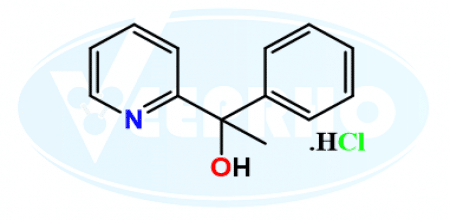 | Doxylamine EP Impurity B (HCl Salt) | VE007036 |
| Doxylamine EP Impurity C (Free Base) | VL38003 | |
| Doxylamine EP Impurity D | VL38004 | |
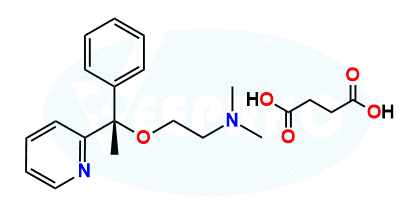 | (S)-Doxylamine Succinate | VE0014668 |
| Doxylamine Di-N-Oxide | VL38006 | |
| Doxylamine Impurity 1 | VE0014569 | |
| Doxylamine Phenyl(pyridin-2-yl)methanol | VL38007 | |
| Doxylamine Pyridinyl N- oxide | VL38008 | |
| N-Desmethyldoxylamine (Succinate Salt) | VE0022470 | |
| N-Methyl-N-(2-(phenyl(pyridin-2-yl)methoxy)ethyl)nitrous amide | VE0025329 |
Show all related products N-Nitroso Doxylamine impurities (2)