
- 100% accuracy of data
- 24/7 scientific support
- 0% tolerance in quality of product
Stock Locations
- New Jersey, USA
- Czech Republic, EUIn stock
* Stock subject to availability.
Documentation
Batch COA on file. The batch COA includes HPLC, MASS/LC-MS, 1H NMR, FT-IR, Potency, and Structure Elucidation Report (SER)..
41451-91-6
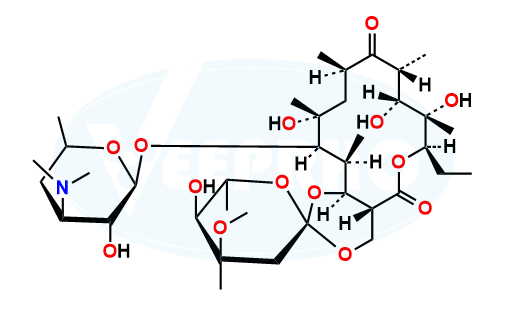
Erythromycin EP Impurity C
● In Stock
| Catalogue No.: | VL690004 |
|---|---|
| CAS No.: | 41451-91-6 |
| Mol. Formula: | C37H65NO14 |
| Mol. Weight: | 747.91 |
For laboratory use only: analytical, development and regulatory purposes. Supplied in mg quantities. Not for human or veterinary use.
Request a quote for a set
- Request quote for this set
All EP impurities of Erythromycin
15 productsSee the 15 products
- Clarithromycin EP Impurity J VL740012
CAS 111321-02-9 - Erythromycin EP Impurity A (Free Base) VL690005
CAS 82230-93-1 - Erythromycin EP Impurity B VL690023
CAS 992-62-1 - Erythromycin EP Impurity C VL690004
CAS 41451-91-6 - Erythromycin EP Impurity D VL690010
CAS 23893-13-2 - Erythromycin EP Impurity E VL690020
CAS 33396-29-1 - Erythromycin EP Impurity F VL690011
CAS 105882-69-7 - Erythromycin EP Impurity H VL690013
CAS 992-65-4 - Erythromycin EP Impurity I VL690017
CAS 546-57-6 - Erythromycin EP Impurity J VL690018
CAS 105900-46-7 - Erythromycin EP Impurity K VL690025
CAS 33442-56-7 - Erythromycin EP Impurity L VL690014
CAS 127955-44-6 - Erythromycin EP Impurity M VL690022
CAS 616234-56-1 - Erythromycin EP Impurity N VL690019
CAS 3225-82-9 - Erythromycin Estolate EP Impurity G VE0021713
CAS 147702-49-6
- Clarithromycin EP Impurity J VL740012


Additional information on CAS 41451-91-6
| Parent drug | Erythromycin |
|---|---|
| Product type | Impurity standards |
| IUPAC name | (2S,4aR,4′R,5′S,6′S,7R,8S,9R,10R,12R,14R,15R,16S)-7-Ethyl-5′,8,9,14-tetrahydroxy-4′-methoxy-4′,6′,8,10,12,14,16-heptamethyl-15-[[3,4,6-trideoxy-3-(dimethylamino)-β-D-xylo-hexopyranosyl]oxy]hexadecahydrospiro[5H,11H-1,3-dioxino[5,4c]oxacyclotetradecin-2,2′-pyrane]-5,11-dione |
| EP name | Erythromycin EP Impurity C |
| SMILES | CC[C@H]1OC(=O)[C@@H]2CO[C@@]3(C[C@@](C)(OC)[C@@H](O)[C@H](C)O3)O[C@H]2[C@H](C)[C@@H](O[C@@H]2O[C@H](C)C[C@H](N(C)C)[C@H]2O)[C@](C)(O)C[C@@H](C)C(=O)[C@H](C)[C@@H](O)[C@]1(C)O |
| InChIKey | PRUSTPADOGZAML-LMXGZOGMSA-N |
| CHNS Ratio (%) (calculated) | C 59.42 · H 8.76 · N 1.87 · S 0.00 |
| References | - |
| Additional characterisation data | QNMR, D2O Exchange, 13C NMR, 13C APT, COSY NMR, NOESY NMR, 15N NMR, HSQC NMR, HMQC NMR, and HMBC NMR. These are available upon request and may be free or subject to additional charges. |
| Description | Erythromycin EP Impurity C, also designated erythromycin E, is a macrolide-derived process-related impurity associated with semisynthetic erythromycin manufacturing and acid-catalyzed structural rearrangement. CAS 41451-91-6 corresponds to the molecular formula C37H65NO14 and molecular weight 747.91, consistent with a high-mass oxygenated lactone containing multiple hydroxyl functionalities and a desosamine sugar. Its closely related macrolide architecture can complicate chromatographic resolution and requires orthogonal characterization by LC-MS/MS, high-resolution mass spectrometry, and NMR, often with RP-HPLC separation under carefully controlled pH. The impurity is evaluated as a specified related substance in pharmacopeial monographs rather than as a genotoxic alert class. |
Request a Quote
"*" indicates required fields