
- 100% accuracy of data
- 24/7 scientific support
- 0% tolerance in quality of product
Mutagenicity assessment (ICH M7)
Potentially mutagenic impurity (ICH M7 Class 1–3).
N-nitroso compound: ICH M7 cohort of concern.Stock Locations
- New Jersey, USA
- Czech Republic, EU
* Stock subject to availability.
Documentation
Includes: HPLC, MASS/LC-MS, 1H NMR, FT-IR, Potency, Structure Elucidation Report (SER), and additional analytical data depending on the product.
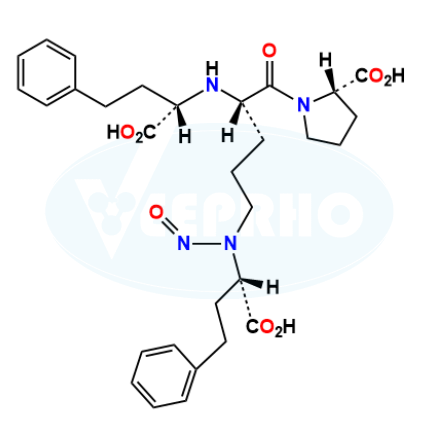
Lisinopril EP Impurity I Nitroso 1
● Under Development
| Catalogue No.: | VE0028007 |
|---|---|
| CAS No.: | N/A |
| Mol. Formula: | C31H40N4O8 |
| Mol. Weight: | 596.67 g/mol |
For laboratory use only: analytical, development and regulatory purposes. Supplied in mg quantities. Not for human or veterinary use.
Request a quote for a set
- Request quote for this set
All nitrosamine impurities of Lisinopril
13 productsSee the 13 products
- Dinitroso Lisinopril EP Impurity G VE0028006
- Dinitroso Lisinopril EP Impurity I VE0028011
- Dinitroso Lisinopril EP Impurity J VE0028009
- Lisinopril EP Impurity G Nitroso 1 VE0028002
- Lisinopril EP Impurity G Nitroso 2 VE0028003
- Lisinopril EP Impurity I Nitroso 1 VE0028007
- Lisinopril EP Impurity I Nitroso 2 VE0028008
- Lisinopril EP Impurity J Nitroso 1 VE0028004
- Lisinopril EP Impurity J Nitroso 2 VE0028005
- N-Nitroso Lisinopril VE0010130
CAS 519175-80-5 - N-Nitroso Lisinopril EP Impurity E VE0011216
- N-Nitroso Lisinopril EP Impurity F VE0011217
- N-Nitroso Lisinopril EP Impurity H VE0028001


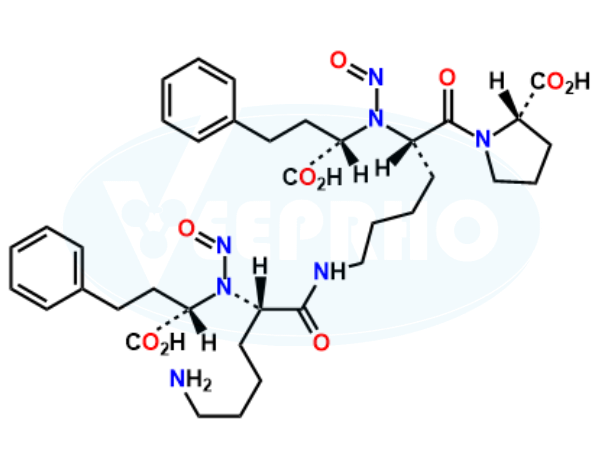
Additional information on Lisinopril EP Impurity I Nitroso 1
| Parent drug | Lisinopril |
|---|---|
| Product type | Impurity standards, Nitroso impurities |
| IUPAC name | (S)-1-((S)-6-(((S)-1-carboxy-3-phenylpropyl)(nitroso)amino)-2-(((S)-1-carboxy-3-phenylpropyl)amino)hexanoyl)pyrrolidine-2-carboxylic acid |
| SMILES | [H][C@@](N[C@@]([H])(CCCCN(N=O)[C@]([H])(C(O)=O)CCC1=CC=CC=C1)C(N2CCC[C@]2(C(O)=O)[H])=O)(C(O)=O)CCC3=CC=CC=C3 |
| InChI | InChI=1S/C31H40N4O8/c36-28(34-20-9-15-26(34)30(39)40)24(32-25(29(37)38)18-16-22-10-3-1-4-11-22)14-7-8-21-35(33-43)27(31(41)42)19-17-23-12-5-2-6-13-23/h1-6,10-13,24-27,32H,7-9,14-21H2,(H,37,38)(H,39,40)(H,41,42)/t24-,25?,26?,27?/m0/s1 |
| InChIKey | FNAZZKWPJZAXSK-FWEHEUNISA-N |
| CHNS Ratio (%) (calculated) | C 62.40 · H 6.76 · N 9.39 · S 0.00 |
| Description | Lisinopril EP Impurity I Nitroso 1 is a nitroso-class degradation product identified in the Lisinopril impurity profile and is characterized for its analytical detectability and regulatory significance. This impurity requires targeted surveillance due to the nitroso functionality and potential genotoxic risk, necessitating trace-level control in accordance with ICH M7 guidance. Analytical characterization typically employs HPLC with UV detection, LC-MS/MS for mass confirmation, and NMR for structural verification. Stability studies and forced-degradation experiments support root cause analysis and control strategy development. Accurate quantification, validated limit of detection and limit of quantitation, and robust sampling protocols ensure compliance with EP specifications and product safety assurance. |
Request a Quote
"*" indicates required fields