
- 100% accuracy of data
- 24/7 scientific support
- 0% tolerance in quality of product
Mutagenicity assessment (ICH M7)
Potentially mutagenic impurity (ICH M7 Class 1–3).
N-nitroso compound: ICH M7 cohort of concern.Stock Locations
- New Jersey, USA
- Czech Republic, EU
* Stock subject to availability.
Documentation
Includes: HPLC, MASS/LC-MS, 1H NMR, FT-IR, Potency, Structure Elucidation Report (SER), and additional analytical data depending on the product.
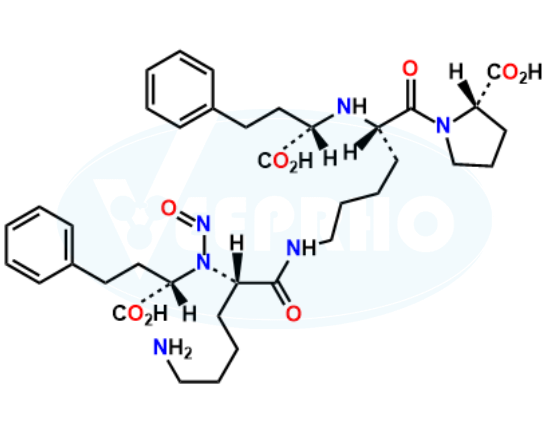
Lisinopril EP Impurity J Nitroso 1
● Under Development
| Catalogue No.: | VE0028004 |
|---|---|
| CAS No.: | N/A |
| Mol. Formula: | C37H52N6O9 |
| Mol. Weight: | 724.84 g/mol |
For laboratory use only: analytical, development and regulatory purposes. Supplied in mg quantities. Not for human or veterinary use.
Request a quote for a set
- Request quote for this set
All nitrosamine impurities of Lisinopril
13 productsSee the 13 products
- Dinitroso Lisinopril EP Impurity G VE0028006
- Dinitroso Lisinopril EP Impurity I VE0028011
- Dinitroso Lisinopril EP Impurity J VE0028009
- Lisinopril EP Impurity G Nitroso 1 VE0028002
- Lisinopril EP Impurity G Nitroso 2 VE0028003
- Lisinopril EP Impurity I Nitroso 1 VE0028007
- Lisinopril EP Impurity I Nitroso 2 VE0028008
- Lisinopril EP Impurity J Nitroso 1 VE0028004
- Lisinopril EP Impurity J Nitroso 2 VE0028005
- N-Nitroso Lisinopril VE0010130
CAS 519175-80-5 - N-Nitroso Lisinopril EP Impurity E VE0011216
- N-Nitroso Lisinopril EP Impurity F VE0011217
- N-Nitroso Lisinopril EP Impurity H VE0028001


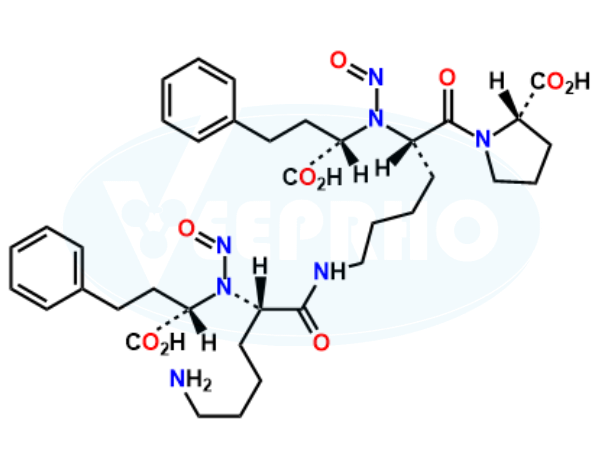
Additional information on Lisinopril EP Impurity J Nitroso 1
| Parent drug | Lisinopril |
|---|---|
| Product type | Impurity standards, Nitroso impurities |
| IUPAC name | (S)-1-((S)-6-((S)-6-amino-2-(((S)-1-carboxy-3-phenylpropyl)(nitroso)amino)hexanamido)-2-(((S)-1-carboxy-3-phenylpropyl)amino)hexanoyl)pyrrolidine-2-carboxylic acid |
| SMILES | [H][C@@](N[C@@]([H])(CCCCNC([C@](N(N=O)[C@]([H])(C(O)=O)CCC1=CC=CC=C1)([H])CCCCN)=O)C(N2CCC[C@]2(C(O)=O)[H])=O)(C(O)=O)CCC3=CC=CC=C3 |
| InChI | InChI=1S/C37H52N6O9/c38-23-9-7-17-30(43(41-52)32(37(50)51)22-20-27-14-5-2-6-15-27)33(44)39-24-10-8-16-28(34(45)42-25-11-18-31(42)36(48)49)40-29(35(46)47)21-19-26-12-3-1-4-13-26/h1-6,12-15,28-32,40H,7-11,16-25,38H2,(H,39,44)(H,46,47)(H,48,49)(H,50,51)/t28-,29?,30-,31?,32?/m0/s1 |
| InChIKey | FHHMCECVKCJUNB-XDIGFQIYSA-N |
| CHNS Ratio (%) (calculated) | C 61.31 · H 7.23 · N 11.59 · S 0.00 |
| Description | Lisinopril EP Impurity J Nitroso 1 is a nitroso-class degradation and synthetic byproduct observed during lisinopril manufacture and storage. Characterized by a nitroso functional group, this low-level impurity raises genotoxicity concerns and requires rigorous identification and quantification. Analytical control typically employs validated LC-MS/MS and HPLC with UV detection complemented by high resolution mass spectrometry for confirmation. Control strategies include optimized synthetic route selection, impurity-scavenging reagents, and stability-aware formulation to minimize formation. Risk assessment per ICH M7 principles, establishment of acceptable limits, and routine batch release testing are critical to ensure drug substance safety and regulatory compliance. |
Request a Quote
"*" indicates required fields