
- 100% accuracy of data
- 24/7 scientific support
- 0% tolerance in quality of product
Mutagenicity assessment (ICH M7)
Potentially mutagenic impurity (ICH M7 Class 1–3).
N-nitroso compound: ICH M7 cohort of concern.Stock Locations
- New Jersey, USA
- Czech Republic, EU
* Stock subject to availability.
Documentation
Includes: HPLC, MASS/LC-MS, 1H NMR, FT-IR, Potency, Structure Elucidation Report (SER), and additional analytical data depending on the product.
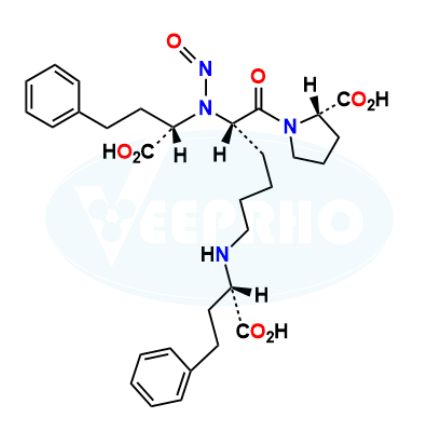
Lisinopril EP Impurity I Nitroso 2
● Under Development
| Catalogue No.: | VE0028008 |
|---|---|
| CAS No.: | N/A |
| Mol. Formula: | C31H40N4O8 |
| Mol. Weight: | 596.67 g/mol |
For laboratory use only: analytical, development and regulatory purposes. Supplied in mg quantities. Not for human or veterinary use.
Request a quote for a set
- Request quote for this set
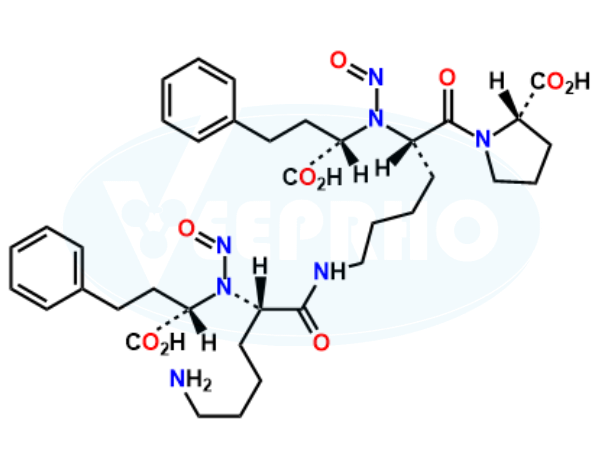
All nitrosamine impurities of Lisinopril
13 productsSee the 13 products
- Dinitroso Lisinopril EP Impurity G VE0028006
- Dinitroso Lisinopril EP Impurity I VE0028011
- Dinitroso Lisinopril EP Impurity J VE0028009
- Lisinopril EP Impurity G Nitroso 1 VE0028002
- Lisinopril EP Impurity G Nitroso 2 VE0028003
- Lisinopril EP Impurity I Nitroso 1 VE0028007
- Lisinopril EP Impurity I Nitroso 2 VE0028008
- Lisinopril EP Impurity J Nitroso 1 VE0028004
- Lisinopril EP Impurity J Nitroso 2 VE0028005
- N-Nitroso Lisinopril VE0010130
CAS 519175-80-5 - N-Nitroso Lisinopril EP Impurity E VE0011216
- N-Nitroso Lisinopril EP Impurity F VE0011217
- N-Nitroso Lisinopril EP Impurity H VE0028001


Additional information on Lisinopril EP Impurity I Nitroso 2
| Parent drug | Lisinopril |
|---|---|
| Product type | Impurity standards, Nitroso impurities |
| IUPAC name | (S)-1-((S)-2-(((S)-1-carboxy-3-phenylpropyl)(nitroso)amino)-6-(((S)-1-carboxy-3-phenylpropyl)amino)hexanoyl)pyrrolidine-2-carboxylic acid |
| SMILES | [H][C@@](N(N=O)[C@@]([H])(CCCCN[C@]([H])(C(O)=O)CCC1=CC=CC=C1)C(N2CCC[C@]2(C(O)=O)[H])=O)(C(O)=O)CCC3=CC=CC=C3 |
| InChI | InChI=1S/C31H40N4O8/c36-28(34-21-9-15-26(34)30(39)40)25(35(33-43)27(31(41)42)19-17-23-12-5-2-6-13-23)14-7-8-20-32-24(29(37)38)18-16-22-10-3-1-4-11-22/h1-6,10-13,24-27,32H,7-9,14-21H2,(H,37,38)(H,39,40)(H,41,42)/t24?,25-,26?,27?/m0/s1 |
| InChIKey | NVMDGNPNMJYAKH-FWEHEUNISA-N |
| CHNS Ratio (%) (calculated) | C 62.40 · H 6.76 · N 9.39 · S 0.00 |
| Description | Lisinopril EP Impurity I Nitroso 2 is a monitored nitroso derivative observed as a trace-level byproduct during Lisinopril synthesis or storage. Structurally defined by an N-nitroso moiety, this impurity presents analytical and regulatory challenges because nitroso species are subject to genotoxicity assessment under current guidelines. Accurate quantitation typically uses LC-MS/MS with high resolution mass spectrometry for identification and HPLC-UV for routine release testing, supported by NMR confirmation when needed. Formation pathways involve nitrosation of secondary amines in presence of nitrosating agents, acidic conditions, or contaminated solvents. Control strategies focus on route optimization, elimination of nitrosating reagents, pH control, antioxidant scavengers and validated stability-indicating methods. |
Request a Quote
"*" indicates required fields