
- 100% accuracy of data
- 24/7 scientific support
- 0% tolerance in quality of product
Mutagenicity assessment (ICH M7)
Treated as a potentially non-mutagenic impurity (ICH M7 Class 4–5).
Computational (in silico) assessmentStock Locations
- New Jersey, USA
- Czech Republic, EU
* Stock subject to availability.
Documentation
Includes: HPLC, MASS/LC-MS, 1H NMR, FT-IR, Potency, Structure Elucidation Report (SER), and additional analytical data depending on the product.
160009-35-8
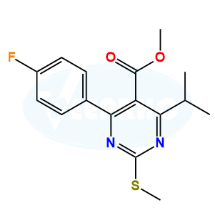
Methyl 4-(4-Fluorophenyl)-6-isopropyl-2-(methylthio)pyrimidine-5-carboxylate
● In Stock
| Catalogue No.: | VE0026703 |
|---|---|
| CAS No.: | 160009-35-8 |
| Mol. Formula: | C16H17FN2O2S |
| Mol. Weight: | 320.38 g/mol |
For laboratory use only: analytical, development and regulatory purposes. Supplied in mg quantities. Not for human or veterinary use.
Additional information on CAS 160009-35-8
| Parent drug | Rosuvastatin |
|---|---|
| Product type | Impurity standards |
| IUPAC name | methyl 4-(4-fluorophenyl)-2-methylsulfanyl-6-propan-2-ylpyrimidine-5-carboxylate |
| SMILES | O=C(OC)C(C(C(C)C)=NC(SC)=N1)=C1C2=CC=C(F)C=C2 |
| InChI | InChI=1S/C16H17FN2O2S/c1-9(2)13-12(15(20)21-3)14(19-16(18-13)22-4)10-5-7-11(17)8-6-10/h5-9H,1-4H3 |
| InChIKey | ZOHVECQKEABYPF-UHFFFAOYSA-N |
| CHNS Ratio (%) (calculated) | C 59.98 · H 5.35 · N 8.74 · S 10.01 |
| Description | Methyl 4-(4-Fluorophenyl)-6-isopropyl-2-(methylthio)pyrimidine-5-carboxylate (CAS 160009-35-8) is characterized as a lipophilic synthetic impurity arising from incomplete conversion or side reactions during pyrimidine derivatization. Its ester and methylthio functionalities influence chromatographic retention and potential hydrolytic or oxidative degradation pathways, complicating stability profiles. Analytical identification is routinely achieved by HPLC-UV for quantitation and by LC-MS and 1H and 13C NMR for structural confirmation and mass fragmentation mapping. Monitoring and control are recommended in line with ICH Q3A impurity thresholds, with targeted methods for limit testing and forced-degradation studies to assess its impact on purity and downstream quality attributes. |
Request a Quote
"*" indicates required fields
Other products related to Rosuvastatin impurities
| Impurity structure | Name of Impurity | Catalogue No. |
|---|---|---|
| Rosuvastatin EP Impurity A | VL127008 | |
| Rosuvastatin EP Impurity A (Free Base) | VE0024818 | |
| Rosuvastatin EP Impurity A (Sodium Salt) | VE008146 | |
| Rosuvastatin EP Impurity B (Free Base) | VE0024819 | |
| Rosuvastatin EP Impurity B (Racemic Mixture) | VL127001 | |
| Rosuvastatin EP Impurity C | VL127003 | |
| Rosuvastatin EP Impurity C (Free Base) | VE0011116 | |
| Rosuvastatin EP Impurity C (Sodium Salt) | VE0026666 | |
| Rosuvastatin EP Impurity D | VL127002 | |
| Rosuvastatin EP Impurity E | VL127005 | |
| Rosuvastatin EP Impurity F | VL127004 | |
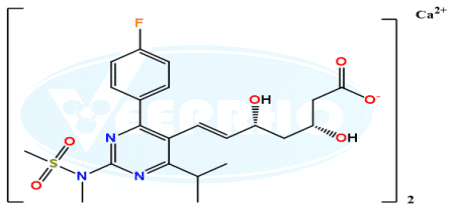 | Rosuvastatin EP Impurity G | VL127009 |
Show all related products N-Nitroso Rosuvastatin impurities (2)