
- 100% accuracy of data
- 24/7 scientific support
- 0% tolerance in quality of product
Stock Locations
- New Jersey, USA
- Czech Republic, EUIn stock
* Stock subject to availability.
Documentation
Includes: HPLC, MASS/LC-MS, 1H NMR, FT-IR, Potency, Structure Elucidation Report (SER), and additional analytical data depending on the product.
151213-15-9
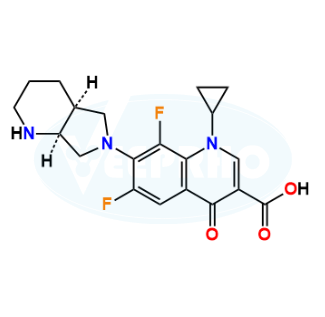
Moxifloxacin EP Impurity A
● In Stock
| Catalogue No.: | VL106001 |
|---|---|
| CAS No.: | 151213-15-9 |
| Mol. Formula: | C20H21F2N3O3 |
| Mol. Weight: | 389.40 g/mol |
For laboratory use only: analytical, development and regulatory purposes. Supplied in mg quantities. Not for human or veterinary use.
Request a quote for a set
- Request quote for this set
All EP impurities of Moxifloxacin
15 productsSee the 15 products
- Moxifloxacin EP Impurity A VL106001
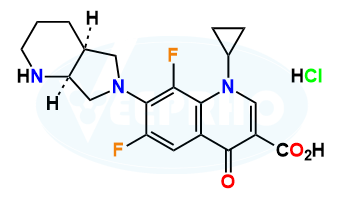
CAS 151213-15-9 - Moxifloxacin EP Impurity A (HCl Salt) VE0021495
CAS 151282-23-4 - Moxifloxacin EP Impurity B VL106002
CAS 1029364-73-5 - Moxifloxacin EP Impurity B (HCl Salt) VE0025145
CAS 2252446-68-5 - Moxifloxacin EP Impurity B (Hydrochloride Monohydrate) VE0021488
- Moxifloxacin EP Impurity C (HCl salt) VL106003
CAS 2252446-70-9 - Moxifloxacin EP Impurity C (Hydrochloride Hydrate) VE0021489
- Moxifloxacin EP Impurity D VL106004
CAS 1029364-77-9 - Moxifloxacin EP Impurity D (Hydrochloride Salt) VE0021494
CAS 2252446-69-6 - Moxifloxacin EP Impurity E VL106005
CAS 721970-36-1 - Moxifloxacin EP Impurity E (2HCl) VE009652
- Moxifloxacin EP Impurity E (Hydrobromide Salt) VE0021493
CAS 1292904-74-5 - Moxifloxacin Ethyl Analog (Free Base) VE008397
CAS 1029364-75-7 - Moxifloxacin Methyl Ester VL106007
CAS 721970-35-0 - Moxifloxacin Related Compound F (Free Base) VL106019
CAS 721970-37-2 & 1179992-99-4
- Moxifloxacin EP Impurity A VL106001
- Request quote for this set
All USP impurities of Moxifloxacin
18 productsSee the 18 products
- Moxifloxacin 7-Amino Impurity VL106018
CAS 172426-88-9 - Moxifloxacin Decarboxy Impurity VL106006
CAS 1322062-57-6 - Moxifloxacin EP Impurity A VL106001
CAS 151213-15-9 - Moxifloxacin EP Impurity A (HCl Salt) VE0021495
CAS 151282-23-4 - Moxifloxacin EP Impurity B VL106002
CAS 1029364-73-5 - Moxifloxacin EP Impurity B (Hydrochloride Monohydrate) VE0021488
- Moxifloxacin EP Impurity C (HCl salt) VL106003
CAS 2252446-70-9 - Moxifloxacin EP Impurity C (Hydrochloride Hydrate) VE0021489
- Moxifloxacin EP Impurity D VL106004
CAS 1029364-77-9 - Moxifloxacin EP Impurity E VL106005
CAS 721970-36-1 - Moxifloxacin EP Impurity E (2HCl) VE009652
- Moxifloxacin EP Impurity F VL106009
CAS 1350716-67-4 - Moxifloxacin Ethyl Analog (Free Base) VE008397
CAS 1029364-75-7 - Moxifloxacin Related Compound F (Free Base) VL106019
CAS 721970-37-2 & 1179992-99-4 - Moxifloxacin Related Compound G VL106010
CAS 1346603-25-5 - Moxifloxacin Related Compound G (Free Base) VE009489
CAS 268545-13-7 - Moxifloxacin Related Compound G (HCl Salt) VE0011551
CAS 1394029-14-1 - Moxifloxacin Related Compound G (Hydrochloride Monohydrate) VE006991
- Moxifloxacin 7-Amino Impurity VL106018


Additional information on CAS 151213-15-9
| Parent drug | Moxifloxacin |
|---|---|
| Product type | Impurity standards |
| IUPAC name | 1-Cyclopropyl-6,8-difluoro-7-[(4aS,7aS)-octahydro-6H-pyrrolo[3,4-b]pyridin-6-yl]-4-oxo-1,4-dihydroquinoline-3-carboxylic acid |
| EP name | Moxifloxacin EP Impurity A |
| USP name | Moxifloxacin Related Compound A |
| SMILES | O=C(O)c1cn(C2CC2)c2c(F)c(N3C[C@@H]4CCCN[C@@H]4C3)c(F)cc2c1=O |
| InChIKey | WEXQOLCYKFJAJZ-ZUZCIYMTSA-N |
| CHNS Ratio (%) (calculated) | C 61.69 · H 5.44 · N 10.79 · S 0.00 |
| References | Al Omari | Mahmoud M. H. | et al. “Moxifloxacin Hydrochloride.†Profiles of Drug Substances | Excipients and Related Methodology | 2014 | pp. 299–431 | https://doi.org/10.1016/b978-0-12-800173-8.00007-6. ?CHODOSH | S. | et al. “Short-Course Moxifloxacin Therapy for Treatment of Acute Bacterial Exacerbations of Chronic Bronchitis.†Respiratory Medicine | vol. 94 | no. 1 | Jan. 2000 | pp. 18–27 | https://doi.org/10.1053/rmed.1999.0708. ? |
| Description | Moxifloxacin EP Impurity A, CAS 151213-15-9, is the difluoro analog of moxifloxacin corresponding to 8-desmethoxy-8-fluoro substitution on the quinolone scaffold. With molecular formula C20H21F2N3O3 and molecular weight 389.40 g/mol, it represents a structurally related process or synthetic impurity rather than a classical degradant. Its presence may arise from incomplete control of fluorination or late-stage coupling steps during manufacture of the fluoroquinolone core. Because close structural similarity can complicate coelution, orthogonal characterization typically requires HPLC coupled to LC-MS/MS, high-resolution mass spectrometry, and, where needed, NMR confirmation. It is evaluated within pharmacopeial impurity control and ICH Q3A/Q3B frameworks. |
Request a Quote
"*" indicates required fields
Other products related to Moxifloxacin impurities
| Impurity structure | Name of Impurity | Catalogue No. |
|---|---|---|
| Moxifloxacin EP Impurity A (HCl Salt) | VE0021495 | |
| Moxifloxacin EP Impurity B | VL106002 | |
| Moxifloxacin EP Impurity B (HCl Salt) | VE0025145 | |
| Moxifloxacin EP Impurity B (Hydrochloride Monohydrate) | VE0021488 | |
| Moxifloxacin EP Impurity C (HCl salt) | VL106003 | |
| Moxifloxacin EP Impurity C (Hydrochloride Hydrate) | VE0021489 | |
| Moxifloxacin EP Impurity D | VL106004 | |
| Moxifloxacin EP Impurity D (Hydrochloride Salt) | VE0021494 | |
| Moxifloxacin EP Impurity E | VL106005 | |
 | Moxifloxacin EP Impurity E (2HCl) | VE009652 |
| Moxifloxacin EP Impurity E (Hydrobromide Salt) | VE0021493 | |
| Moxifloxacin EP Impurity F | VL106009 |
Show all related products N-Nitroso Moxifloxacin impurities (10)