
- 100% accuracy of data
- 24/7 scientific support
- 0% tolerance in quality of product
Stock Locations
- New Jersey, USA
- Czech Republic, EU
* Stock subject to availability.
Documentation
Includes: HPLC, MASS/LC-MS, 1H NMR, FT-IR, Potency, Structure Elucidation Report (SER), and additional analytical data depending on the product.
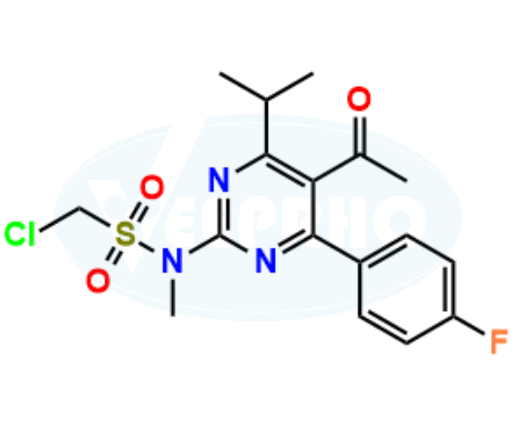
N-(5-Acetyl-4-(4-fluorophenyl)-6- isopropylpyrimidin-2-yl)-1-chloro-N- methylmethanesulfonamide
● In Stock
| Catalogue No.: | VE0027811 |
|---|---|
| CAS No.: | N/A |
| Mol. Formula: | C17H19ClFN3O3S |
| Mol. Weight: | 399.87 g/mol |
For laboratory use only: analytical, development and regulatory purposes. Supplied in mg quantities. Not for human or veterinary use.
Additional information on N-(5-Acetyl-4-(4-fluorophenyl)-6- isopropylpyrimidin-2-yl)-1-chloro-N- methylmethanesulfonamide
| Parent drug | Rosuvastatin |
|---|---|
| Product type | Impurity standards |
| IUPAC name | N-(5-Acetyl-4-(4-fluorophenyl)-6- isopropylpyrimidin-2-yl)-1-chloro-N- methylmethanesulfonamide |
| SMILES | O=S(CCl)(N(C1=NC(C(C)C)=C(C(C)=O)C(C2=CC=C(F)C=C2)=N1)C)=O |
| InChI | InChI=1S/C17H19ClFN3O3S/c1-10(2)15-14(11(3)23)16(12-5-7-13(19)8-6-12)21-17(20-15)22(4)26(24,25)9-18/h5-8,10H,9H2,1-4H3 |
| InChIKey | LBMLJUYIVUDHAW-UHFFFAOYSA-N |
| CHNS Ratio (%) (calculated) | C 51.06 · H 4.79 · N 10.51 · S 8.02 |
| Description | N-(5-Acetyl-4-(4-fluorophenyl)-6-isopropylpyrimidin-2-yl)-1-chloro-N-methylmethanesulfonamide is an alkylated pyrimidine-derived impurity characterized by a ketone-bearing heterocycle and a chlorinated N-methyl methanesulfonamide moiety. It displays moderate lipophilicity with increased molecular weight and distinct polarity differences from the parent API, affecting reversed-phase HPLC retention and requiring gradient methods for adequate separation. Detectable by LC-MS with signature fragment ions from loss of methylsulfonyl and acetyl cleavage, and by 1H and 13C NMR for confirming acetyl and isopropyl signals. Potential routes of formation include incomplete sulfonylation or chlorination side reactions and oxidative acetylation. Control strategy should include limits based on ICH Q3A guidance, stability monitoring and orthogonal analytical methods. |
Request a Quote
"*" indicates required fields
Other products related to Rosuvastatin impurities
| Impurity structure | Name of Impurity | Catalogue No. |
|---|---|---|
| Rosuvastatin EP Impurity A | VL127008 | |
| Rosuvastatin EP Impurity A (Free Base) | VE0024818 | |
| Rosuvastatin EP Impurity A (Sodium Salt) | VE008146 | |
| Rosuvastatin EP Impurity B (Free Base) | VE0024819 | |
| Rosuvastatin EP Impurity B (Racemic Mixture) | VL127001 | |
| Rosuvastatin EP Impurity C | VL127003 | |
| Rosuvastatin EP Impurity C (Free Base) | VE0011116 | |
| Rosuvastatin EP Impurity C (Sodium Salt) | VE0026666 | |
| Rosuvastatin EP Impurity D | VL127002 | |
| Rosuvastatin EP Impurity E | VL127005 | |
| Rosuvastatin EP Impurity F | VL127004 | |
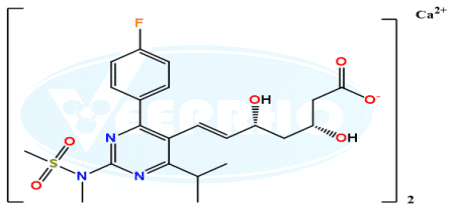 | Rosuvastatin EP Impurity G | VL127009 |
Show all related products N-Nitroso Rosuvastatin impurities (2)