
- 100% accuracy of data
- 24/7 scientific support
- 0% tolerance in quality of product
Mutagenicity assessment (ICH M7)
Potentially mutagenic impurity (ICH M7 Class 1–3).
N-nitroso compound: ICH M7 cohort of concern.Stock Locations
- New Jersey, USA
- Czech Republic, EU
* Stock subject to availability.
Documentation
Includes: HPLC, MASS/LC-MS, 1H NMR, FT-IR, Potency, Structure Elucidation Report (SER), and additional analytical data depending on the product.
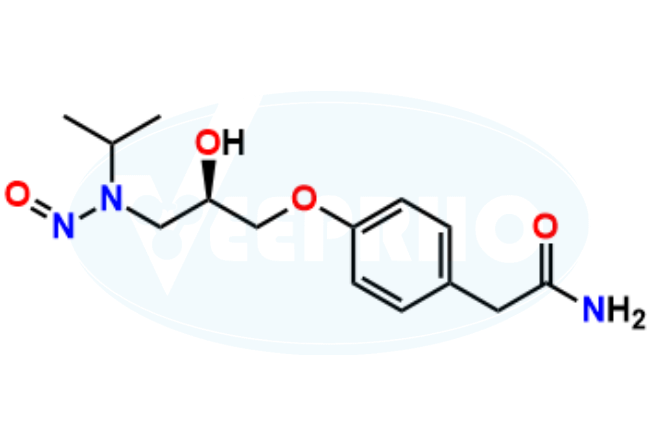
N-Nitroso Atenolol R-Isomer
● Under Development
| Catalogue No.: | VE0027770 |
|---|---|
| CAS No.: | N/A |
| Mol. Formula: | C14H21N3O4 |
| Mol. Weight: | 295.33 g/mol |
For laboratory use only: analytical, development and regulatory purposes. Supplied in mg quantities. Not for human or veterinary use.
Request a quote for a set
- Request quote for this set
All nitrosamine impurities of Atenolol
7 productsSee the 7 products
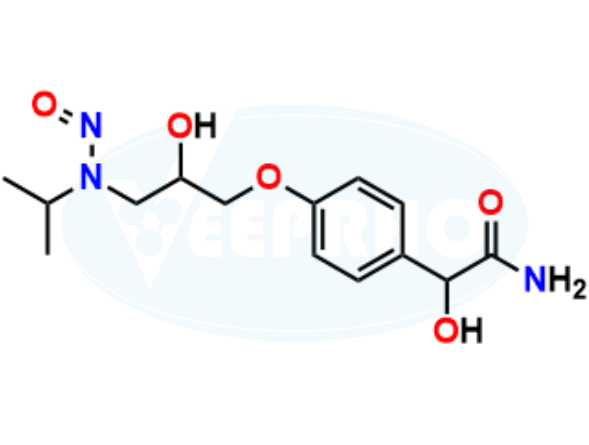
- N-Nitroso 2-Hydroxy Atenolol VE0027792
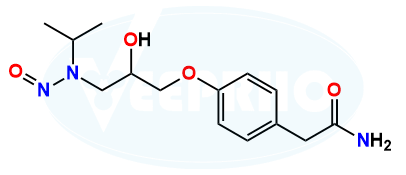
- N-Nitroso Atenolol VE007278
CAS 134720-04-0 - N-Nitroso Atenolol Impurity G VE0011712
- N-Nitroso Atenolol Impurity H VE0011713
- N-Nitroso Atenolol Impurity I VE0011714
- N-Nitroso Atenolol R-Isomer VE0027770
- N-Nitroso Atenolol S-Isomer VE0027796

Additional information on N-Nitroso Atenolol R-Isomer
| Parent drug | Atenolol |
|---|---|
| Product type | Impurity standards, Nitroso impurities |
| IUPAC name | (R)-2-(4-(2-hydroxy-3-(isopropyl(nitroso)amino)propoxy)phenyl)acetamide |
| SMILES | O=C(N)CC1=CC=C(OC[C@H](O)CN(N=O)C(C)C)C=C1 |
| InChI | InChI=1S/C14H21N3O4/c1-10(2)17(16-20)8-12(18)9-21-13-5-3-11(4-6-13)7-14(15)19/h3-6,10,12,18H,7-9H2,1-2H3,(H2,15,19)/t12-/m1/s1 |
| InChIKey | BLORPAGHSJJNFB-GFCCVEGCSA-N |
| CHNS Ratio (%) (calculated) | C 56.94 · H 7.17 · N 14.23 · S 0.00 |
| Description | N-Nitroso Atenolol R-Isomer is a stereospecific nitrosamine impurity observed in atenolol synthesis and storage, presenting potential genotoxic risk that requires stringent control. This R-enantiomer forms by nitrosation of the secondary amine under acidic conditions or in the presence of nitrite contaminants and may arise during quenching, solvent recycling, or inadequate purification. Analytical identification and quantitation typically rely on chiral LC-MS/MS or high-resolution MS combined with validated sample preparation to achieve low ng g-1 detection limits. Risk mitigation includes nitrite monitoring, optimized reaction conditions, enhanced purification, and specification limits supported by stability and impurity profiling to meet regulatory expectations. |
Request a Quote
"*" indicates required fields