
- 100% accuracy of data
- 24/7 scientific support
- 0% tolerance in quality of product
Mutagenicity assessment (ICH M7)
Potentially mutagenic impurity (ICH M7 Class 1–3).
N-nitroso compound: ICH M7 cohort of concern.Stock Locations
- New Jersey, USA
- Czech Republic, EU
* Stock subject to availability.
Documentation
Includes: HPLC, MASS/LC-MS, 1H NMR, FT-IR, Potency, Structure Elucidation Report (SER), and additional analytical data depending on the product.
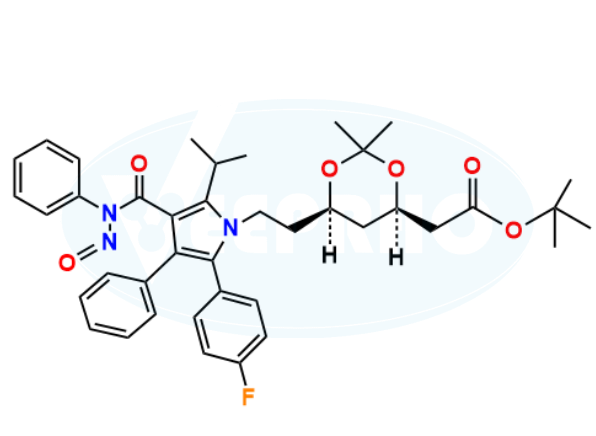
N-Nitroso Atorvastatin EP Impurity I
● Under Development
| Catalogue No.: | VE0027951 |
|---|---|
| CAS No.: | N/A |
| Mol. Formula: | C40H46FN3O6 |
| Mol. Weight: | 683.81 g/mol |
For laboratory use only: analytical, development and regulatory purposes. Supplied in mg quantities. Not for human or veterinary use.
Request a quote for a set
- Request quote for this set
All nitrosamine impurities of Atorvastatin
16 productsSee the 16 products
- N-Nitroso Amlodipine Atorvastatine Adduct VE0010279
- N-Nitroso Atorvastatin EP Impurity A VE0027943
- N-Nitroso Atorvastatin EP Impurity C VE0027945
- N-Nitroso Atorvastatin EP Impurity E VE0027950
- N-Nitroso Atorvastatin EP Impurity G VE0027946
- N-Nitroso Atorvastatin EP Impurity H VE0027948
- N-Nitroso Atorvastatin EP Impurity I VE0027951
- N-Nitroso Atorvastatin EP Impurity J VE0027953
- N-Nitroso Atorvastatin EP Impurity K VE0027956
- N-Nitroso Atorvastatin EP Impurity M VE0027947
- N-Nitroso Atorvastatin EP Impurity N VE0027949
- N-Nitroso Atorvastatin EP Impurity O VE0027952
- N-Nitroso Atorvastatin EP Impurity P VE0027954
- N-Nitroso Atorvastatin EP Impurity Q VE0027957
- Nitrosamine Impurity Of Atorvastatin VE0011042
- 5-(4-fluorophenyl)-2-isopropyl-1-nitroso-N,4-diphenyl-1H-pyrrole-3-carboxamide VE0011043

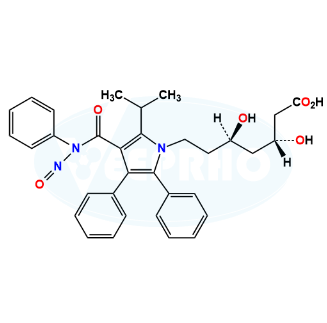
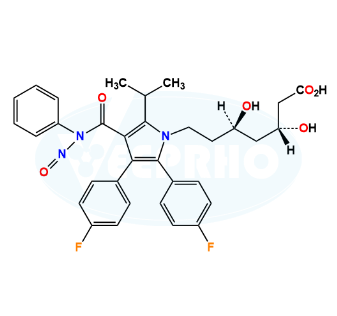
Additional information on N-Nitroso Atorvastatin EP Impurity I
| Parent drug | Atorvastatin |
|---|---|
| Product type | Impurity standards, Nitroso impurities |
| IUPAC name | Tert-butyl 2-((4R,6R)-6-(2-(2-(4-fluorophenyl)-5-isopropyl-4-(nitroso(phenyl)carbamoyl)-3-phenyl-1H-pyrrol-1-yl)ethyl)-2,2-dimethyl-1,3-dioxan-4-yl)acetate |
| SMILES | O=C(C1=C(C(C)C)N(CC[C@]2([H])C[C@]([H])(CC(OC(C)(C)C)=O)OC(C)(C)O2)C(C3=CC=C(F)C=C3)=C1C4=CC=CC=C4)N(N=O)C5=CC=CC=C5 |
| InChI | InChI=1S/C40H46FN3O6/c1-26(2)36-35(38(46)44(42-47)30-16-12-9-13-17-30)34(27-14-10-8-11-15-27)37(28-18-20-29(41)21-19-28)43(36)23-22-31-24-32(49-40(6,7)48-31)25-33(45)50-39(3,4)5/h8-21,26,31-32H,22-25H2,1-7H3/t31-,32-/m1/s1 |
| InChIKey | ZKQYTHNCTGXSFN-ROJLCIKYSA-N |
| CHNS Ratio (%) (calculated) | C 70.26 · H 6.78 · N 6.15 · S 0.00 |
| Description | N-Nitroso Atorvastatin EP Impurity I is a nitrosamine-class degradation impurity associated with the atorvastatin active pharmaceutical ingredient. It is characterized by low-level occurrence and potential genotoxic concern, prompting rigorous regulatory scrutiny. Analytical identification and quantification rely on high-sensitivity LC-MS/MS or GC-MS methods with selected ion monitoring and isotopic internal standards to achieve trace-level detection. Control strategies emphasize raw material qualification, mitigation of nitrosating reagents, optimized synthetic routes, and validated cleaning processes. Stability and forced-degradation studies elucidate formation pathways and kinetics. Establishing specification limits and implementing routine batch release testing supports compliance with pharmacopeial monographs and regulatory guidance. |
Request a Quote
"*" indicates required fields
Other products related to Atorvastatin and Nitroso impurities
| Impurity structure | Name of Impurity | Catalogue No. |
|---|---|---|
| Atorvastatin EP Impurity A | VE008745 | |
| Atorvastatin EP Impurity A (Ca salt) | VL10004 | |
 | Atorvastatin EP Impurity A (Na Salt) | VE0020562 |
| Atorvastatin EP Impurity B (Free Base) | VE009319 | |
| Atorvastatin EP Impurity C | VE008906 | |
 | Atorvastatin EP Impurity C (Na Salt) | VE0012975 |
| Atorvastatin EP Impurity D (Impurity D1) | VL10003 | |
 | Atorvastatin EP Impurity D (Mixture of D1 & D2) | VE0022694 |
| Atorvastatin EP Impurity E (Ca Salt) | VL10006 | |
| Atorvastatin EP Impurity E (Free Base) | VE0012984 | |
| Atorvastatin EP Impurity E (Na Salt) | VE009244 | |
| Atorvastatin EP Impurity F (Ca Salt) | VL10011 |
Show all related products N-Nitroso Atorvastatin impurities (14)