
- 100% accuracy of data
- 24/7 scientific support
- 0% tolerance in quality of product
Mutagenicity assessment (ICH M7)
Potentially mutagenic impurity (ICH M7 Class 1–3).
N-nitroso compound: ICH M7 cohort of concern.Stock Locations
- New Jersey, USA
- Czech Republic, EU
* Stock subject to availability.
Documentation
Includes: HPLC, MASS/LC-MS, 1H NMR, FT-IR, Potency, Structure Elucidation Report (SER), and additional analytical data depending on the product.
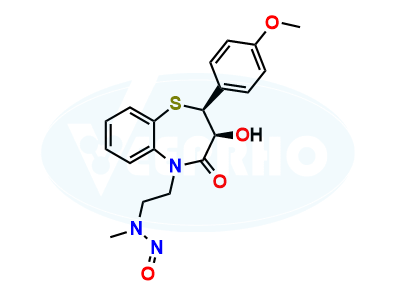
N-Nitroso Diltiazem EP Impurity G
● In Stock
| Catalogue No.: | VE0024814 |
|---|---|
| CAS No.: | N/A |
| Mol. Formula: | C19H21N3O4S |
| Mol. Weight: | 387.5 g/mol |
For laboratory use only: analytical, development and regulatory purposes. Supplied in mg quantities. Not for human or veterinary use.
Request a quote for a set
- Request quote for this set
All nitrosamine impurities of Diltiazem
2 productsSee the 2 products
- N-Nitroso Desmethyl Diltiazem VE0012597
CAS 3036581-85-5 - N-Nitroso Diltiazem EP Impurity G VE0024814
- N-Nitroso Desmethyl Diltiazem VE0012597

Additional information on N-Nitroso Diltiazem EP Impurity G
| Parent drug | Diltiazem |
|---|---|
| Product type | Impurity standards, Nitroso impurities |
| IUPAC name | N-(2-((2S,3S)-3-Hydroxy-2-(4-methoxyphenyl)-4-oxo-3,4-dihydrobenzo[b][1,4]thiazepin-5(2H)-yl)ethyl)-N-methylnitrous amide |
| SMILES | COc1ccc([C@@H]2Sc3ccccc3N(CCN(C)N=O)C(=O)[C@@H]2O)cc1 |
| InChIKey | UHCCHTPNHPFLEJ-MSOLQXFVSA-N |
| CHNS Ratio (%) (calculated) | C 58.90 · H 5.46 · N 10.85 · S 8.27 |
| Description | N-Nitroso Diltiazem EP Impurity G, also designated N-Nitroso O-Desacetyl-N-desmethyl Diltiazem, is a nitrosamine-related process impurity of the benzothiazepine calcium-channel blocker diltiazem. With molecular formula C19H21N3O4S and molecular weight 387.5 g/mol, it represents an N-nitrosated derivative arising plausibly from nitrosative conditions during synthesis, workup, or storage of desmethylated and deacetylated intermediates. As a class, nitrosamines are treated as potential genotoxic impurities under ICH M7 due to structural alerts and carcinogenic concern. Trace-level characterization commonly requires LC-MS/MS, high-resolution mass spectrometry, and, where volatility permits, GC-MS with selective derivatization. |
Request a Quote
"*" indicates required fields