
- 100% accuracy of data
- 24/7 scientific support
- 0% tolerance in quality of product
Mutagenicity assessment (ICH M7)
Potentially mutagenic impurity (ICH M7 Class 1–3).
N-nitroso compound: ICH M7 cohort of concern.Stock Locations
- New Jersey, USA
- Czech Republic, EU
* Stock subject to availability.
Documentation
Includes: HPLC, MASS/LC-MS, 1H NMR, FT-IR, Potency, Structure Elucidation Report (SER), and additional analytical data depending on the product.
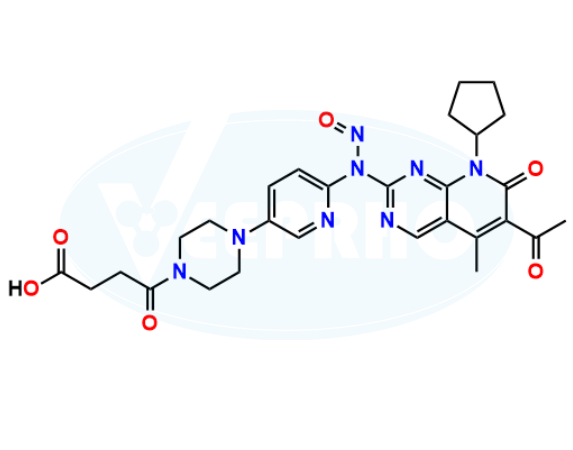
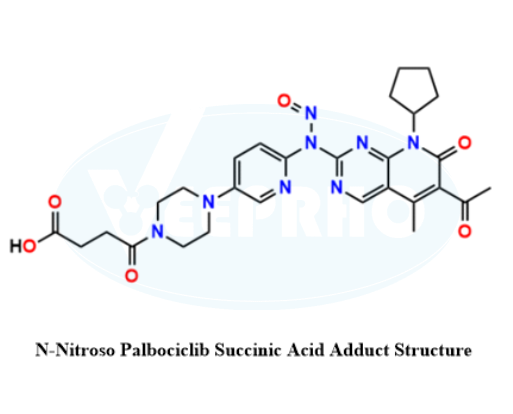
N-Nitroso Palbociclib Succinic Acid Adduct
● Report Available Immediately
| Catalogue No.: | VE0027866 |
|---|---|
| CAS No.: | N/A |
| Mol. Formula: | C28H32N8O6 |
| Mol. Weight: | 576.60 g/mol |
For laboratory use only: analytical, development and regulatory purposes. Supplied in mg quantities. Not for human or veterinary use.
Request a quote for a set
- Request quote for this set
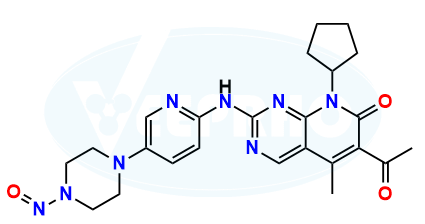
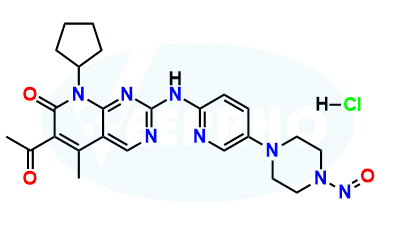
All nitrosamine impurities of Palbociclib
13 productsSee the 13 products
- Dinitroso Palbociclib VE0015659
- N-Nitroso Palbociclib VE009744
- N-Nitroso Palbociclib (HCl Salt) VE0018607
- N-Nitroso Palbociclib 2 VE0018970
- N-Nitroso Palbociclib 2; Synthesis Attempts and Failure Report (NAP Test) VE0027872
- N-Nitroso Palbociclib Impurity 35 VE0018608
CAS 2089333-12-8 - N-Nitroso Palbociclib Intermediate Stage I VE0027805
- N-Nitroso Palbociclib Intermediate Stage I; Synthesis Attempts and Failure Report (NAP Test) VE0027874
- N-Nitroso Palbociclib Intermediate Stage II VE0027807
- N-Nitroso Palbociclib Intermediate Stage II; Synthesis Attempts and Failure Report (NAP Test) VE0027877
- N-Nitroso Palbociclib Succinic Acid Adduct VE0027866
- N-Nitroso Palbociclib Succinic Acid Adduct; Synthesis Attempts and Failure Report (NAP Test) VE0027927
- 5-(4-Nitrosopiperazin-1-yl)pyridin-2-amine VE0024210
- Request quote for this set
This impurity and its failure report
2 productsSee the 2 products

Additional information on N-Nitroso Palbociclib Succinic Acid Adduct
| Parent drug | Palbociclib |
|---|---|
| Product type | Impurity standards, Nitroso impurities |
| IUPAC name | 4-(4-(6-((6-acetyl-8-cyclopentyl-5-methyl-7-oxo-7,8-dihydropyrido[2,3-d]pyrimidin-2-yl)(nitroso)amino)pyridin-3-yl)piperazin-1-yl)-4-oxobutanoic acid |
| SMILES | O=C(O)CCC(N1CCN(C2=CC=C(N(N=O)C3=NC=C(C(C)=C(C(C)=O)C(N4C5CCCC5)=O)C4=N3)N=C2)CC1)=O |
| InChI | InChI=1S/C28H32N8O6/c1-17-21-16-30-28(31-26(21)35(19-5-3-4-6-19)27(41)25(17)18(2)37)36(32-42)22-8-7-20(15-29-22)33-11-13-34(14-12-33)23(38)9-10-24(39)40/h7-8,15-16,19H,3-6,9-14H2,1-2H3,(H,39,40) |
| InChIKey | XFTXKQHUCVNCJG-UHFFFAOYSA-N |
| CHNS Ratio (%) (calculated) | C 58.32 · H 5.59 · N 19.43 · S 0.00 |
| Description | N-Nitroso Palbociclib Succinic Acid Adduct is a nitrosated impurity formed via reaction between palbociclib and nitrosating agents in presence of succinic acid during synthesis or storage. It exhibits increased polarity and a distinct mass shift detectable by LC-MS and requires targeted HPLC and MS/MS methods for accurate quantification. Analytical characterization includes retention time, fragmentation pattern, and HRMS confirmation. Stability studies indicate potential formation under acidic, nitrite-rich, or oxidative conditions necessitating control strategies such as raw material quality, nitrite limits, and validated purification. Considerations for genotoxicity assessment and regulatory reporting are essential for risk mitigation. |
Request a Quote
"*" indicates required fields
Other products related to Palbociclib and Nitroso impurities
| Impurity structure | Name of Impurity | Catalogue No. |
|---|---|---|
| 2-Bromo-3-[2-chloro-4-(cyclopentylamino)-5-pyrimidinyl]-2-butenoic Acid | VE0024349 | |
| 2H-Thiopyran-4-carboxamide, N-(2,6-dimethylphenyl)tetrahydro-, 1,1-dioxide | VE0024353 | |
| 5-(4-Nitrosopiperazin-1-yl)pyridin-2-amine | VE0024210 | |
| 5-(Piperazin-1-yl)pyridine-2-amine | VE0010734 | |
| 6-Acetyl-2-amino-8-cyclopentyl-5-methyl-8H-pyrido[2,3-d]pyrimidin-7-one | VE0022033 | |
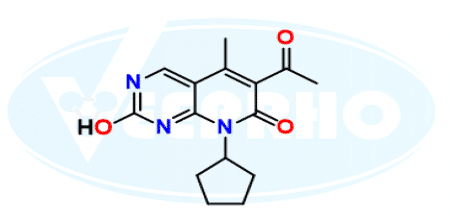 | 6-Acetyl-8-cyclopentyl-2-hydroxy-5-methylpyrido[2,3-d]pyrimidin-7(8H)-one | VE009340 |
| 6-Desacetyl-6-Bromo Palbociclib | VE0018593 | |
| 6-Desacetyl-6-bromo-N-Boc Palbociclib | VE0018602 | |
| Desoxo-Palbociclib | VE009337 | |
| Desoxo-Palbociclib (2HCl Salt) | VE0024763 | |
| Dinitroso Palbociclib | VE0015659 | |
| N-Hydroxy palbociclib | VE0018600 |
Show all related products N-Nitroso Palbociclib impurities (8)