
- 100% accuracy of data
- 24/7 scientific support
- 0% tolerance in quality of product
Stock Locations
- New Jersey, USA
- Czech Republic, EU
* Stock subject to availability.
Documentation
Includes: HPLC, MASS/LC-MS, 1H NMR, FT-IR, Potency, Structure Elucidation Report (SER), and additional analytical data depending on the product.
1320360-87-9
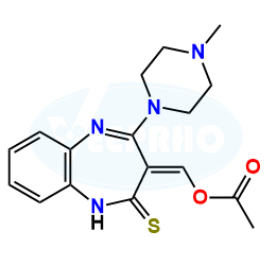
Olanzapine Acetyl Open Ring Analog
● Under Development
| Catalogue No.: | VE008122 |
|---|---|
| CAS No.: | 1320360-87-9 |
| Mol. Formula: | C17H20N4O2S |
| Mol. Weight: | 344.43 g/mol |
For laboratory use only: analytical, development and regulatory purposes. Supplied in mg quantities. Not for human or veterinary use.
Additional information on CAS 1320360-87-9
| Parent drug | Olanzapine |
|---|---|
| Product type | Impurity standards |
| IUPAC name | (Z)-(4-(4-methylpiperazin-1-yl)-2-thioxo-1H-benzo[b][1,4]diazepin-3(2H)-ylidene)methyl acetate |
| SMILES | CC(=O)O/C=C1\C(=S)Nc2ccccc2N=C1N1CCN(C)CC1 |
| InChIKey | KMCOFWWWTNQXFV-QBFSEMIESA-N |
| CHNS Ratio (%) (calculated) | C 59.28 · H 5.85 · N 16.27 · S 9.31 |
| References | Rao | P. Sreenivasa | et al. “Identification of Oxidative Degradation Impurities of Olanzapine Drug Substance as Well as Drug Product.†Journal of Pharmaceutical and Biomedical Analysis | vol. 56 | no. 2 | Sept. 2011 | pp. 413–18 | https://doi.org/10.1016/j.jpba.2011.05.003.? |
| Description | Olanzapine Acetyl Open Ring Analog, also designated Olanzapine Acetoxymethylidene, is a process- and degradation-related impurity associated with the thienobenzodiazepine scaffold of olanzapine. CAS 1320360-87-9 corresponds to C17H20N4O2S, molecular weight 344.43 g/mol. The open-ring acetylated structure reflects oxidative or hydrolytic transformation of the parent heterocycle during synthesis, storage, or stress conditions, with altered conformational and chromatographic behavior relative to olanzapine. Its determination typically requires LC-MS/MS or high-resolution LC-MS, often complemented by HPLC-UV for profiling and impurity mapping. Regulatory assessment focuses on impurity qualification, relative response factors, and possible genotoxic concern depending on formation context and exposure level. |
Request a Quote
"*" indicates required fields
Other products related to Olanzapine impurities
| Impurity structure | Name of Impurity | Catalogue No. |
|---|---|---|
| N-Nitroso Olanzapine EP Impurity B | VE0024726 | |
| N-Nitroso Olanzapine EP Impurity C | VE0024745 | |
| N-Nitroso Olanzapine EP Impurity D | VE0024727 | |
| Olanzapine EP Impurity A | VL109001 | |
| Olanzapine EP Impurity B | VL109002 | |
| Olanzapine EP Impurity C (Chloride) | VL109003 | |
| Olanzapine EP Impurity C (Free Base) | VE0028926 | |
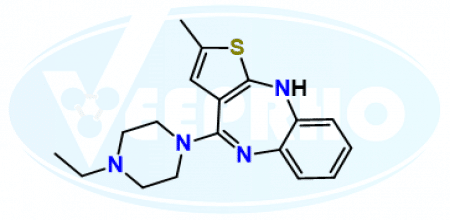 | Olanzapine Related Compound 03 | VL109004 |
| Olanzapine Related Compound 07 | VL109005 | |
 | Olanzapine Related Compound 08 | VL109006 |
| Olanzapine Related Compound C | VL109009 | |
| 2-Hydroxymethyl Olanzapine | VE0018343 |
Show all related products N-Nitroso Olanzapine impurities (7)