

- 100% accuracy of data
- 24/7 scientific support
- 0% tolerance in quality of product
Stock Locations
- New Jersey, USA
- Czech Republic, EUIn stock
* Stock subject to availability.
Documentation
Includes: HPLC, MASS/LC-MS, 1H NMR, FT-IR, Potency, Structure Elucidation Report (SER), and additional analytical data depending on the product.
174794-02-6
Olanzapine Related Compound C
● In Stock
| Catalogue No.: | VL109009 |
|---|---|
| CAS No.: | 174794-02-6 |
| Mol. Formula: | C17H20N4OS |
| Mol. Weight: | 328.43 g/mol |
For laboratory use only: analytical, development and regulatory purposes. Supplied in mg quantities. Not for human or veterinary use.
Request a quote for a set
- Request quote for this set
All EP impurities of Olanzapine
5 productsSee the 5 products
- Olanzapine EP Impurity A VL109001
CAS 138564-59-7 - Olanzapine EP Impurity B VL109002
CAS 221176-49-4 - Olanzapine EP Impurity C (Chloride) VL109003
CAS 719300-59-1 - Olanzapine EP Impurity C (Free Base) VE0028926
CAS 735264-27-4 - Olanzapine Related Compound C VL109009
CAS 174794-02-6
- Olanzapine EP Impurity A VL109001
- Request quote for this set
All USP impurities of Olanzapine
4 productsSee the 4 products
- Olanzapine EP Impurity A VL109001
CAS 138564-59-7 - Olanzapine EP Impurity B VL109002
CAS 221176-49-4 - Olanzapine EP Impurity C (Chloride) VL109003
CAS 719300-59-1 - Olanzapine Related Compound C VL109009
CAS 174794-02-6
- Olanzapine EP Impurity A VL109001

Additional information on CAS 174794-02-6
| Parent drug | Olanzapine |
|---|---|
| Product type | Impurity standards |
| IUPAC name | (2-Methyl-4-(4-methylpiperazin-1-yl)-10H-benzo[b]thieno[2,3-e][1,4]diazepine 4′-N-oxide) |
| EP name | Olanzapine EP Impurity D |
| USP name | Olanzapine Related Compound C |
| SMILES | Cc1cc2c(s1)Nc1ccccc1N=C2N1CC[N+](C)([O-])CC1 |
| InChIKey | LJVNYCDXBXGQIK-UHFFFAOYSA-N |
| CHNS Ratio (%) (calculated) | C 62.17 · H 6.14 · N 17.06 · S 9.76 |
| References | “Synthesis and Characterization of Impurities of an Anti-Psychotic Drug Substance | Olanzapine.†Arkivoc | vol. 2008 | no. 11 | Apr. 2008 | p. 195 | https://doi.org/10.3998/ark.5550190.0009.b19.?Conley | Robert R. | et al. “Olanzapine Response in Treatment-Refractory Schizophrenic Patients with a History of Substance Abuse.†Schizophrenia Research | vol. 33 | no. 1-2 | Sept. 1998 | pp. 95–101 | https://doi.org/10.1016/s0920-9964(98)00062-0.? |
| Description | Olanzapine Related Compound C, also designated Olanzapine EP Impurity D, Olanzapine BP Impurity D, and Olanzapine N-Oxide, is the N-oxide oxidation product of the thienobenzodiazepine antipsychotic scaffold. With CAS 174794-02-6, formula C17H20N4OS, and molecular weight 328.43 g/mol, it typically arises through oxidative stress during synthesis, storage, or exposure to peroxides and oxygen. Its polar N-oxide functionality alters chromatographic retention and mass spectral behavior, often requiring LC-MS/MS, high-resolution LC-MS, and orthogonal HPLC methods for definitive identification and quantification. It is a process- and degradation-related impurity relevant to impurity profiling and stability assessment. |
Request a Quote
"*" indicates required fields
Other products related to Olanzapine impurities
| Impurity structure | Name of Impurity | Catalogue No. |
|---|---|---|
| N-Nitroso Olanzapine EP Impurity B | VE0024726 | |
| N-Nitroso Olanzapine EP Impurity C | VE0024745 | |
| N-Nitroso Olanzapine EP Impurity D | VE0024727 | |
| Olanzapine EP Impurity A | VL109001 | |
| Olanzapine EP Impurity B | VL109002 | |
| Olanzapine EP Impurity C (Chloride) | VL109003 | |
| Olanzapine EP Impurity C (Free Base) | VE0028926 | |
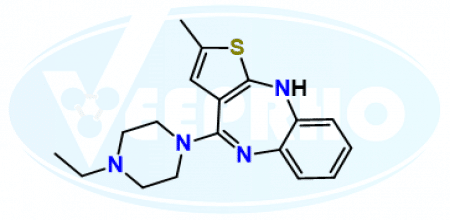 | Olanzapine Related Compound 03 | VL109004 |
| Olanzapine Related Compound 07 | VL109005 | |
 | Olanzapine Related Compound 08 | VL109006 |
| 2-Hydroxymethyl Olanzapine | VE0018343 | |
| 4-Amino-2-methyl-10H-thieno-[2,3-b][1,5]benzodiazepine | VE0021365 |
Show all related products N-Nitroso Olanzapine impurities (7)