

- 100% accuracy of data
- 24/7 scientific support
- 0% tolerance in quality of product
Stock Locations
- New Jersey, USA
- Czech Republic, EUIn stock
* Stock subject to availability.
Documentation
Includes: HPLC, MASS/LC-MS, 1H NMR, FT-IR, Potency, Structure Elucidation Report (SER), and additional analytical data depending on the product.
1017241-34-7
Olanzapine Lactam Impurity
● In Stock
| Catalogue No.: | VL109008 |
|---|---|
| CAS No.: | 1017241-34-7 |
| Mol. Formula: | C17H20N4O2 |
| Mol. Weight: | 312.37 g/mol |
For laboratory use only: analytical, development and regulatory purposes. Supplied in mg quantities. Not for human or veterinary use.
Additional information on CAS 1017241-34-7
| Parent drug | Olanzapine |
|---|---|
| Product type | Impurity standards |
| IUPAC name | (3Z)-1,3-Dihydro-4-(4-methyl-1-piperazinyl)-3-(2-oxopropylidene)-2H-1,5-benzodiazepin-2-one |
| SMILES | O=C1NC2=CC=CC=C2N=C(N3CCN(C)CC3)/C1=C/C(C)=O |
| InChI | InChI=1S/C17H20N4O2/c1-12(22)11-13-16(21-9-7-20(2)8-10-21)18-14-5-3-4-6-15(14)19-17(13)23/h3-6,11H,7-10H2,1-2H3,(H,19,23)/b13-11- |
| InChIKey | MJPUVQLOQVCMBU-QBFSEMIESA-N |
| CHNS Ratio (%) (calculated) | C 65.37 · H 6.45 · N 17.94 · S 0.00 |
| References | Rao | P. Sreenivasa | et al. "Identification of Oxidative Degradation Impurities of Olanzapine Drug Substance as Well as Drug Product. "Journal of Pharmaceutical and Biomedical Analysis | vol. 56 | no. 2 | Sept. 2011 | pp. 413-18 | https://doi.org/10.1016/j.jpba.2011.05.003. |
| Description | Olanzapine lactam impurity, also referred to as olanzapine ketolactam impurity, is a structurally related oxidative degradation and process-related impurity of the thienobenzodiazepine antipsychotic scaffold. The compound, CAS 1017241-34-7, has molecular formula C17H20N4O2 and molecular weight 312.37 g/mol. Its lactam carbonyl indicates ring oxidation and rearrangement relative to the parent drug, consistent with impurity formation during synthesis or storage under oxidative conditions. Because such related substances can affect assay specificity and stability interpretation, characterization commonly relies on LC-MS/MS, HPLC with diode-array detection, and, when needed, NMR and high-resolution mass spectrometry for definitive structural assignment. |
Request a Quote
"*" indicates required fields
Other products related to Olanzapine impurities
| Impurity structure | Name of Impurity | Catalogue No. |
|---|---|---|
| N-Nitroso Olanzapine EP Impurity B | VE0024726 | |
| N-Nitroso Olanzapine EP Impurity C | VE0024745 | |
| N-Nitroso Olanzapine EP Impurity D | VE0024727 | |
| Olanzapine EP Impurity A | VL109001 | |
| Olanzapine EP Impurity B | VL109002 | |
| Olanzapine EP Impurity C (Chloride) | VL109003 | |
| Olanzapine EP Impurity C (Free Base) | VE0028926 | |
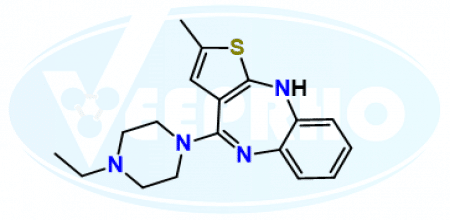 | Olanzapine Related Compound 03 | VL109004 |
| Olanzapine Related Compound 07 | VL109005 | |
 | Olanzapine Related Compound 08 | VL109006 |
| Olanzapine Related Compound C | VL109009 | |
| 2-Hydroxymethyl Olanzapine | VE0018343 |
Show all related products N-Nitroso Olanzapine impurities (7)