

- 100% accuracy of data
- 24/7 scientific support
- 0% tolerance in quality of product
Stock Locations
- New Jersey, USA
- Czech Republic, EU
* Stock subject to availability.
Documentation
Includes: HPLC, MASS/LC-MS, 1H NMR, FT-IR, Potency, Structure Elucidation Report (SER), and additional analytical data depending on the product.
138564-60-0
Olanzapine PIN-3 Impurity
● In Stock
| Catalogue No.: | VL109013 |
|---|---|
| CAS No.: | 138564-60-0 |
| Mol. Formula: | C₁₂H₁₂ClN₃S |
| Mol. Weight: | 265.76 g/mol |
For laboratory use only: analytical, development and regulatory purposes. Supplied in mg quantities. Not for human or veterinary use.
Additional information on CAS 138564-60-0
| Parent drug | Olanzapine |
|---|---|
| Product type | Impurity standards |
| IUPAC name | 4-Amino-2-methyl-10H-thieno[2,3-b][1,5]-benzodiazapine, Hydrochloride |
| Other Synonyms | 2-Methyl-10H-benzo[b]thieno[2,3-e][1,4]diazepin-4-amine hydrochloride ; Olanzapine Amine Impurity |
| SMILES | CC(S1)=CC2=C1NC3=CC=CC=C3N=C2N.[H]Cl |
| InChI | InChI=1S/C12H11N3S.ClH/c1-7-6-8-11(13)14-9-4-2-3-5-10(9)15-12(8)16-7;/h2-6,15H,1H3,(H2,13,14);1H |
| InChIKey | FDWMAKNNNPSUTL-UHFFFAOYSA-N |
| CHNS Ratio (%) (calculated) | C 54.23 · H 4.55 · N 15.81 · S 12.06 |
| References | Synthesis and Characterization of Impurities of an Anti-Psychotic Drug Substance | Olanzapine. Arkivoc | vol. 2008 | no. 11 | Apr. 2008 | p. 195 | https://doi.org/10.3998/ark.5550190.0009.b19.?Conley | Robert R. | et al. Olanzapine Response in Treatment-Refractory Schizophrenic Patients with a History of Substance Abuse. Schizophrenia Research | vol. 33 | no. 1-2 | Sept. 1998 | pp. 95 “101 | https://doi.org/10.1016/s0920-9964(98)00062-0.? |
| Description | Olanzapine PIN-3 Impurity, also referred to as Olanzapine Amine Impurity, is the hydrochloride salt of 2-methyl-10H-benzo[b]thieno[2,3-e][1,4]diazepin-4-amine, CAS 138564-60-0. Its molecular formula is C12H12ClN3S and molecular weight 265.76. This related substance represents a dechloro, amino precursor within the olanzapine synthetic space and is generally associated with incomplete cyclization or carryover of advanced intermediates rather than oxidative degradation. Because structurally defined process impurities can contribute to impurity profiling under ICH Q3A and, where applicable, impurity risk assessment under ICH M7, confirmation commonly requires LC-MS/MS and, for orthogonal structure elucidation, HPLC with diode-array detection and high-resolution MS. |
Request a Quote
"*" indicates required fields
Other products related to Olanzapine impurities
| Impurity structure | Name of Impurity | Catalogue No. |
|---|---|---|
| N-Nitroso Olanzapine EP Impurity B | VE0024726 | |
| N-Nitroso Olanzapine EP Impurity C | VE0024745 | |
| N-Nitroso Olanzapine EP Impurity D | VE0024727 | |
| Olanzapine EP Impurity A | VL109001 | |
| Olanzapine EP Impurity B | VL109002 | |
| Olanzapine EP Impurity C (Chloride) | VL109003 | |
| Olanzapine EP Impurity C (Free Base) | VE0028926 | |
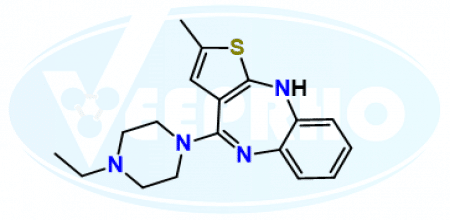 | Olanzapine Related Compound 03 | VL109004 |
| Olanzapine Related Compound 07 | VL109005 | |
 | Olanzapine Related Compound 08 | VL109006 |
| Olanzapine Related Compound C | VL109009 | |
| 2-Hydroxymethyl Olanzapine | VE0018343 |
Show all related products N-Nitroso Olanzapine impurities (7)