
- 100% accuracy of data
- 24/7 scientific support
- 0% tolerance in quality of product
Stock Locations
- New Jersey, USA
- Czech Republic, EUIn stock
* Stock subject to availability.
Documentation
Includes: HPLC, MASS/LC-MS, 1H NMR, FT-IR, Potency, Structure Elucidation Report (SER), and additional analytical data depending on the product.
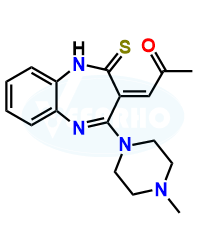
1017241-36-9
Olanzapine Thio lactum
● In Stock
| Catalogue No.: | VL109007 |
|---|---|
| CAS No.: | 1017241-36-9 |
| Mol. Formula: | C17H20N4OS |
| Mol. Weight: | 328.43 g/mol |
For laboratory use only: analytical, development and regulatory purposes. Supplied in mg quantities. Not for human or veterinary use.
Packs and prices
| Pack | Price | Qty |
|---|---|---|
| 50 mg | USD 626.50 |
Prices shown are valid for issuing a purchase order.
Prices are subject to change depending on compound availability and the cost of synthesis based on current raw material costs. Veeprho reserves the right to change prices without notice.
Need another pack size or quantity? Request a custom quoteHow can we help?
Additional information on CAS 1017241-36-9
| Parent drug | Olanzapine |
|---|---|
| Product type | Impurity standards |
| IUPAC name | (1Z)-1-[4,5-Dihydro-2-(4-methyl-1-piperazinyl)-4-thioxo-3H-1,5-benzodiazepin-3-ylidene]-2-propanone |
| CHNS Ratio (%) (calculated) | C 62.17 · H 6.14 · N 17.06 · S 9.76 |
| References | Rao | P. Sreenivasa | et al. “Identification of Oxidative Degradation Impurities of Olanzapine Drug Substance as Well as Drug Product.†Journal of Pharmaceutical and Biomedical Analysis | vol. 56 | no. 2 | Sept. 2011 | pp. 413–18 | https://doi.org/10.1016/j.jpba.2011.05.003 Wolters | E. Ch. | et al. “Olanzapine in the Treatment of Dopaminomimetic Psychosis in Patients with Parkinson’s Disease.†Neurology | vol. 47 | no. 4 | Oct. 1996 | pp. 1085–87 | https://doi.org/10.1212/wnl.47.4.1085.? |
| Description | Olanzapine Thio Lactum Impurity, CAS 1017241-36-9, is a sulfur-containing heterocyclic process impurity associated with the thienobenzodiazepine scaffold of olanzapine. With molecular formula C17H20N4OS and molecular weight 328.43 g/mol, it is typically discussed as a structurally related synthetic byproduct or transformation product arising during cyclization, sulfur incorporation, or late-stage oxidation chemistry. Its polarity and close structural similarity to the parent drug can complicate resolution by conventional reversed-phase HPLC, making LC-MS/MS and high-resolution LC-MS the principal tools for identity confirmation and trace-level quantification. From a regulatory perspective, its structural alert profile should be evaluated within ICH M7 and impurity qualification frameworks. |
Request a Quote
"*" indicates required fields
Other products related to Olanzapine impurities
| Impurity structure | Name of Impurity | Catalogue No. |
|---|---|---|
| N-Nitroso Olanzapine EP Impurity B | VE0024726 | |
| N-Nitroso Olanzapine EP Impurity C | VE0024745 | |
| N-Nitroso Olanzapine EP Impurity D | VE0024727 | |
| Olanzapine EP Impurity A | VL109001 | |
| Olanzapine EP Impurity B | VL109002 | |
| Olanzapine EP Impurity C (Chloride) | VL109003 | |
| Olanzapine EP Impurity C (Free Base) | VE0028926 | |
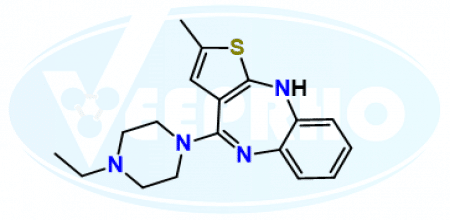 | Olanzapine Related Compound 03 | VL109004 |
| Olanzapine Related Compound 07 | VL109005 | |
 | Olanzapine Related Compound 08 | VL109006 |
| Olanzapine Related Compound C | VL109009 | |
| 2-Hydroxymethyl Olanzapine | VE0018343 |
Show all related products N-Nitroso Olanzapine impurities (7)