
- 100% accuracy of data
- 24/7 scientific support
- 0% tolerance in quality of product
Stock Locations
- New Jersey, USA
- Czech Republic, EU
* Stock subject to availability.
Documentation
Includes: HPLC, MASS/LC-MS, 1H NMR, FT-IR, Potency, Structure Elucidation Report (SER), and additional analytical data depending on the product.
1320360-86-8
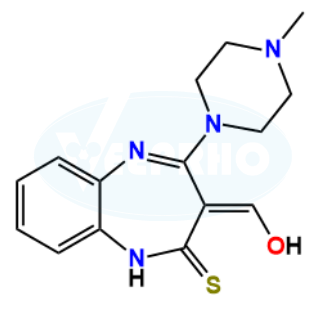
Olanzapine Thiohydroxymethylidene
● In Stock
| Catalogue No.: | VE008103 |
|---|---|
| CAS No.: | 1320360-86-8 |
| Mol. Formula: | C15H18N4OS |
| Mol. Weight: | 302.39 g/mol |
For laboratory use only: analytical, development and regulatory purposes. Supplied in mg quantities. Not for human or veterinary use.
Additional information on CAS 1320360-86-8
| Parent drug | Olanzapine |
|---|---|
| Product type | Impurity standards |
| IUPAC name | (Z)-3-(Hydroxymethylene)-4-(4-methylpiperazin-1-yl)-1H-benzo[b][1,4]diazepine-2(3H)-thione |
| SMILES | CN1CCN(C2=C(C=O)C(=S)Nc3ccccc3N2)CC1 |
| InChIKey | PAMJDHCSSZUOEW-UHFFFAOYSA-N |
| CHNS Ratio (%) (calculated) | C 59.58 · H 6.00 · N 18.53 · S 10.60 |
| References | Rao | P. Sreenivasa | et al. “Identification of Oxidative Degradation Impurities of Olanzapine Drug Substance as Well as Drug Product.†Journal of Pharmaceutical and Biomedical Analysis | vol. 56 | no. 2 | Sept. 2011 | pp. 413–18 | https://doi.org/10.1016/j.jpba.2011.05.003 Sipahimalani | Anil | and Prakash S. Masand. “Olanzapine in the Treatment of Delirium.†Psychosomatics | vol. 39 | no. 5 | Sept. 1998 | pp. 422–30 | https://doi.org/10.1016/s0033-3182(98)71301-5.? |
| Description | Olanzapine Thiohydroxymethylidene, also described as Olanzapine Open Ring Analogue or Hydroxymethylidene Thione, CAS 1320360-86-8, is a sulfur-containing process- and degradation-related impurity of the thienobenzodiazepine scaffold. With molecular formula C15H18N4OS and molecular weight 302.39 g/mol, it reflects ring-opening and subsequent thione tautomeric stabilization of the parent heterocycle. Its presence may arise during synthetic intermediates handling, oxidative or hydrolytic stress, or incomplete cyclization. Structural assignment and trace quantification typically require LC-MS/MS, high-resolution MS, and orthogonal HPLC with UV or diode-array detection; GC-MS may support volatile derivative confirmation. Regulatory assessment focuses on impurity profiling and limit control under current pharmacopeial and ICH expectations. |
Request a Quote
"*" indicates required fields
Other products related to Olanzapine impurities
| Impurity structure | Name of Impurity | Catalogue No. |
|---|---|---|
| N-Nitroso Olanzapine EP Impurity B | VE0024726 | |
| N-Nitroso Olanzapine EP Impurity C | VE0024745 | |
| N-Nitroso Olanzapine EP Impurity D | VE0024727 | |
| Olanzapine EP Impurity A | VL109001 | |
| Olanzapine EP Impurity B | VL109002 | |
| Olanzapine EP Impurity C (Chloride) | VL109003 | |
| Olanzapine EP Impurity C (Free Base) | VE0028926 | |
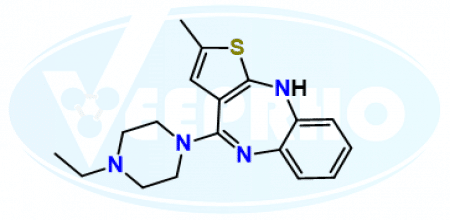 | Olanzapine Related Compound 03 | VL109004 |
| Olanzapine Related Compound 07 | VL109005 | |
 | Olanzapine Related Compound 08 | VL109006 |
| Olanzapine Related Compound C | VL109009 | |
| 2-Hydroxymethyl Olanzapine | VE0018343 |
Show all related products N-Nitroso Olanzapine impurities (7)