
- 100% accuracy of data
- 24/7 scientific support
- 0% tolerance in quality of product
Stock Locations
- New Jersey, USA
- Czech Republic, EU
* Stock subject to availability.
Documentation
Includes: HPLC, MASS/LC-MS, 1H NMR, FT-IR, Potency, Structure Elucidation Report (SER), and additional analytical data depending on the product.
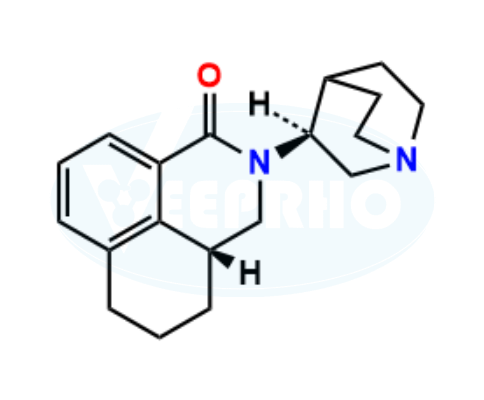
Palonosetron EP Impurity E (Free Base)
● In Stock
| Catalogue No.: | VE0027385 |
|---|---|
| CAS No.: | N/A |
| Mol. Formula: | C19H24N2O |
| Mol. Weight: | 296.41 g/mol |
For laboratory use only: analytical, development and regulatory purposes. Supplied in mg quantities. Not for human or veterinary use.
Request a quote for a set
- Request quote for this set
All EP impurities of Palonosetron
6 productsSee the 6 products
- Palonosetron EP Impurity B VE0029010
- Palonosetron EP Impurity C VE0029011
- Palonosetron EP Impurity D (Free Base) VE0027384
- Palonosetron EP Impurity E (Free Base) VE0027385
- Palonosetron EP Impurity F (Free Base) VE0027383
- Palonosetron EP Impurity H VE0027411
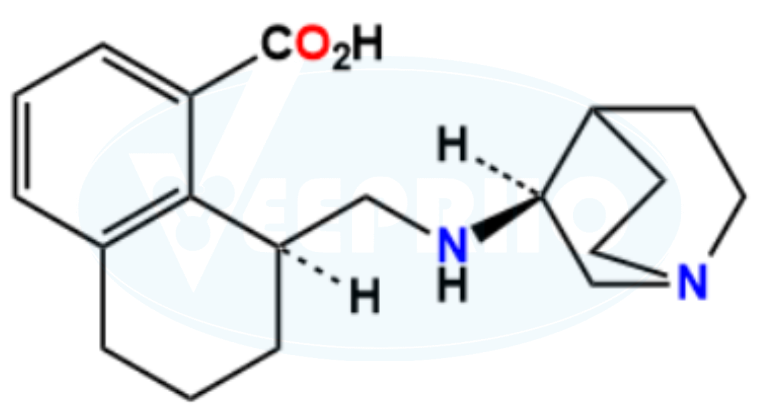

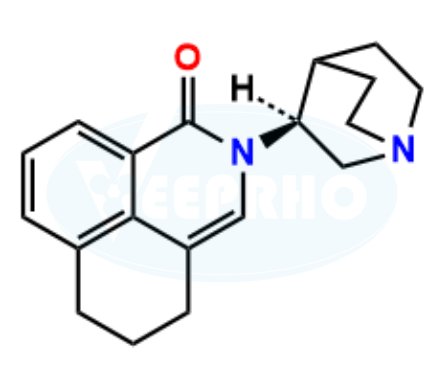
Additional information on Palonosetron EP Impurity E (Free Base)
| Parent drug | Palonosetron |
|---|---|
| Product type | Impurity standards |
| IUPAC name | (3aR)-2-[(3S)-1-azabicyclo[2.2.2]octan-3-yl]-2,3,3a,4,5,6-hexahydro-1H-benzo[de]isoquinolin-1-one |
| EP name | Palonosetron EP Impurity E |
| SMILES | O=C1N([C@]2([H])CN3CCC2CC3)C[C@]4([H])CCCC5=C4C1=CC=C5 |
| InChI | InChI=1S/C19H24N2O/c22-19-16-6-2-4-14-3-1-5-15(18(14)16)11-21(19)17-12-20-9-7-13(17)8-10-20/h2,4,6,13,15,17H,1,3,5,7-12H2/t15-,17+/m0/s1 |
| InChIKey | CPZBLNMUGSZIPR-DOTOQJQBSA-N |
| CHNS Ratio (%) (calculated) | C 76.99 · H 8.16 · N 9.45 · S 0.00 |
| Description | Palonosetron EP Impurity E is a defined organic related substance associated with the palonosetron scaffold, with molecular formula C19H24N2O and molecular weight 296.41 g/mol. Its structural profile indicates a non-ionizable heteroaromatic impurity rather than a classical nitrosamine or mutagenic fragment, and it is generally regarded as a process- or degradation-linked variant arising from incomplete construction or selective transformation of the tricyclic amine framework. Characterization typically relies on LC-MS/MS, high-resolution mass spectrometry, and NMR spectroscopy, with chromatographic separation by RP-HPLC or UHPLC to resolve closely related positional isomers and trace-level impurities. |
Request a Quote
"*" indicates required fields
Other products related to Palonosetron impurities
| Impurity structure | Name of Impurity | Catalogue No. |
|---|---|---|
| Palonosetron EP Impurity A | VE0027340 | |
| Palonosetron EP Impurity B | VE0029010 | |
| Palonosetron EP Impurity C | VE0029011 | |
| Palonosetron EP Impurity D (Free Base) | VE0027384 | |
| Palonosetron EP Impurity F (Free Base) | VE0027383 | |
| Palonosetron EP Impurity H | VE0027411 | |
| Palonosetron Related Compound A | VL3010001 | |
| Palonosetron Related Compound B | VL3010002 | |
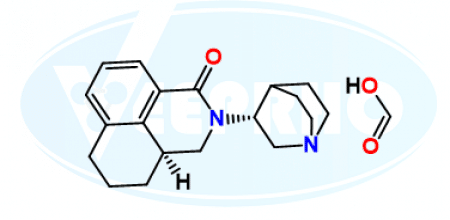 | Palonosetron Related Compound C | VL3010003 |
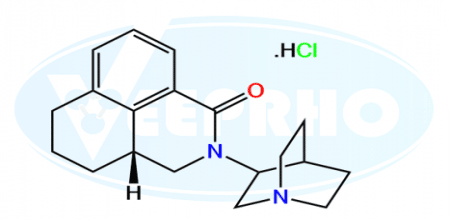 | Palonosetron Related Compound D | VE006195 |
 | Palonosetron Related compound E | VE008340 |
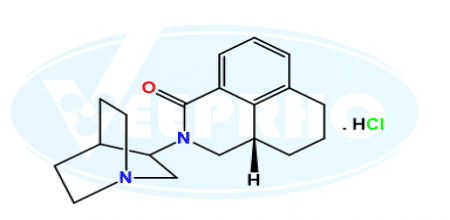 | (S,R)-Palonosetron (HCl Salt) | VE008339 |
Show all related products N-Nitroso Palonosetron impurities (2)