
- 100% accuracy of data
- 24/7 scientific support
- 0% tolerance in quality of product
Stock Locations
- New Jersey, USA
- Czech Republic, EU
* Stock subject to availability.
Documentation
Includes: HPLC, MASS/LC-MS, 1H NMR, FT-IR, Potency, Structure Elucidation Report (SER), and additional analytical data depending on the product.
813425-83-1
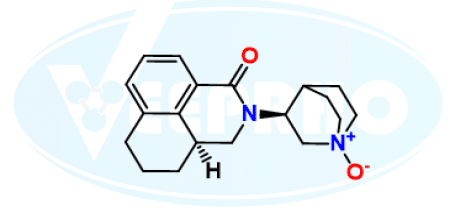
Palonosetron Related Compound A
● In Stock
| Catalogue No.: | VL3010001 |
|---|---|
| CAS No.: | 813425-83-1 |
| Mol. Formula: | C19H24N2O2 |
| Mol. Weight: | 312.41 g/mol |
For laboratory use only: analytical, development and regulatory purposes. Supplied in mg quantities. Not for human or veterinary use.
Packs and prices
| Pack | Price | Qty |
|---|---|---|
| 50 mg | USD 313.00 |
Prices shown are valid for issuing a purchase order.
Prices are subject to change depending on compound availability and the cost of synthesis based on current raw material costs. Veeprho reserves the right to change prices without notice.
Need another pack size or quantity? Request a custom quoteHow can we help?
Request a quote for a set
- Request quote for this set
All USP impurities of Palonosetron
6 productsSee the 6 products
- Palonosetron Related Compound A VL3010001
CAS 813425-83-1 - Palonosetron Related Compound B VL3010002
CAS 1021456-82-5 - Palonosetron Related Compound C VL3010003
- Palonosetron Related Compound D VE006195
CAS 135755-51-0 - Palonosetron Related compound E VE008340
CAS 135729-55-4 - (S,R)-Palonosetron (HCl Salt) VE008339
CAS 135729-76-9
- Palonosetron Related Compound A VL3010001
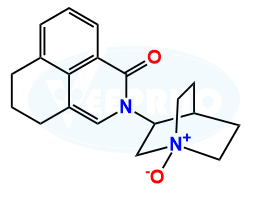
Additional information on CAS 813425-83-1
| Parent drug | Palonosetron |
|---|---|
| Product type | Impurity standards |
| IUPAC name | (3aS)-2-[(3S)-1-Azabicyclo[2.2.2]oct-3-yl]-2,3,3a,4,5,6-hexahydro-1H-benz[de]isoquinolin-1-one N-Oxide |
| USP name | Palonosetron Related Compound A |
| SMILES | O=C1c2cccc3c2[C@H](CCC3)CN1[C@@H]1C[N+]2([O-])CCC1CC2 |
| InChIKey | IQQIWUDYGYXXEA-BGAFOXLKSA-N |
| CHNS Ratio (%) (calculated) | C 73.05 · H 7.74 · N 8.97 · S 0.00 |
| Description | Palonosetron Related Compound A, identified as palonosetron N-oxide (CAS 813425-83-1), is an oxidative impurity arising from tertiary amine N-oxidation during synthesis, storage, or exposure to peroxides and other oxidizing conditions. With molecular formula C19H24N2O2 and molecular weight 312.41 g/mol, it represents a polar analog of the parent 5-HT3 antagonist, often exhibiting altered chromatographic retention and ionization behavior. Structural assignment and trace quantification typically require LC-MS/MS, high-resolution MS, and orthogonal HPLC methods with UV or fluorescence detection. Its presence is assessed as a process- and degradation-related impurity within impurity profiling frameworks. |
Request a Quote
"*" indicates required fields
Other products related to Palonosetron impurities
| Impurity structure | Name of Impurity | Catalogue No. |
|---|---|---|
| Palonosetron EP Impurity A | VE0027340 | |
| Palonosetron EP Impurity B | VE0029010 | |
| Palonosetron EP Impurity C | VE0029011 | |
| Palonosetron EP Impurity D (Free Base) | VE0027384 | |
| Palonosetron EP Impurity E (Free Base) | VE0027385 | |
| Palonosetron EP Impurity F (Free Base) | VE0027383 | |
| Palonosetron EP Impurity H | VE0027411 | |
| Palonosetron Related Compound B | VL3010002 | |
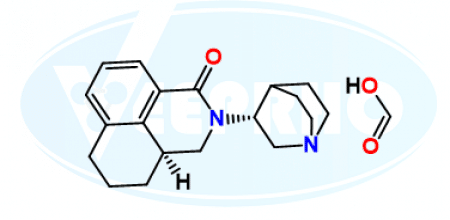 | Palonosetron Related Compound C | VL3010003 |
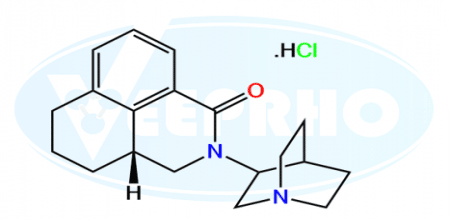 | Palonosetron Related Compound D | VE006195 |
 | Palonosetron Related compound E | VE008340 |
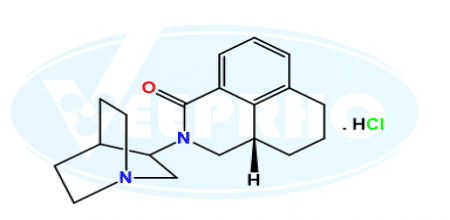 | (S,R)-Palonosetron (HCl Salt) | VE008339 |
Show all related products N-Nitroso Palonosetron impurities (2)