
- 100% accuracy of data
- 24/7 scientific support
- 0% tolerance in quality of product
Stock Locations
- New Jersey, USA
- Czech Republic, EU
* Stock subject to availability.
Documentation
Includes: HPLC, MASS/LC-MS, 1H NMR, FT-IR, Potency, Structure Elucidation Report (SER), and additional analytical data depending on the product.
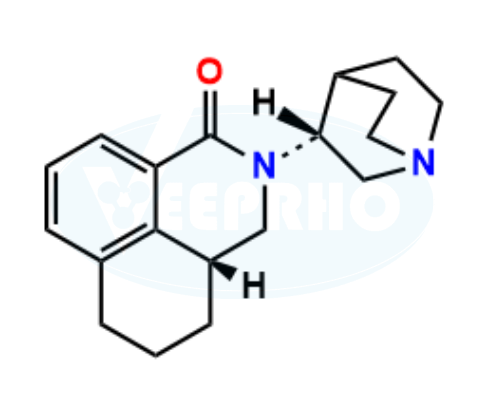
Palonosetron EP Impurity F (Free Base)
● In Stock
| Catalogue No.: | VE0027383 |
|---|---|
| CAS No.: | N/A |
| Mol. Formula: | C19H24N2O |
| Mol. Weight: | 296.41 g/mol |
For laboratory use only: analytical, development and regulatory purposes. Supplied in mg quantities. Not for human or veterinary use.
Request a quote for a set
- Request quote for this set
All EP impurities of Palonosetron
6 productsSee the 6 products
- Palonosetron EP Impurity B VE0029010
- Palonosetron EP Impurity C VE0029011
- Palonosetron EP Impurity D (Free Base) VE0027384
- Palonosetron EP Impurity E (Free Base) VE0027385
- Palonosetron EP Impurity F (Free Base) VE0027383
- Palonosetron EP Impurity H VE0027411
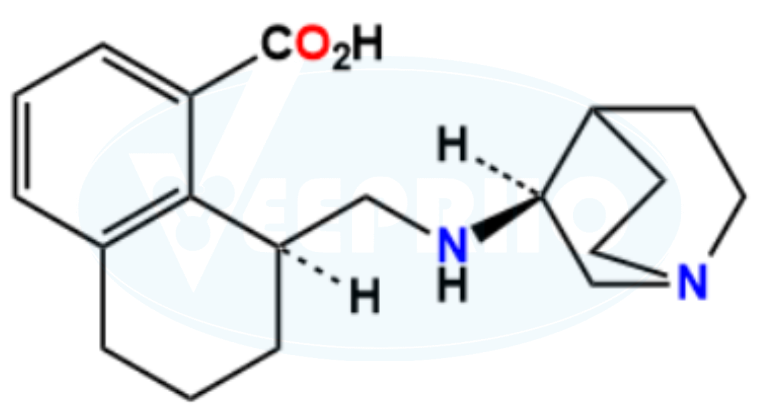

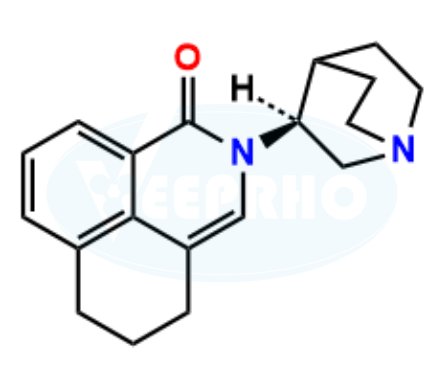
Additional information on Palonosetron EP Impurity F (Free Base)
| Parent drug | Palonosetron |
|---|---|
| Product type | Impurity standards |
| IUPAC name | (3aR)-2-[(3R)-1-azabicyclo[2.2.2]octan-3-yl]-2,3,3a,4,5,6-hexahydro-1H-benzo[de]isoquinolin-1-one |
| EP name | Palonosetron EP Impurity F; ent-palonosetron |
| Pharmacopeial synonyms | ent-Palonosetron |
| SMILES | O=C1N([C@@]2([H])CN3CCC2CC3)C[C@]4([H])CCCC5=C4C1=CC=C5 |
| InChI | InChI=1S/C19H24N2O/c22-19-16-6-2-4-14-3-1-5-15(18(14)16)11-21(19)17-12-20-9-7-13(17)8-10-20/h2,4,6,13,15,17H,1,3,5,7-12H2/t15-,17-/m0/s1 |
| InChIKey | CPZBLNMUGSZIPR-RDJZCZTQSA-N |
| CHNS Ratio (%) (calculated) | C 76.99 · H 8.16 · N 9.45 · S 0.00 |
| Description | Palonosetron EP Impurity F, also known as ent-Palonosetron, is a stereoisomeric impurity encountered during synthesis and stability of palonosetron. Characterization requires chiral and achiral analytical techniques including chiral HPLC for enantiomeric separation, LC-MS for mass confirmation, and 1H/13C NMR for structural assignment. This impurity typically arises from incomplete stereochemical inversion or racemization and is monitored in impurity profiling and forced-degradation studies to meet pharmacopeial and ICH Q3A/Q3B control strategies. Quantitative determination with validated methods ensures sensitivity at low ppm levels and supports specification setting, batch release assessment and process optimization to minimize formation during synthesis and storage. |
Request a Quote
"*" indicates required fields
Other products related to Palonosetron impurities
| Impurity structure | Name of Impurity | Catalogue No. |
|---|---|---|
| Palonosetron EP Impurity A | VE0027340 | |
| Palonosetron EP Impurity B | VE0029010 | |
| Palonosetron EP Impurity C | VE0029011 | |
| Palonosetron EP Impurity D (Free Base) | VE0027384 | |
| Palonosetron EP Impurity E (Free Base) | VE0027385 | |
| Palonosetron EP Impurity H | VE0027411 | |
| Palonosetron Related Compound A | VL3010001 | |
| Palonosetron Related Compound B | VL3010002 | |
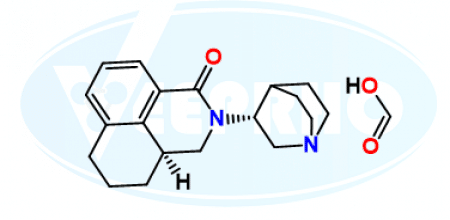 | Palonosetron Related Compound C | VL3010003 |
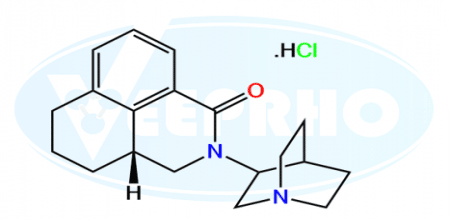 | Palonosetron Related Compound D | VE006195 |
 | Palonosetron Related compound E | VE008340 |
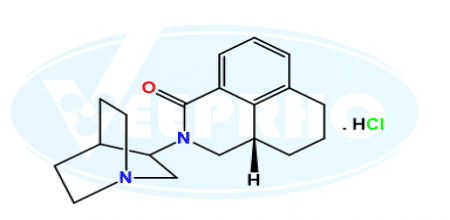 | (S,R)-Palonosetron (HCl Salt) | VE008339 |
Show all related products N-Nitroso Palonosetron impurities (2)