
- 100% accuracy of data
- 24/7 scientific support
- 0% tolerance in quality of product
Stock Locations
- New Jersey, USA
- Czech Republic, EU
* Stock subject to availability.
Documentation
Includes: HPLC, MASS/LC-MS, 1H NMR, FT-IR, Potency, Structure Elucidation Report (SER), and additional analytical data depending on the product.
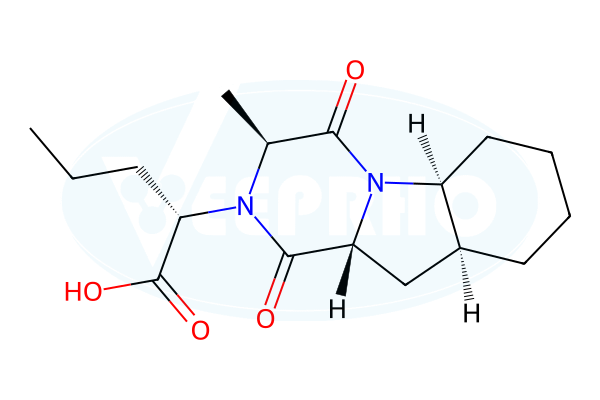
130061-28-8
Perindopril EP Impurity D
● In Stock
| Catalogue No.: | VL114006 |
|---|---|
| CAS No.: | 130061-28-8 |
| Mol. Formula: | C17H26N2O4 |
| Mol. Weight: | 322.40 g/mol |
For laboratory use only: analytical, development and regulatory purposes. Supplied in mg quantities. Not for human or veterinary use.
Request a quote for a set
- Request quote for this set
All EP impurities of Perindopril
16 productsSee the 16 products
- Perindopril EP Impurity A VL114001
CAS 80875-98-5 - Perindopril EP Impurity B VL114002
CAS 95153-31-4 - Perindopril EP Impurity C VL114005
CAS 129970-99-6 - Perindopril EP Impurity D VL114006
CAS 130061-28-8 - Perindopril EP Impurity E VL114003
CAS 1356837-89-2 - Perindopril EP Impurity F VL114004
CAS 129970-98-5 - Perindopril EP Impurity G VE009780
CAS 353777-66-9 - Perindopril EP Impurity H VL114007
CAS 353777-64-7 - Perindopril EP Impurity I VE006840
CAS 145513-33-3 - Perindopril EP Impurity J (Free Base) VE0011316
CAS 685523-06-2 - Perindopril EP Impurity K VL114008
CAS 2165676-00-4 - Perindopril EP Impurity L VE0025100
CAS 111836-22-7 - Perindopril EP Impurity M VE0025098
- Perindopril EP Impurity N VE0025099
- Perindopril EP Impurity O VE0025102
- Perindopril EP Impurity O (Sodium Salt) VE0025103
- Perindopril EP Impurity A VL114001
- Request quote for this set
All USP impurities of Perindopril
8 productsSee the 8 products
- Perindopril EP Impurity A VL114001
CAS 80875-98-5 - Perindopril EP Impurity B VL114002
CAS 95153-31-4 - Perindopril EP Impurity C VL114005
CAS 129970-99-6 - Perindopril EP Impurity D VL114006
CAS 130061-28-8 - Perindopril EP Impurity E VL114003
CAS 1356837-89-2 - Perindopril EP Impurity F VL114004
CAS 129970-98-5 - Perindopril EP Impurity K VL114008
CAS 2165676-00-4 - Perindopril Related Compound B (Monohydrate) VE0010184
CAS 1418095-48-3
- Perindopril EP Impurity A VL114001
Additional information on CAS 130061-28-8
| Parent drug | Perindopril |
|---|---|
| Product type | Impurity standards |
| IUPAC name | (2S)-2-[(3S,5aS,9aS,10aR)-3-Methyl-1,4-dioxodecahydropyrazino[1,2-a]indol-2(1H)-yl]pentanoic acid |
| EP name | Perindopril EP Impurity D |
| USP name | Perindopril Related Compound D |
| Pharmacopeial synonyms | Perindopril Related Compound D |
| Other Synonyms | ((S)-2-{(3S,5aS,9aS,10aR)-3-methyl-1,4-dioxodecahydropyrazino[1,2-a]indol-2(1H)-yl}pentanoic acid); Perindoprilat Lactam B ;Perindopril (10aR)-Dione Acid |
| SMILES | CCC[C@H](N([C@@H](C)C1=O)C([C@]2([H])N1[C@@]3([H])CCCC[C@@]3([H])C2)=O)C(O)=O |
| InChI | InChI=1S/C17H26N2O4/c1-3-6-13(17(22)23)18-10(2)15(20)19-12-8-5-4-7-11(12)9-14(19)16(18)21/h10-14H,3-9H2,1-2H3,(H,22,23)/t10-,11-,12-,13-,14+/m0/s1 |
| InChIKey | GBVXUKWRYVJUFG-HTVCTNPSSA-N |
| CHNS Ratio (%) (calculated) | C 63.33 · H 8.13 · N 8.69 · S 0.00 |
| Description | Perindopril EP Impurity D, also designated Perindopril Related Compound D, Perindoprilat Lactam B, and Perindopril (10aR)-Dione Acid, is a defined process- and degradation-related impurity of the ACE inhibitor perindopril. The structure, CAS 130061-28-8, corresponds to C17H26N2O4 with a molecular weight of 322.40 g/mol, consistent with intramolecular cyclization to the bicyclic diketopiperazine-like lactam framework. Such species may arise during synthesis, storage, or hydrolytic transformation of the parent drug and related ester forms. Characterization typically relies on LC-MS/MS, high-resolution mass spectrometry, and orthogonal HPLC methods, with NMR used for structural confirmation. It is not a nitrosamine and is not classed as an ICH M7 DNA-reactive impurity. |
Request a Quote
"*" indicates required fields