

- 100% accuracy of data
- 24/7 scientific support
- 0% tolerance in quality of product
Stock Locations
- New Jersey, USA
- Czech Republic, EUIn stock
* Stock subject to availability.
Documentation
Includes: HPLC, MASS/LC-MS, 1H NMR, FT-IR, Potency, Structure Elucidation Report (SER), and additional analytical data depending on the product.
1356837-89-2
Perindopril EP Impurity E
● In Stock
| Catalogue No.: | VL114003 |
|---|---|
| CAS No.: | 1356837-89-2 |
| Mol. Formula: | C20H34N2O5 |
| Mol. Weight: | 382.49 g/mol |
For laboratory use only: analytical, development and regulatory purposes. Supplied in mg quantities. Not for human or veterinary use.
Packs and prices
| Pack | Price | Qty |
|---|---|---|
| 100 mg | USD 1,002.00 |
Prices shown are valid for issuing a purchase order.
Prices are subject to change depending on compound availability and the cost of synthesis based on current raw material costs. Veeprho reserves the right to change prices without notice.
Need another pack size or quantity? Request a custom quoteHow can we help?
Request a quote for a set
- Request quote for this set
All EP impurities of Perindopril
16 productsSee the 16 products
- Perindopril EP Impurity A VL114001
CAS 80875-98-5 - Perindopril EP Impurity B VL114002
CAS 95153-31-4 - Perindopril EP Impurity C VL114005
CAS 129970-99-6 - Perindopril EP Impurity D VL114006
CAS 130061-28-8 - Perindopril EP Impurity E VL114003
CAS 1356837-89-2 - Perindopril EP Impurity F VL114004
CAS 129970-98-5 - Perindopril EP Impurity G VE009780
CAS 353777-66-9 - Perindopril EP Impurity H VL114007
CAS 353777-64-7 - Perindopril EP Impurity I VE006840
CAS 145513-33-3 - Perindopril EP Impurity J (Free Base) VE0011316
CAS 685523-06-2 - Perindopril EP Impurity K VL114008
CAS 2165676-00-4 - Perindopril EP Impurity L VE0025100
CAS 111836-22-7 - Perindopril EP Impurity M VE0025098
- Perindopril EP Impurity N VE0025099
- Perindopril EP Impurity O VE0025102
- Perindopril EP Impurity O (Sodium Salt) VE0025103
- Perindopril EP Impurity A VL114001
- Request quote for this set
All USP impurities of Perindopril
8 productsSee the 8 products
- Perindopril EP Impurity A VL114001
CAS 80875-98-5 - Perindopril EP Impurity B VL114002
CAS 95153-31-4 - Perindopril EP Impurity C VL114005
CAS 129970-99-6 - Perindopril EP Impurity D VL114006
CAS 130061-28-8 - Perindopril EP Impurity E VL114003
CAS 1356837-89-2 - Perindopril EP Impurity F VL114004
CAS 129970-98-5 - Perindopril EP Impurity K VL114008
CAS 2165676-00-4 - Perindopril Related Compound B (Monohydrate) VE0010184
CAS 1418095-48-3
- Perindopril EP Impurity A VL114001
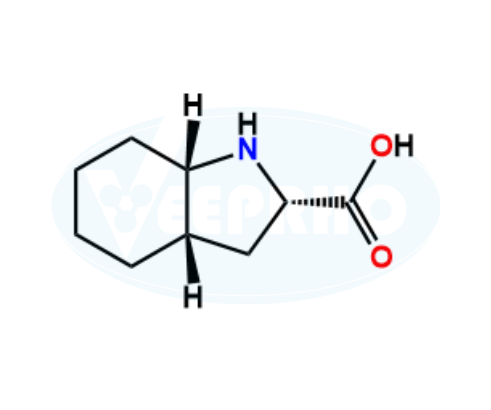
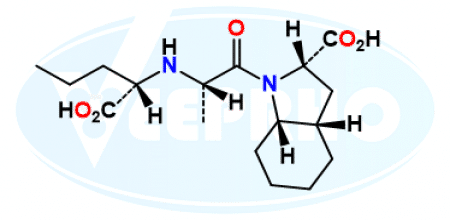
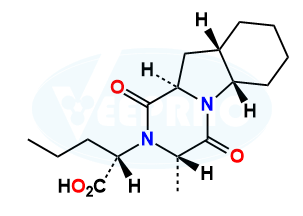
Additional information on CAS 1356837-89-2
| Parent drug | Perindopril |
|---|---|
| Product type | Impurity standards |
| IUPAC name | (2S,3aS,7aS)-1-[(2S)-2-[[1-[(1-Methylethoxy)carbonyl]butyl]amino]propanoyl]octahydro-1H-indole-2-carboxylic acid |
| EP name | Perindopril EP Impurity E |
| USP name | Perindopril Related Compound E |
| SMILES | CCC[C@H](N[C@@H](C)C(=O)N1[C@H](C(=O)O)C[C@@H]2CCCC[C@@H]21)C(=O)OC(C)C |
| InChIKey | CEIYXTQJLBUCRQ-WOYTXXSLSA-N |
| CHNS Ratio (%) (calculated) | C 62.80 · H 8.96 · N 7.32 · S 0.00 |
| Description | Perindopril EP Impurity E, also designated Perindopril Related Compound E and Perindopril BP Impurity E, is a defined synthetic related substance associated with the perindopril manufacturing profile, with CAS 1356837-89-2, molecular formula C20H34N2O5, and molecular weight 382.49 g/mol. Its structural attributes indicate a non-nitrosamine process-related impurity rather than a classic degradation product, commonly monitored in impurity profiling of the ester prodrug. Characterization typically relies on LC-MS/MS and high-resolution LC-UV methods, with confirmatory NMR or LC-HRMS when positional or stereochemical assignment is required. Regulatory assessment follows pharmacopeial impurity control principles and impurity qualification expectations. |
Request a Quote
"*" indicates required fields