
- 100% accuracy of data
- 24/7 scientific support
- 0% tolerance in quality of product
Stock Locations
- New Jersey, USA
- Czech Republic, EU
* Stock subject to availability.
Documentation
Includes: HPLC, MASS/LC-MS, 1H NMR, FT-IR, Potency, Structure Elucidation Report (SER), and additional analytical data depending on the product.
98626-59-6
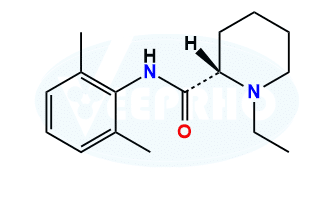
Ropivacaine EP Impurity D
● In Stock
| Catalogue No.: | VE0018333 |
|---|---|
| CAS No.: | 98626-59-6 |
| Mol. Formula: | C16H24N2O |
| Mol. Weight: | 260.37 g/mol |
For laboratory use only: analytical, development and regulatory purposes. Supplied in mg quantities. Not for human or veterinary use.
Request a quote for a set
- Request quote for this set
All EP impurities of Ropivacaine
8 productsSee the 8 products
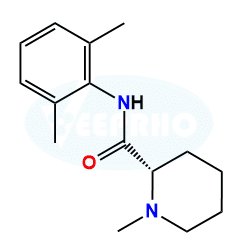
- Lidocaine EP Impurity A VL1040001
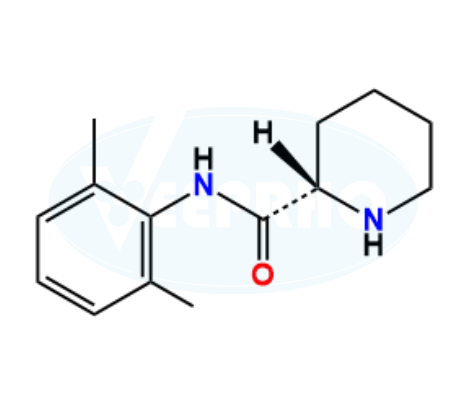
CAS 87-62-7 - Ropivacaine EP Impurity B VE0020045
CAS 27262-40-4 - Ropivacaine EP Impurity C VE0018304
CAS 24358-84-7 - Ropivacaine EP Impurity D VE0018333
CAS 98626-59-6 - Ropivacaine EP Impurity E VE0018019
CAS 265120-58-9 - Ropivacaine EP Impurity G VE009399
CAS 112773-90-7 - Ropivacaine EP Impurity G Hydrochloride Monohydrate VE0028824
CAS 3081822-32-1 - Ropivacaine Related Compound A (HCl salt) VE006435
CAS 21436-98-6
- Lidocaine EP Impurity A VL1040001

Additional information on CAS 98626-59-6
| Parent drug | Ropivacaine |
|---|---|
| Product type | Impurity standards |
| IUPAC name | (−)-(S)-N-(2,6-Dimethylphenyl)-1-ethylpiperidine-2-carboxamide ; |
| EP name | Ropivacaine EP Impurity D |
| SMILES | CCN1CCCC[C@H]1C(=O)Nc1c(C)cccc1C |
| InChIKey | AALBZAYEBOEAPQ-AWEZNQCLSA-N |
| CHNS Ratio (%) (calculated) | C 73.81 · H 9.29 · N 10.76 · S 0.00 |
| References | - |
| Description | Ropivacaine EP Impurity D, also designated Ropivacaine BP Impurity D and Ropivacaine N-Ethyl Analog, is the N-ethyl homolog of the amide local anesthetic ropivacaine, CAS 98626-59-6, with molecular formula C16H24N2O and molecular weight 260.37 g/mol. This structural variant typically arises as a process-related byproduct from alkylation steps or incomplete control of N-alkyl transfer during synthesis. As a defined organic impurity rather than a classical genotoxic alert, it is evaluated in the context of pharmacopeial impurity profiling and ICH Q3A/Q3B control strategies. Determination commonly relies on stability-indicating HPLC with LC-MS/MS confirmation, and, where volatile derivative studies are required, GC-MS may be applied. |
Request a Quote
"*" indicates required fields
Other products related to Ropivacaine impurities
| Impurity structure | Name of Impurity | Catalogue No. |
|---|---|---|
| Lidocaine EP Impurity A | VL1040001 | |
| Ropivacaine EP Impurity B | VE0020045 | |
| Ropivacaine EP Impurity C | VE0018304 | |
| Ropivacaine EP Impurity E | VE0018019 | |
| Ropivacaine EP Impurity G | VE009399 | |
| Ropivacaine EP Impurity G Hydrochloride Monohydrate | VE0028824 | |
| Ropivacaine Related Compound A (HCl salt) | VE006435 | |
| N-Nitroso Ropivacaine | VE0014753 | |
| N-Nitroso-2,6-Pipecoloxilidide | VE0016754 | |
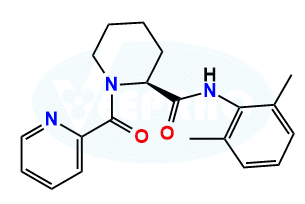 | Ropivacaine Impurity 11 | VE0017825 |
Show all related products N-Nitroso Ropivacaine impurities (2)