
- 100% accuracy of data
- 24/7 scientific support
- 0% tolerance in quality of product
Mutagenicity assessment (ICH M7)
Treated as a potentially non-mutagenic impurity (ICH M7 Class 4–5).
Computational (in silico) assessmentStock Locations
- New Jersey, USA
- Czech Republic, EU
* Stock subject to availability.
Documentation
Includes: HPLC, MASS/LC-MS, 1H NMR, FT-IR, Potency, Structure Elucidation Report (SER), and additional analytical data depending on the product.
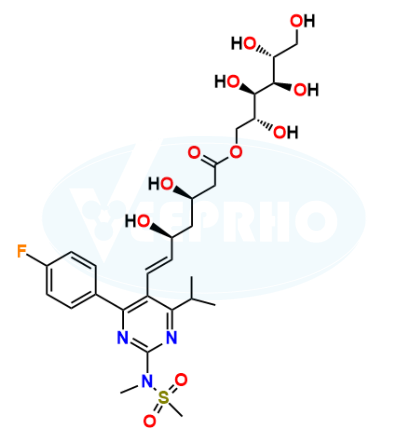
Rosuvastatin Impurity 217
● In Stock
| Catalogue No.: | VE0026628 |
|---|---|
| CAS No.: | N/A |
| Mol. Formula: | C28H40FN3O11S |
| Mol. Weight: | 645.7 g/mol |
For laboratory use only: analytical, development and regulatory purposes. Supplied in mg quantities. Not for human or veterinary use.
Additional information on Rosuvastatin Impurity 217
| Parent drug | Rosuvastatin |
|---|---|
| Product type | Impurity standards |
| IUPAC name | [(2R,3R,4R,5R)-2,3,4,5,6-pentahydroxyhexyl] (E,3R,5S)-7-[4-(4-fluorophenyl)-2-[methyl(methylsulfonyl)amino]-6-propan-2-ylpyrimidin-5-yl]-3,5-dihydroxyhept-6-enoate |
| SMILES | FC1=CC=C(C2=C(/C=C/[C@H](C[C@@H](O)CC(OC[C@H]([C@@H](O)[C@H](O)[C@H](O)CO)O)=O)O)C(C(C)C)=NC(N(C)S(=O)(C)=O)=N2)C=C1 |
| InChI | InChI=1S/C28H40FN3O11S/c1-15(2)24-20(25(16-5-7-17(29)8-6-16)31-28(30-24)32(3)44(4,41)42)10-9-18(34)11-19(35)12-23(38)43-14-22(37)27(40)26(39)21(36)13-33/h5-10,15,18-19,21-22,26-27,33-37,39-40H,11-14H2,1-4H3/b10-9+/t18-,19-,21-,22-,26-,27-/m1/s1 |
| InChIKey | PTSGONVOLHJGLT-SGVSIIBQSA-N |
| CHNS Ratio (%) (calculated) | C 52.08 · H 6.24 · N 6.51 · S 4.97 |
| Description | Rosuvastatin Impurity 217 is a process-related and degradation impurity identified during impurity profiling of rosuvastatin active pharmaceutical ingredient, characterized by LC-MS, HPLC and NMR for structural elucidation and quantification. This impurity can originate from side reactions in late stage synthesis or from hydrolytic and oxidative degradation pathways, and its presence may impact API purity, stability and downstream formulation performance. Control strategies include optimization of reaction conditions, enhanced purification and crystallization steps, antioxidant or pH control during processing, and validated HPLC/UPLC assays with LC-MS confirmation. Compliance with ICH Q3A and Q3B reporting and qualification thresholds is essential for specification setting and stability monitoring. |
Request a Quote
"*" indicates required fields
Other products related to Rosuvastatin impurities
| Impurity structure | Name of Impurity | Catalogue No. |
|---|---|---|
| Rosuvastatin EP Impurity A | VL127008 | |
| Rosuvastatin EP Impurity A (Free Base) | VE0024818 | |
| Rosuvastatin EP Impurity A (Sodium Salt) | VE008146 | |
| Rosuvastatin EP Impurity B (Free Base) | VE0024819 | |
| Rosuvastatin EP Impurity B (Racemic Mixture) | VL127001 | |
| Rosuvastatin EP Impurity C | VL127003 | |
| Rosuvastatin EP Impurity C (Free Base) | VE0011116 | |
| Rosuvastatin EP Impurity C (Sodium Salt) | VE0026666 | |
| Rosuvastatin EP Impurity D | VL127002 | |
| Rosuvastatin EP Impurity E | VL127005 | |
| Rosuvastatin EP Impurity F | VL127004 | |
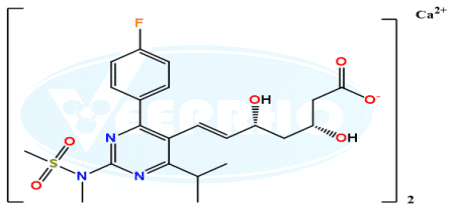 | Rosuvastatin EP Impurity G | VL127009 |
Show all related products N-Nitroso Rosuvastatin impurities (2)