
- 100% accuracy of data
- 24/7 scientific support
- 0% tolerance in quality of product
Mutagenicity assessment (ICH M7)
Treated as a potentially non-mutagenic impurity (ICH M7 Class 4–5).
Computational (in silico) assessmentStock Locations
- New Jersey, USA
- Czech Republic, EU
* Stock subject to availability.
Documentation
Includes: HPLC, MASS/LC-MS, 1H NMR, FT-IR, Potency, Structure Elucidation Report (SER), and additional analytical data depending on the product.
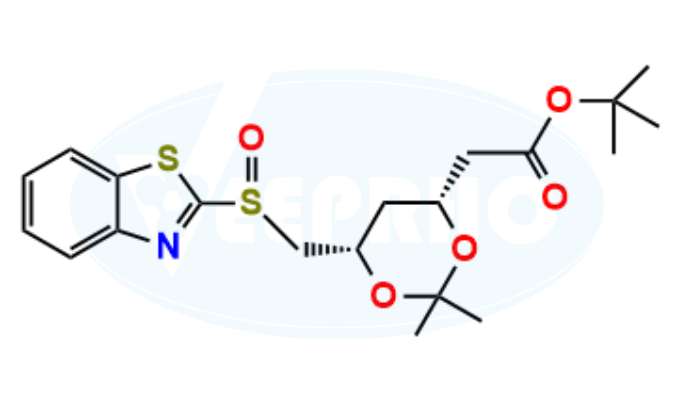
Rosuvastatin Impurity 88
● In Stock
| Catalogue No.: | VE0026612 |
|---|---|
| CAS No.: | N/A |
| Mol. Formula: | C20H27NO5S2 |
| Mol. Weight: | 425.6 g/mol |
For laboratory use only: analytical, development and regulatory purposes. Supplied in mg quantities. Not for human or veterinary use.
Additional information on Rosuvastatin Impurity 88
| Parent drug | Rosuvastatin |
|---|---|
| Product type | Impurity standards |
| IUPAC name | Tert-butyl 2-[(4R,6S)-6-(1,3-benzothiazol-2-ylsulfinylmethyl)-2,2-dimethyl-1,3-dioxan-4-yl]acetate |
| SMILES | O=S(C[C@H]1OC(C)(C)O[C@@H](CC(OC(C)(C)C)=O)C1)C2=NC3=CC=CC=C3S2 |
| InChI | InChI=1S/C20H27NO5S2/c1-19(2,3)26-17(22)11-13-10-14(25-20(4,5)24-13)12-28(23)18-21-15-8-6-7-9-16(15)27-18/h6-9,13-14H,10-12H2,1-5H3/t13-,14+,28?/m1/s1 |
| InChIKey | LDXFGNYWDMIQIF-PKACVQKSSA-N |
| CHNS Ratio (%) (calculated) | C 56.45 · H 6.40 · N 3.29 · S 15.07 |
| Description | Rosuvastatin Impurity 88 is a characterized process-related and/or degradation impurity encountered during rosuvastatin synthesis and stability. The impurity is defined by its chromatographic behavior and mass spectral profile and requires targeted identification and qualification under ICH Q3A/Q3B. Analytical control is typically achieved using validated HPLC or UPLC methods with orthogonal confirmation by LC-MS and NMR to establish structure and purity. Stability studies and forced-degradation experiments aid in elucidating formation pathways and setting specification limits. Routine monitoring, validated quantification with appropriate LOQ/LOD, and risk-based toxicological assessment ensure consistent impurity control through development and commercial manufacture. |
Request a Quote
"*" indicates required fields
Other products related to Rosuvastatin impurities
| Impurity structure | Name of Impurity | Catalogue No. |
|---|---|---|
| Rosuvastatin EP Impurity A | VL127008 | |
| Rosuvastatin EP Impurity A (Free Base) | VE0024818 | |
| Rosuvastatin EP Impurity A (Sodium Salt) | VE008146 | |
| Rosuvastatin EP Impurity B (Free Base) | VE0024819 | |
| Rosuvastatin EP Impurity B (Racemic Mixture) | VL127001 | |
| Rosuvastatin EP Impurity C | VL127003 | |
| Rosuvastatin EP Impurity C (Free Base) | VE0011116 | |
| Rosuvastatin EP Impurity C (Sodium Salt) | VE0026666 | |
| Rosuvastatin EP Impurity D | VL127002 | |
| Rosuvastatin EP Impurity E | VL127005 | |
| Rosuvastatin EP Impurity F | VL127004 | |
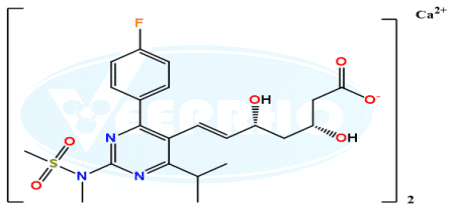 | Rosuvastatin EP Impurity G | VL127009 |
Show all related products N-Nitroso Rosuvastatin impurities (2)