
- 100 % Datengenauigkeit
- Wissenschaftlicher Support rund um die Uhr
- 0 % Toleranz bei der Produktqualität
Lagerstandorte
- New Jersey, USA
- Tschechien, EUAuf Lager
* Bestand vorbehaltlich Verfügbarkeit.
Dokumentation
Enthält: HPLC, MASS/LC-MS, 1H-NMR, FT-IR, Gehalt, Structure Elucidation Report (SER) sowie zusätzliche analytische Daten je nach Produkt.
151213-15-9
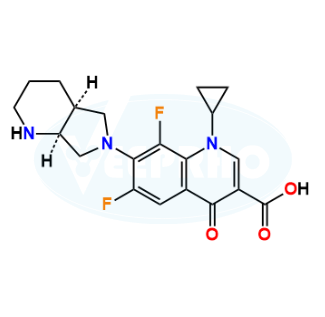
Moxifloxacin EP Impurity A
● Auf Lager
| Katalog-Nr.: | VL106001 |
|---|---|
| CAS-Nr.: | 151213-15-9 |
| Summenformel: | C20H21F2N3O3 |
| Molare Masse: | 389.40 g/mol |
For laboratory use only: analytical, development and regulatory purposes. Supplied in mg quantities. Not for human or veterinary use.
Angebot für ein Set anfordern
- Angebot für dieses Set anfragen
Alle EP-Verunreinigungen von Moxifloxacin
15 ProdukteDie 15 Produkte ansehen
- Moxifloxacin EP Impurity A VL106001
CAS 151213-15-9 - Moxifloxacin EP Impurity A (HCl Salt) VE0021495
CAS 151282-23-4 - Moxifloxacin EP Impurity B VL106002
CAS 1029364-73-5 - Moxifloxacin EP Impurity B (HCl Salt) VE0025145
CAS 2252446-68-5 - Moxifloxacin EP Impurity B (Hydrochloride Monohydrate) VE0021488
- Moxifloxacin EP Impurity C (HCl salt) VL106003
CAS 2252446-70-9 - Moxifloxacin EP Impurity C (Hydrochloride Hydrate) VE0021489
- Moxifloxacin EP Impurity D VL106004
CAS 1029364-77-9 - Moxifloxacin EP Impurity D (Hydrochloride Salt) VE0021494
CAS 2252446-69-6 - Moxifloxacin EP Impurity E VL106005
CAS 721970-36-1 - Moxifloxacin EP Impurity E (2HCl) VE009652
- Moxifloxacin EP Impurity E (Hydrobromide Salt) VE0021493
CAS 1292904-74-5 - Moxifloxacin Ethyl Analog (Free Base) VE008397
CAS 1029364-75-7 - Moxifloxacin Methyl Ester VL106007
CAS 721970-35-0 - Moxifloxacin Related Compound F (Free Base) VL106019
CAS 721970-37-2 & 1179992-99-4
- Moxifloxacin EP Impurity A VL106001
- Angebot für dieses Set anfragen
Alle USP-Verunreinigungen von Moxifloxacin
18 ProdukteDie 18 Produkte ansehen
- Moxifloxacin 7-Amino Impurity VL106018
CAS 172426-88-9 - Moxifloxacin Decarboxy Impurity VL106006
CAS 1322062-57-6 - Moxifloxacin EP Impurity A VL106001
CAS 151213-15-9 - Moxifloxacin EP Impurity A (HCl Salt) VE0021495
CAS 151282-23-4 - Moxifloxacin EP Impurity B VL106002
CAS 1029364-73-5 - Moxifloxacin EP Impurity B (Hydrochloride Monohydrate) VE0021488
- Moxifloxacin EP Impurity C (HCl salt) VL106003
CAS 2252446-70-9 - Moxifloxacin EP Impurity C (Hydrochloride Hydrate) VE0021489
- Moxifloxacin EP Impurity D VL106004
CAS 1029364-77-9 - Moxifloxacin EP Impurity E VL106005
CAS 721970-36-1 - Moxifloxacin EP Impurity E (2HCl) VE009652
- Moxifloxacin EP Impurity F VL106009
CAS 1350716-67-4 - Moxifloxacin Ethyl Analog (Free Base) VE008397
CAS 1029364-75-7 - Moxifloxacin Related Compound F (Free Base) VL106019
CAS 721970-37-2 & 1179992-99-4 - Moxifloxacin Related Compound G VL106010
CAS 1346603-25-5 - Moxifloxacin Related Compound G (Free Base) VE009489
CAS 268545-13-7 - Moxifloxacin Related Compound G (HCl Salt) VE0011551
CAS 1394029-14-1 - Moxifloxacin Related Compound G (Hydrochloride Monohydrate) VE006991
- Moxifloxacin 7-Amino Impurity VL106018


Zusätzliche Informationen zu CAS 151213-15-9
| Wirkstoff | Moxifloxacin |
|---|---|
| Produkttyp | Verunreinigungsstandards |
| IUPAC-Name | 1-Cyclopropyl-6,8-difluoro-7-[(4aS,7aS)-octahydro-6H-pyrrolo[3,4-b]pyridin-6-yl]-4-oxo-1,4-dihydroquinoline-3-carboxylic acid |
| Name im EP | Moxifloxacin EP Impurity A |
| Name in der USP | Moxifloxacin Related Compound A |
| SMILES | O=C(O)c1cn(C2CC2)c2c(F)c(N3C[C@@H]4CCCN[C@@H]4C3)c(F)cc2c1=O |
| InChIKey | WEXQOLCYKFJAJZ-ZUZCIYMTSA-N |
| CHNS-Verhältnis (%) (berechnet) | C 61.69 · H 5.44 · N 10.79 · S 0.00 |
| Referenzen | Al Omari | Mahmoud M. H. | et al. “Moxifloxacin Hydrochloride.†Profiles of Drug Substances | Excipients and Related Methodology | 2014 | pp. 299–431 | https://doi.org/10.1016/b978-0-12-800173-8.00007-6. ?CHODOSH | S. | et al. “Short-Course Moxifloxacin Therapy for Treatment of Acute Bacterial Exacerbations of Chronic Bronchitis.†Respiratory Medicine | vol. 94 | no. 1 | Jan. 2000 | pp. 18–27 | https://doi.org/10.1053/rmed.1999.0708. ? |
| Beschreibung | Moxifloxacin EP Impurity A, CAS 151213-15-9, ist das Difluor-Analogon von Moxifloxacin mit 8-Desmethoxy-8-fluoro-Substitution am Chinolon-Gerüst. Mit der Summenformel C20H21F2N3O3 und einer Molmasse von 389.40 g/mol handelt es sich um eine strukturverwandte Prozess- oder Syntheseverunreinigung und nicht um einen klassischen Abbauproduktmarker. Die Bildung kann aus unvollständiger Kontrolle von Fluorierungsschritten oder späten Kupplungsreaktionen in der Herstellung des Fluorchinolon-Kerns resultieren. Aufgrund der engen strukturellen Nähe ist zur sicheren Identifizierung meist eine orthogonale Analytik mit HPLC, LC-MS/MS, hochauflösender Massenspektrometrie und gegebenenfalls NMR erforderlich. Die Bewertung erfolgt im Kontext pharmakopöischer Impuritätskontrolle sowie der ICH-Q3A/Q3B-Leitlinien. |
Angebot anfordern
"*" kennzeichnet Pflichtfelder
Weitere Produkte zu Moxifloxacin Verunreinigungen
| Struktur der Verunreinigung | Name der Verunreinigung | Katalog-Nr. |
|---|---|---|
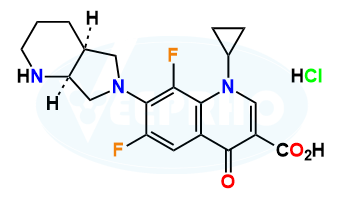
| Moxifloxacin EP Impurity A (HCl Salt) | VE0021495 | |
| Moxifloxacin EP Impurity B | VL106002 | |
| Moxifloxacin EP Impurity B (HCl Salt) | VE0025145 | |
| Moxifloxacin EP Impurity B (Hydrochloride Monohydrate) | VE0021488 | |
| Moxifloxacin EP Impurity C (HCl salt) | VL106003 | |
| Moxifloxacin EP Impurity C (Hydrochloride Hydrate) | VE0021489 | |
| Moxifloxacin EP Impurity D | VL106004 | |
| Moxifloxacin EP Impurity D (Hydrochloride Salt) | VE0021494 | |
| Moxifloxacin EP Impurity E | VL106005 | |
 | Moxifloxacin EP Impurity E (2HCl) | VE009652 |
| Moxifloxacin EP Impurity E (Hydrobromide Salt) | VE0021493 | |
| Moxifloxacin EP Impurity F | VL106009 |
Alle verwandten Produkte zeigen N-Nitroso-Moxifloxacin-Verunreinigungen (10)