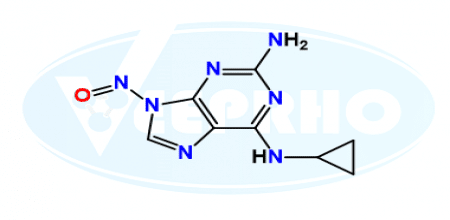
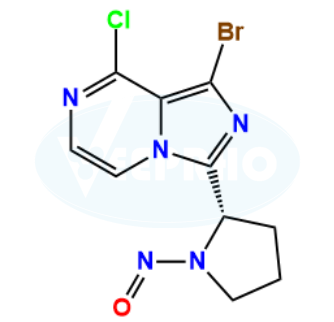
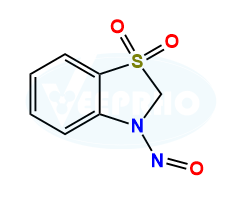
In organic chemistry, nitroso refers to a functional group in which the nitric oxide (−N=O) group is attached to an organic moiety. As such, various nitroso groups can be categorized as C-nitroso compounds (e.g., nitrosoalkanes; R−N=O), S-nitroso compound + some more technical info S-nitrosothiols (R-S-NO) are a common S-nitroso class that act as labile nitric oxide donors and undergo homolytic or heterolytic cleavage to release NO under photolysis, reductive conditions, or trans-nitrosation. C-nitroso species are generally electrophilic at nitrogen, can dimerize to azodioxide-type dimers, and participate in characteristic transformations such as nitroso-ene and cycloaddition reactions that are exploited in synthesis of hydroxylamines, oximes, and aminoxy intermediates. Nitroso functionality has distinct spectroscopic signatures in IR and NMR, shows characteristic UV-vis charge-transfer bands for conjugated systems, and requires handling controls due to potential reactivity toward nucleophiles and propensity for secondary reactions.

Parent: Baricitinib
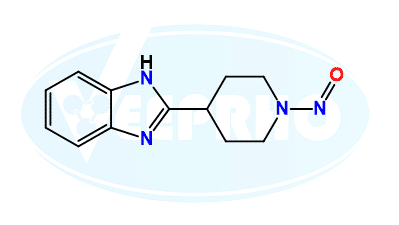
Parent: Bilastine

Parent: N/A

Parent: Brexpiprazole

Parent: Clopidogrel

Parent: N-Nitroso

Parent: Propyl Gallate

Parent: Moxifloxacin

Parent: N/A
![Dimethyl-[7-[methyl(nitroso)amino]phenothiazin-3-ylidene]ammonium;chloride](https://veeprho.com/wp-content/uploads/2024/04/VE0019918-Dimethyl-7-methyl-nitroso-amino-phenothiazin-3-ylidene-ammonium-chloride.png "Dimethyl-[7-[methyl(nitroso)amino]phenothiazin-3-ylidene]ammonium;chloride")
Parent: Methylthioninium chloride

Parent: Potassium Clavulanate

Parent: Gatifloxacin
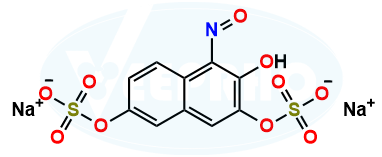
Parent: N/A

Parent: Duloxetine

Parent: Enzalutamide

Parent: Pranlukast
Nitroso-related impurities encompass N-nitrosamines, nitrosamides, S-nitrosothiols, and trace C-nitroso species formed during synthesis or storage. Because many nitroso derivatives, notably some N-nitrosamines, have genotoxic or mutagenic potential, acceptable levels in pharmaceuticals and food-contact materials are controlled at very low concentrations; regulatory and industry practice therefore targets control and monitoring at low parts-per-billion by mass and acceptable intake often expressed in nanograms per day for the most potent nitrosamines. Common monitored analytes include NDMA, NDEA and other N-nitrosamines, with typical analytical limits of quantification in the low ng/g to sub-ng/g range using LC-MS/MS or GC-MS methods. Sources of nitroso impurities include secondary amines plus nitrosating agents such as nitrite under acidic conditions, nitrosation of thiols to give transient S-nitrosothiols, and contamination introduced via solvents, reagents, or process water. Mitigation strategies focus on control of nitrite and nitrosating species, minimization of secondary amine contamination, pH control, and validated analytical surveillance.
Nitroso denotes the −N=O functional group attached to carbon, sulfur or other atoms; it defines classes such as C-nitroso (R−N=O) and S-nitroso (R-S-NO). These groups have distinctive reactivity: C-nitroso compounds act as electrophiles and participate in cycloaddition and nitroso-ene chemistry, while S-nitrosothiols act as labile nitric oxide donors and undergo trans-nitrosation, photolysis or reductive cleavage.
Nitroso species are not typically added as such, but N-nitrosamines can form in cured or processed meats and in some smoked foods when nitrite preservatives react with secondary amines during processing or storage. Nitrate in vegetables can be reduced to nitrite and contribute to nitrosation chemistry under acidic conditions. Levels vary widely with processing, storage, and cooking; regulatory bodies therefore set limits on nitrite use and monitor N-nitrosamine formation in food processing.
Yes, but use is selective and controlled. Some nitroso-containing classes, such as nitrosourea anticancer agents, are clinically used alkylating drugs with potent biological activity. S-nitrosothiols and other nitroso derivatives are studied and sometimes applied as nitric oxide donors or prodrugs in targeted therapies. Conversely, many N-nitrosamines are avoided because of genotoxicity, so medicinal applications require rigorous impurity control, safety assessment, and validated manufacturing controls.