- 100% accuracy of data
- 24/7 scientific support
- 0% tolerance in quality of product
Stock Locations
- New Jersey, USA
- Czech Republic, EU
* Stock subject to availability.
Documentation
Includes: HPLC, MASS/LC-MS, 1H NMR, FT-IR, Potency, Structure Elucidation Report (SER), and additional analytical data depending on the product.
1187966-93-3
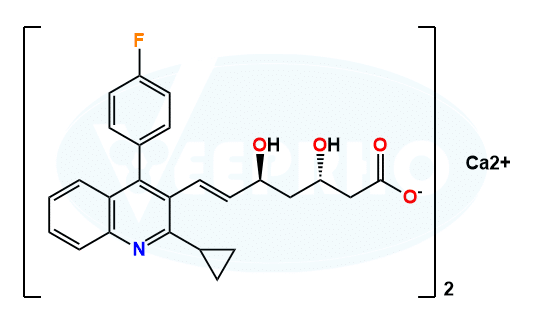
(3R,5S)-5-(6-cyclopropyl-10-fluorobenzo[k]phenanthridin-8-yl)-3,5-dihydroxypentanoic acid
● In Stock
| Catalogue No.: | VE0026357 |
|---|---|
| CAS No.: | 1187966-93-3 |
| Mol. Formula: | C25H22FNO4 |
| Mol. Weight: | 419.44 g/mol |
For laboratory use only: analytical, development and regulatory purposes. Supplied in mg quantities. Not for human or veterinary use.
Additional information on CAS 1187966-93-3
| Parent drug | Pitavastatin |
|---|---|
| Product type | Impurity standards |
| IUPAC name | (3R,5S)-5-(6-cyclopropyl-10-fluorobenzo[k]phenanthridin-8-yl)-3,5-dihydroxypentanoic acid |
| SMILES | O=C(O)C[C@H](O)C[C@H](O)C(C=C12)=C3C=C(F)C=CC3=C2C4=CC=CC=C4N=C1C5CC5 |
| InChI | InChI=1S/C25H22FNO4/c26-14-7-8-16-18(9-14)19(22(29)10-15(28)11-23(30)31)12-20-24(16)17-3-1-2-4-21(17)27-25(20)13-5-6-13/h1-4,7-9,12-13,15,22,28-29H,5-6,10-11H2,(H,30,31)/t15-,22+/m1/s1 |
| InChIKey | JEAIZQYPWPSXQH-QRQCRPRQSA-N |
| CHNS Ratio (%) (calculated) | C 71.59 · H 5.29 · N 3.34 · S 0.00 |
| Description | (3R,5S)-5-(6-Cyclopropyl-10-fluorobenzo[k]phenanthridin-8-yl)-3,5-dihydroxypentanoic Acid (CAS 1187966-93-3) is a stereochemically defined acidic impurity featuring a benzo[k]phenanthridine core with a 10-fluoro substituent, a cyclopropyl motif and vicinal diol and carboxylic acid functionality. As a polar degradation or process-related impurity it is amenable to LC-MS, HPLC-UV and 1H NMR characterization with distinct retention behavior under reversed phase and ion-pair methods. It can arise from incomplete reduction or hydrolytic side reactions during synthesis and requires control via optimized reaction conditions, targeted purification and stability testing. Recommended handling includes low temperature storage, light protection and quantitation to ICH impurity limits. |
Request a Quote
"*" indicates required fields