- 100% accuracy of data
- 24/7 scientific support
- 0% tolerance in quality of product
Stock Locations
- New Jersey, USA
- Czech Republic, EU
* Stock subject to availability.
Documentation
Includes: HPLC, MASS/LC-MS, 1H NMR, FT-IR, Potency, Structure Elucidation Report (SER), and additional analytical data depending on the product.
1456783-35-9
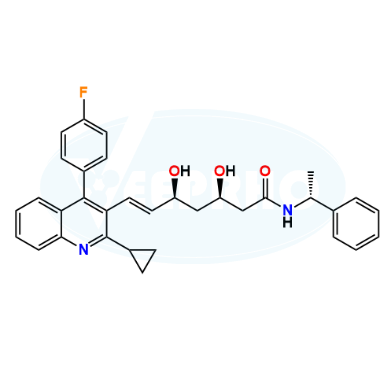
(3R,5S,E)-7-(2-cyclopropyl-4-(4-fluorophenyl)quinolin-3-yl)-3,5-dihydroxy-N-((R)-1-phenylethyl)hept-6-enamide
● In Stock
| Catalogue No.: | VE0027826 |
|---|---|
| CAS No.: | 1456783-35-9 |
| Mol. Formula: | C33H33FN2O3 |
| Mol. Weight: | 524.63 g/mol |
For laboratory use only: analytical, development and regulatory purposes. Supplied in mg quantities. Not for human or veterinary use.
Additional information on CAS 1456783-35-9
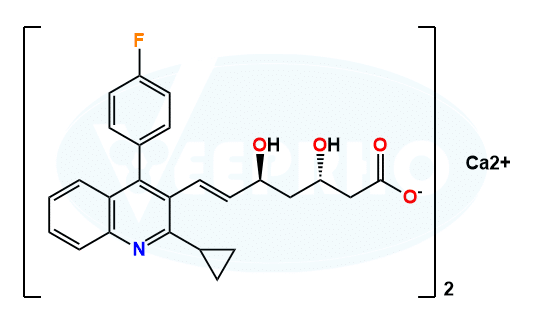
| Parent drug | Pitavastatin |
|---|---|
| Product type | Impurity standards |
| IUPAC name | (3R,5S,E)-7-(2-cyclopropyl-4-(4-fluorophenyl)quinolin-3-yl)-3,5-dihydroxy-N-((R)-1-phenylethyl)hept-6-enamide |
| SMILES | O=C(N[C@@H](C1=CC=CC=C1)C)C[C@H](O)C[C@H](O)/C=C/C2=C(C3=CC=C(F)C=C3)C4=CC=CC=C4N=C2C5CC5 |
| InChI | InChI=1S/C33H33FN2O3/c1-21(22-7-3-2-4-8-22)35-31(39)20-27(38)19-26(37)17-18-29-32(23-13-15-25(34)16-14-23)28-9-5-6-10-30(28)36-33(29)24-11-12-24/h2-10,13-18,21,24,26-27,37-38H,11-12,19-20H2,1H3,(H,35,39)/b18-17+/t21-,26-,27-/m1/s1 |
| InChIKey | JLGWZLJSEGANJP-VSAFNIFHSA-N |
| CHNS Ratio (%) (calculated) | C 75.55 · H 6.34 · N 5.34 · S 0.00 |
| Description | (3R,5S,E)-7-(2-cyclopropyl-4-(4-fluorophenyl)quinolin-3-yl)-3,5-dihydroxy-N-((R)-1-phenylethyl)hept-6-enamide, CAS 1456783-35-9, is a structurally defined quinoline amide impurity with molecular formula C33H33FN2O3 and molecular weight 524.63 g/mol. Its stereochemically complex scaffold suggests formation during late-stage coupling, epimerization, or alkene isomerization steps rather than simple oxidative degradation. The conjugated quinoline and fluorophenyl motifs increase UV response, but definitive characterization typically relies on LC-MS/MS with high-resolution mass spectrometry and, where necessary, NMR confirmation of configurational integrity. In a regulatory setting, such impurities are evaluated for synthetic origin, persistence, and potential qualification under impurity control frameworks. |
Request a Quote
"*" indicates required fields