- 100% accuracy of data
- 24/7 scientific support
- 0% tolerance in quality of product
Stock Locations
- New Jersey, USA
- Czech Republic, EU
* Stock subject to availability.
Documentation
Includes: HPLC, MASS/LC-MS, 1H NMR, FT-IR, Potency, Structure Elucidation Report (SER), and additional analytical data depending on the product.
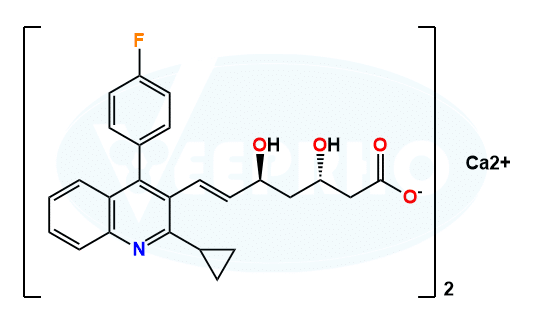
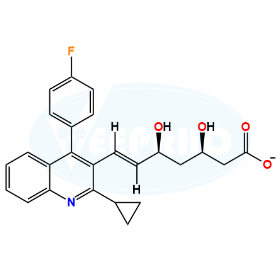
(3R,5S,E)-7-(2-cyclopropyl-4-(4-fluorophenyl)quinolin-3-yl)-3,5-dihydroxyhept-6-enoate
● In Stock
| Catalogue No.: | VE0026338 |
|---|---|
| CAS No.: | N/A |
| Mol. Formula: | C25H23FNO4− |
| Mol. Weight: | 420.45 g/mol |
For laboratory use only: analytical, development and regulatory purposes. Supplied in mg quantities. Not for human or veterinary use.
Additional information on (3R,5S,E)-7-(2-cyclopropyl-4-(4-fluorophenyl)quinolin-3-yl)-3,5-dihydroxyhept-6-enoate
| Parent drug | Pitavastatin |
|---|---|
| Product type | Impurity standards |
| IUPAC name | (E,3R,5S)-7-[2-cyclopropyl-4-(4-fluorophenyl)quinolin-3-yl]-3,5-dihydroxyhept-6-enoate |
| SMILES | O=C([O-])C[C@H](O)C[C@H](O)/C([H])=C([H])/C1=C(C2=CC=C(F)C=C2)C3=CC=CC=C3N=C1C4CC4 |
| InChI | InChI=1S/C25H24FNO4/c26-17-9-7-15(8-10-17)24-20-3-1-2-4-22(20)27-25(16-5-6-16)21(24)12-11-18(28)13-19(29)14-23(30)31/h1-4,7-12,16,18-19,28-29H,5-6,13-14H2,(H,30,31)/p-1/b12-11+/t18-,19-/m1/s1 |
| InChIKey | VGYFMXBACGZSIL-MCBHFWOFSA-M |
| Description | (3R,5S,E)-7-(2-cyclopropyl-4-(4-fluorophenyl)quinolin-3-yl)-3,5-dihydroxyhept-6-enoate is a stereodefined synthetic impurity characterized by vicinal diol functionality and a conjugated olefin adjacent to a quinoline core. It commonly arises from incomplete protection or dehydration during late-stage functionalization, with potential for epimerization at C3/C5 under acidic or basic conditions. Analytical profiling by LC-MS, chiral HPLC and 1H/13C NMR enables sensitive detection and stereochemical assignment, while HRMS confirms molecular formula. Control strategy focuses on optimized protecting group chemistry, pH control and validated purification steps to limit levels, supported by stability testing to define acceptable limits and storage conditions. |
Request a Quote
"*" indicates required fields