- 100% accuracy of data
- 24/7 scientific support
- 0% tolerance in quality of product
Stock Locations
- New Jersey, USA
- Czech Republic, EU
* Stock subject to availability.
Documentation
Includes: HPLC, MASS/LC-MS, 1H NMR, FT-IR, Potency, Structure Elucidation Report (SER), and additional analytical data depending on the product.
254452-86-3
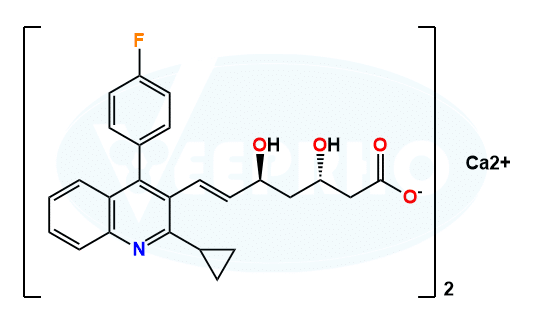
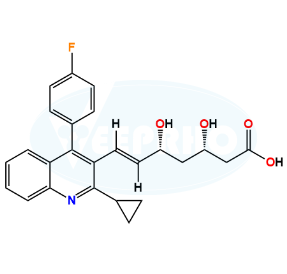
(3S,5R,E)-7-(2-Cyclopropyl-4-(4-fluorophenyl)quinolin-3-yl)-3,5-dihydroxyhept-6-enoic acid
● In Stock
| Catalogue No.: | VE0026350 |
|---|---|
| CAS No.: | 254452-86-3 |
| Mol. Formula: | C25H24FNO4 |
| Mol. Weight: | 421.46 g/mol |
For laboratory use only: analytical, development and regulatory purposes. Supplied in mg quantities. Not for human or veterinary use.
Additional information on CAS 254452-86-3
| Parent drug | Pitavastatin |
|---|---|
| Product type | Impurity standards |
| IUPAC name | (E,3S,5R)-7-[2-cyclopropyl-4-(4-fluorophenyl)quinolin-3-yl]-3,5-dihydroxyhept-6-enoic acid |
| SMILES | O=C(O)C[C@@H](O)C[C@@H](O)/C([H])=C([H])/C1=C(C2=CC=C(F)C=C2)C3=CC=CC=C3N=C1C4CC4 |
| InChI | InChI=1S/C25H24FNO4/c26-17-9-7-15(8-10-17)24-20-3-1-2-4-22(20)27-25(16-5-6-16)21(24)12-11-18(28)13-19(29)14-23(30)31/h1-4,7-12,16,18-19,28-29H,5-6,13-14H2,(H,30,31)/b12-11+/t18-,19-/m0/s1 |
| InChIKey | VGYFMXBACGZSIL-JUFISIKESA-N |
| CHNS Ratio (%) (calculated) | C 71.25 · H 5.74 · N 3.32 · S 0.00 |
| Description | This impurity, (3S,5R,E)-7-(2-Cyclopropyl-4-(4-fluorophenyl)quinolin-3-yl)-3,5-dihydroxyhept-6-enoic acid (CAS 254452-86-3), is a chiral, unsaturated carboxylic acid contaminant observed in quinoline-based syntheses. It features two stereocenters and an E-configured alkene giving rise to distinct chromatographic behavior and potential epimerization under acidic or basic conditions. Analytical detection is routinely achieved by reversed phase HPLC with UV detection supported by LC-MS and 1H NMR for stereochemical assignment. The compound shows moderate polarity from vicinal diols and a terminal acid which affects retention time and solubility in aqueous-organic systems. Control strategies focus on reaction optimization, monitoring and qualification per impurity thresholds. |
Request a Quote
"*" indicates required fields