- 100% accuracy of data
- 24/7 scientific support
- 0% tolerance in quality of product
Stock Locations
- New Jersey, USA
- Czech Republic, EU
* Stock subject to availability.
Documentation
Includes: HPLC, MASS/LC-MS, 1H NMR, FT-IR, Potency, Structure Elucidation Report (SER), and additional analytical data depending on the product.
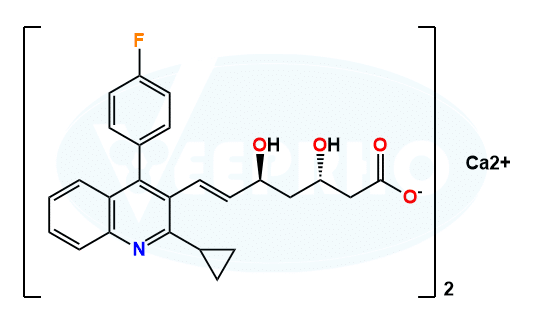
(5S,6E)-7-[2-Cyclopropyl-4-(4-fluorophenyl)-3-quinolinyl]-5-hydroxy-3-oxo-6-heptenoic Acid (Na Salt)
● In Stock
| Catalogue No.: | VE0026339 |
|---|---|
| CAS No.: | N/A |
| Mol. Formula: | C25H21FNNaO4 |
| Mol. Weight: | 441.43 g/mol |
For laboratory use only: analytical, development and regulatory purposes. Supplied in mg quantities. Not for human or veterinary use.
Additional information on (5S,6E)-7-[2-Cyclopropyl-4-(4-fluorophenyl)-3-quinolinyl]-5-hydroxy-3-oxo-6-heptenoic Acid (Na Salt)
| Parent drug | Pitavastatin |
|---|---|
| Product type | Impurity standards |
| IUPAC name | sodium (E,5S)-7-[2-cyclopropyl-4-(4-fluorophenyl)quinolin-3-yl]-5-hydroxy-3-oxohept-6-enoate |
| SMILES | O=C(CC([O-][Na+])=O)C[C@H](O)/C([H])=C([H])/C1=C(C2=CC=C(F)C=C2)C3=CC=CC=C3N=C1C4CC4 |
| InChI | InChI=1S/C25H22FNO4.Na/c26-17-9-7-15(8-10-17)24-20-3-1-2-4-22(20)27-25(16-5-6-16)21(24)12-11-18(28)13-19(29)14-23(30)31;/h1-4,7-12,16,18,28H,5-6,13-14H2,(H,30,31);/q;+1/p-1/b12-11+;/t18-;/m1./s1 |
| CHNS Ratio (%) (calculated) | C 68.02 · H 4.80 · N 3.17 · S 0.00 |
| Description | (5S,6E)-7-[2-Cyclopropyl-4-(4-fluorophenyl)-3-quinolinyl]-5-hydroxy-3-oxo-6-heptenoic Acid (Na Salt) is a process-related impurity characterized by a quinoline core bearing a 4-fluorophenyl and cyclopropyl substitution and a polar 5-hydroxy-3-oxo-6-heptenoic acid sodium moiety. Its combination of aromatic UV chromophores and an ionizable carboxylate makes it amenable to HPLC-UV and LC-MS detection, while moderate polarity affects reversed phase retention and ion-pair behavior. Analytical concerns include E/Z isomerization at the 6-heptenoic double bond and potential epimerization at C5 under acidic or basic conditions. Control strategies focus on optimized reaction conditions, orthogonal chromatographic methods and stability-indicating assays to limit impurity levels and meet regulatory expectations. |
Request a Quote
"*" indicates required fields