
- 100% accuracy of data
- 24/7 scientific support
- 0% tolerance in quality of product
Stock Locations
- New Jersey, USA
- Czech Republic, EU
* Stock subject to availability.
Documentation
Includes: HPLC, MASS/LC-MS, 1H NMR, FT-IR, Potency, Structure Elucidation Report (SER), and additional analytical data depending on the product.
519-32-4
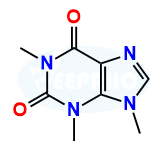
Caffeine EP Impurity C
● In Stock
| Catalogue No.: | VE0013128 |
|---|---|
| CAS No.: | 519-32-4 |
| Mol. Formula: | C8H10N4O2 |
| Mol. Weight: | 194.19 g/mol |
For laboratory use only: analytical, development and regulatory purposes. Supplied in mg quantities. Not for human or veterinary use.
Request a quote for a set
- Request quote for this set
All EP impurities of Caffeine
7 productsSee the 7 products
- Caffeine EP Impurity C VE0013128
CAS 519-32-4 - Caffeine EP Impurity D VL3710004
CAS 83-67-0 - Caffeine EP Impurity E VE0015582
CAS 20041-90-1 - Caffeine EP Impurity E (HCl Salt) VE0013129
CAS 107605-95-8 - Caffeine EP Impurity E (Nitrate Salt) VE0022949
CAS 209725-34-8 - Caffeine EP Impurity F VE0013130
CAS 611-59-6 - Theophylline EP Impurity C VE008571
CAS 7597-60-6
- Caffeine EP Impurity C VE0013128


Additional information on CAS 519-32-4
| Parent drug | Caffeine |
|---|---|
| Product type | Impurity standards |
| IUPAC name | 1,3,9-trimethyl-3,9-dihydro-1H-purine-2,6-dione |
| EP name | Caffeine EP Impurity C |
| SMILES | O=C(N1C)N(C)C2=C(N=CN2C)C1=O |
| InChI | InChI=1S/C8H10N4O2/c1-10-4-9-5-6(10)11(2)8(14)12(3)7(5)13/h4H,1-3H3 |
| InChIKey | LPHGQDQBBGAPDZ-UHFFFAOYSA-N |
| CHNS Ratio (%) (calculated) | C 49.48 · H 5.19 · N 28.85 · S 0.00 |
| References | - |
| Description | Caffeine EP Impurity C, identified as isocaffeine (CAS 519-32-4), is a structural isomer of caffeine arising from methyl group migration within the xanthine scaffold during synthesis or thermal stress. Its molecular formula is C8H10N4O2 with a molecular weight of 194.19 g/mol. As a position isomer rather than a degradant with distinct functional-group changes, its significance lies in process-related impurity profiling and separation from the parent alkaloid. Trace determination generally requires reversed-phase LC-MS/MS or LC-DAD with optimized selectivity, and confirmation may employ high-resolution MS or NMR to resolve closely related methylxanthine isomers. |
Request a Quote
"*" indicates required fields
Other products related to Caffeine impurities
| Impurity structure | Name of Impurity | Catalogue No. |
|---|---|---|
| Caffeine EP Impurity D | VL3710004 | |
| Caffeine EP Impurity E | VE0015582 | |
 | Caffeine EP Impurity E (HCl Salt) | VE0013129 |
| Caffeine EP Impurity E (Nitrate Salt) | VE0022949 | |
| Caffeine EP Impurity F | VE0013130 | |
| Theophylline EP Impurity C | VE008571 | |
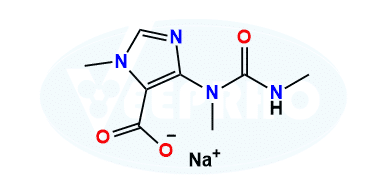 | Caffeine Impurity 1 (Na Salt) | VE0013158 |