

- 100% accuracy of data
- 24/7 scientific support
- 0% tolerance in quality of product
Stock Locations
- New Jersey, USA
- Czech Republic, EU
* Stock subject to availability.
Documentation
Includes: HPLC, MASS/LC-MS, 1H NMR, FT-IR, Potency, Structure Elucidation Report (SER), and additional analytical data depending on the product.
611-59-6
Caffeine EP Impurity F
● In Stock
| Catalogue No.: | VE0013130 |
|---|---|
| CAS No.: | 611-59-6 |
| Mol. Formula: | C7H8N4O2 |
| Mol. Weight: | 180.17 g/mol |
For laboratory use only: analytical, development and regulatory purposes. Supplied in mg quantities. Not for human or veterinary use.
Request a quote for a set
- Request quote for this set
All EP impurities of Caffeine
7 productsSee the 7 products
- Caffeine EP Impurity C VE0013128
CAS 519-32-4 - Caffeine EP Impurity D VL3710004
CAS 83-67-0 - Caffeine EP Impurity E VE0015582
CAS 20041-90-1 - Caffeine EP Impurity E (HCl Salt) VE0013129
CAS 107605-95-8 - Caffeine EP Impurity E (Nitrate Salt) VE0022949
CAS 209725-34-8 - Caffeine EP Impurity F VE0013130
CAS 611-59-6 - Theophylline EP Impurity C VE008571
CAS 7597-60-6
- Caffeine EP Impurity C VE0013128
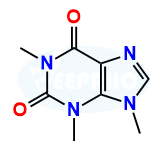


Additional information on CAS 611-59-6
| Parent drug | Caffeine |
|---|---|
| Product type | Impurity standards |
| IUPAC name | 3,7-Dihydro-1,7-dimethyl-1H-purine-2,6-dione |
| EP name | Caffeine EP Impurity F |
| SMILES | Cn1c(=O)[nH]c2ncn(C)c2c1=O |
| InChIKey | QUNWUDVFRNGTCO-UHFFFAOYSA-N |
| CHNS Ratio (%) (calculated) | C 46.67 · H 4.48 · N 31.10 · S 0.00 |
| References | - |
| Description | Caffeine EP Impurity F, identified as paraxanthine, is the 1,7-dimethylxanthine metabolite related to caffeine biotransformation and a structurally defined methylxanthine impurity. CAS 611-59-6 corresponds to a compound with molecular formula C7H8N4O2 and molecular weight 180.17 g/mol. In pharmacopeial and stability contexts, its presence may reflect enzymatic demethylation, oxidative transformation, or process-related carryover from caffeine manufacture. Characterization commonly requires reversed-phase LC-MS/MS, HPLC with UV detection, and confirmatory high-resolution MS or NMR because of close isomeric similarity to other xanthines. Regulatory assessment considers its identity, relative response, and impurity profile in caffeine-containing substances. |
Request a Quote
"*" indicates required fields
Other products related to Caffeine impurities
| Impurity structure | Name of Impurity | Catalogue No. |
|---|---|---|
| Caffeine EP Impurity C | VE0013128 | |
| Caffeine EP Impurity D | VL3710004 | |
| Caffeine EP Impurity E | VE0015582 | |
 | Caffeine EP Impurity E (HCl Salt) | VE0013129 |
| Caffeine EP Impurity E (Nitrate Salt) | VE0022949 | |
| Theophylline EP Impurity C | VE008571 | |
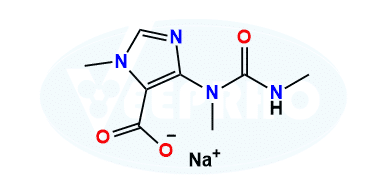 | Caffeine Impurity 1 (Na Salt) | VE0013158 |