

- 100% accuracy of data
- 24/7 scientific support
- 0% tolerance in quality of product
Stock Locations
- New Jersey, USA
- Czech Republic, EUIn stock
* Stock subject to availability.
Documentation
Batch COA on file. The batch COA includes HPLC, MASS/LC-MS, 1H NMR, FT-IR, Potency, and Structure Elucidation Report (SER)..
83-67-0
Caffeine EP Impurity D
● In Stock
| Catalogue No.: | VL3710004 |
|---|---|
| CAS No.: | 83-67-0 |
| Mol. Formula: | C7H8N4O2 |
| Mol. Weight: | 180.16 g/mol |
For laboratory use only: analytical, development and regulatory purposes. Supplied in mg quantities. Not for human or veterinary use.
Request a quote for a set
- Request quote for this set
All EP impurities of Caffeine
7 productsSee the 7 products
- Caffeine EP Impurity C VE0013128
CAS 519-32-4 - Caffeine EP Impurity D VL3710004
CAS 83-67-0 - Caffeine EP Impurity E VE0015582
CAS 20041-90-1 - Caffeine EP Impurity E (HCl Salt) VE0013129
CAS 107605-95-8 - Caffeine EP Impurity E (Nitrate Salt) VE0022949
CAS 209725-34-8 - Caffeine EP Impurity F VE0013130
CAS 611-59-6 - Theophylline EP Impurity C VE008571
CAS 7597-60-6
- Caffeine EP Impurity C VE0013128
- Request quote for this set
All USP impurities of Caffeine
2 productsSee the 2 products
- Caffeine EP Impurity D VL3710004
CAS 83-67-0 - Theophylline EP Impurity C VE008571
CAS 7597-60-6
- Caffeine EP Impurity D VL3710004
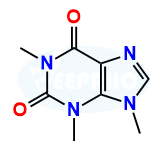


Additional information on CAS 83-67-0
| Parent drug | Caffeine / Pentoxifylline / Theophylline-Ethylenediamine |
|---|---|
| Product type | Impurity standards |
| IUPAC name | 3,7-Dihydro-3,7-dimethyl-1H-purine-2,6-dione |
| EP name | Caffeine EP impurity D / Pentoxifylline EP Impurity A / Theophylline-Ethylenediamine EP Impurity G |
| USP name | Caffeine Related Compound D |
| Pharmacopeial synonyms | Theophylline-Ethylenediamine EP Impurity G; Pentoxifylline EP Impurity A; Theobromine; Caffeine Related Compound D |
| Other Synonyms | 3,7-Dimethylxanthine; Diurobromine; 3,7-Dimethyl-3,7-dihydro -1H-purine-2,6-dione |
| SMILES | Cn1cnc2c1c(=O)[nH]c(=O)n2C |
| InChI | InChI=1S/C7H8N4O2/c1-10-3-8-5-4(10)6(12)9-7(13)11(5)2/h3H,1-2H3,(H,9,12,13) |
| InChIKey | YAPQBXQYLJRXSA-UHFFFAOYSA-N |
| CHNS Ratio (%) (calculated) | C 46.67 · H 4.48 · N 31.10 · S 0.00 |
| Shipping condition | Ambient Temperature |
| Additional characterisation data | QNMR, D2O Exchange, 13C NMR, 13C APT, COSY NMR, NOESY NMR, 15N NMR, HSQC NMR, HMQC NMR, and HMBC NMR. These are available upon request and may be free or subject to additional charges. |
| Description | CAS 83-67-0 corresponds to 3,7-dimethylxanthine, a methylxanthine purine alkaloid also designated Theobromine, Caffeine Related Compound D, Pentoxifylline EP Impurity A, and Theophylline-Ethylenediamine EP Impurity G. With molecular formula C7H8N4O2 and molecular weight 180.16 g/mol, it is structurally defined by the xanthine ring system and two N-methyl substituents. In pharmaceutical substances, it may arise as a process-related impurity or as a degradant from methylxanthine chemistry. Quantification commonly requires LC-MS/MS or LC-UV, with confirmatory GC-MS when trace-level structural discrimination is needed. It is not a genotoxic nitrosamine, but pharmacopoeial control remains relevant. |
Request a Quote
"*" indicates required fields
Other products related to Caffeine impurities
| Impurity structure | Name of Impurity | Catalogue No. |
|---|---|---|
| Caffeine EP Impurity C | VE0013128 | |
| Caffeine EP Impurity E | VE0015582 | |
 | Caffeine EP Impurity E (HCl Salt) | VE0013129 |
| Caffeine EP Impurity E (Nitrate Salt) | VE0022949 | |
| Caffeine EP Impurity F | VE0013130 | |
| Theophylline EP Impurity C | VE008571 | |
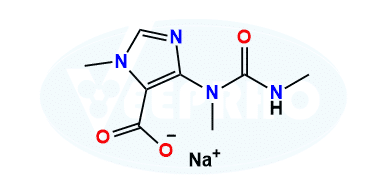 | Caffeine Impurity 1 (Na Salt) | VE0013158 |