

- 100% accuracy of data
- 24/7 scientific support
- 0% tolerance in quality of product
Stock Locations
- New Jersey, USA
- Czech Republic, EUIn stock
* Stock subject to availability.
Documentation
Batch COA on file. The batch COA includes HPLC, MASS/LC-MS, 1H NMR, FT-IR, Potency, and Structure Elucidation Report (SER)..
75128-73-3
Acyclovir EP Impurity G
● In Stock
| Catalogue No.: | VL13011 |
|---|---|
| CAS No.: | 75128-73-3 |
| Mol. Formula: | C12H15N5O5 |
| Mol. Weight: | 309.28 g/mol |
For laboratory use only: analytical, development and regulatory purposes. Supplied in mg quantities. Not for human or veterinary use.
Request a quote for a set
- Request quote for this set
All EP impurities of Acyclovir
18 productsSee the 18 products
- Acyclovir EP Impurity A VL13001
CAS 102728-64-3 - Acyclovir EP Impurity B VL13014
CAS 73-40-5 - Acyclovir EP Impurity C VL13002
CAS 91702-61-3 - Acyclovir EP Impurity D VL13021
CAS 59277-91-7 - Acyclovir EP Impurity E VL13024
CAS 374697-95-7 - Acyclovir EP Impurity F VL13007
CAS 110104-37-5 - Acyclovir EP Impurity G VL13011
CAS 75128-73-3 - Acyclovir EP Impurity H VL13022
CAS 133186-23-9 - Acyclovir EP Impurity I VL13020
CAS 1797832-75-7 - Acyclovir EP Impurity J VL13004
CAS 166762-90-9 - Acyclovir EP Impurity K VL13005
CAS 1797131-64-6 - Acyclovir EP Impurity L VL13013
CAS 3056-33-5 - Acyclovir EP Impurity M VL13016
CAS 91702-60-2 - Acyclovir EP Impurity O VL13017
CAS 2190509-40-9 - Acyclovir EP Impurity P VL13012
CAS 23169-33-7 - Acyclovir EP Impurity Q VL13023
- Acyclovir EP Impurity R VL13018
- Valaciclovir EP Impurity J VL149011
CAS 142963-63-1
- Acyclovir EP Impurity A VL13001
- Request quote for this set
All USP impurities of Acyclovir
5 productsSee the 5 products
- Acyclovir EP Impurity A VL13001
CAS 102728-64-3 - Acyclovir EP Impurity B VL13014
CAS 73-40-5 - Acyclovir EP Impurity F VL13007
CAS 110104-37-5 - Acyclovir EP Impurity G VL13011
CAS 75128-73-3 - Valaciclovir EP Impurity J VL149011
CAS 142963-63-1
- Acyclovir EP Impurity A VL13001


Additional information on CAS 75128-73-3
| Parent drug | Acyclovir |
|---|---|
| Product type | Impurity standards |
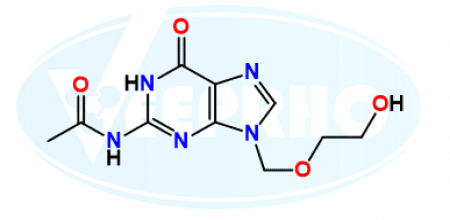
| IUPAC name | 2-[[2-(Acetylamino)-6-oxo-1,6-dihydro-9H-purin-9-yl]methoxy]ethyl acetate |
| EP name | Acyclovir EP Impurity G |
| USP name | Acyclovir Related Compound G |
| Pharmacopeial synonyms | Acyclovir Related Compound G |
| Other Synonyms | 9-Acetyl Acyclovir; Acyclovir N,O-Diacetate; Diacetyl Acyclovir; N-[9-[[2-(Acetyloxy)ethoxy]methyl]-6, 9-dihydro-6-oxo-1H-purin-2-yl]acetamide; 9-[(2-Acetoxyethoxy)methyl]-N2-acetylguanine |
| SMILES | CC(=O)Nc2nc1c(ncn1COCCOC(C)=O)c(=O)[nH]2 |
| InChI | InChI=1S/C12H15N5O5/c1-7(18)14-12-15-10-9(11(20)16-12)13-5-17(10)6-21-3-4-22-8(2)19/h5H,3-4,6H2,1-2H3,(H2,14,15,16,18,20) |
| InChIKey | VBHLKZHSCMQLTI-UHFFFAOYSA-N |
| CHNS Ratio (%) (calculated) | C 46.60 · H 4.89 · N 22.64 · S 0.00 |
| Shipping condition | Ambient Temperature |
| References | Darville | J. M. | et al. “Development | Evaluation and Application of an Isocratic High-Performance Liquid Chromatography (HPLC) Assay for the Simultaneous Determination of Aciclovir and Its Metabolite 9-Carboxymethoxymethylguanine in Human Serum and Cerebrospinal Fluid.” International Journal of Antimicrobial Agents | vol. 30 | no. 1 | July 2007 | pp. 30–33 | https://doi.org/10.1016/j.ijantimicag.2007.02.005. Huidobro | A. L. | et al. “LC Methods for Acyclovir and Related Impurities Determination.” Jour |
| Additional characterisation data | QNMR, D2O Exchange, 13C NMR, 13C APT, COSY NMR, NOESY NMR, 15N NMR, HSQC NMR, HMQC NMR, and HMBC NMR. These are available upon request and may be free or subject to additional charges. |
| Description | Acyclovir EP Impurity G, also designated Acyclovir Related Compound G, 9-Acetyl Acyclovir, Acyclovir N,O-Diacetate, or Diacetyl Acyclovir, CAS 75128-73-3, is a diacetylated acyclic guanine nucleoside derivative with molecular formula C12H15N5O5 and molecular weight 309.28 g/mol. Structurally, it represents an N2- and O-acetylated acetylation product of acyclovir, typically arising from over-acetylation during synthesis or from acetyl-transfer mediated degradation under acylating conditions. Because it is a closely related process impurity rather than a classical mutagenic alert, characterization generally relies on LC-MS/MS, HPLC with diode-array detection, and, when needed, NMR confirmation. |
Request a Quote
"*" indicates required fields