
- 100% accuracy of data
- 24/7 scientific support
- 0% tolerance in quality of product
Stock Locations
- New Jersey, USA
- Czech Republic, EU
* Stock subject to availability.
Documentation
Includes: HPLC, MASS/LC-MS, 1H NMR, FT-IR, Potency, Structure Elucidation Report (SER), and additional analytical data depending on the product.
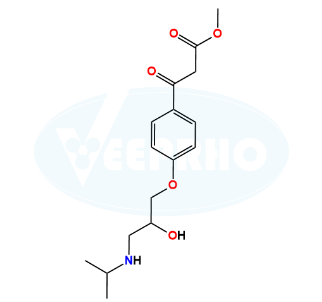
Methyl 3-(4-(2-hydroxy-3-(isopropylamino)propoxy)phenyl)-3-oxopropanoate
● In Stock
| Catalogue No.: | VE0028291 |
|---|---|
| CAS No.: | N/A |
| Mol. Formula: | C16H23NO5 |
| Mol. Weight: | 309.36 g/mol |
For laboratory use only: analytical, development and regulatory purposes. Supplied in mg quantities. Not for human or veterinary use.
Additional information on Methyl 3-(4-(2-hydroxy-3-(isopropylamino)propoxy)phenyl)-3-oxopropanoate
| Parent drug | Metoprolol |
|---|---|
| Product type | Impurity standards |
| IUPAC name | Methyl 3-(4-(2-hydroxy-3-(isopropylamino)propoxy)phenyl)-3-oxopropanoate |
| SMILES | O=C(OC)CC(C1=CC=C(OCC(O)CNC(C)C)C=C1)=O |
| InChI | InChI=1S/C16H23NO5/c1-11(2)17-9-13(18)10-22-14-6-4-12(5-7-14)15(19)8-16(20)21-3/h4-7,11,13,17-18H,8-10H2,1-3H3 |
| InChIKey | LDJBWTUZKHXWAD-UHFFFAOYSA-N |
| CHNS Ratio (%) (calculated) | C 62.12 · H 7.49 · N 4.53 · S 0.00 |
| Description | Methyl 3-(4-(2-hydroxy-3-(isopropylamino)propoxy)phenyl)-3-oxopropanoate is a process-related impurity characterized by a methyl ester and beta-keto moiety adjacent to a para-substituted phenyl ether bearing a secondary isopropylamino alcohol. Its mixed polar-lipophilic profile can produce intermediate retention in reversed-phase HPLC and strong ionization in LC-MS, facilitating trace-level detection. Likely formed through incomplete esterification or side-chain alkylation during synthesis, it may undergo hydrolytic cleavage or keto-enol tautomerism under acidic or basic conditions. Recommended analytical approaches include gradient reversed-phase HPLC with MS detection, orthogonal confirmation by 1H and 13C NMR, and forced degradation studies to establish stability and specification limits. |
Request a Quote
"*" indicates required fields
Other products related to Metoprolol impurities
| Impurity structure | Name of Impurity | Catalogue No. |
|---|---|---|
| Betaxolol EP Impurity B (Free Base) | VL103014 | |
| Bisoprolol EP Impurity L | VL191001 | |
| Dinitroso Metoprolol EP Impurity M | VE0027788 | |
| Metoprolol EP Impurity A | VL103001 | |
 | Metoprolol EP Impurity A (HCl Salt) | VE0010647 |
| Metoprolol EP Impurity B | VL103012 | |
| Metoprolol EP Impurity C (Maleate Salt) | VE0021438 | |
| Metoprolol EP Impurity C (Oxalate Salt) | VE0021432 | |
| Metoprolol EP Impurity D | VL103007 | |
| Metoprolol EP Impurity E | VE006518 | |
| Metoprolol EP Impurity F | VL103013 | |
| Metoprolol EP Impurity G | VL103002 |
Show all related products N-Nitroso Metoprolol impurities (8)