
- 100% accuracy of data
- 24/7 scientific support
- 0% tolerance in quality of product
Mutagenicity assessment (ICH M7)
Potentially mutagenic impurity (ICH M7 Class 1–3).
N-nitroso compound: ICH M7 cohort of concern.Stock Locations
- New Jersey, USA
- Czech Republic, EU
* Stock subject to availability.
Documentation
Includes: HPLC, MASS/LC-MS, 1H NMR, FT-IR, Potency, Structure Elucidation Report (SER), and additional analytical data depending on the product.
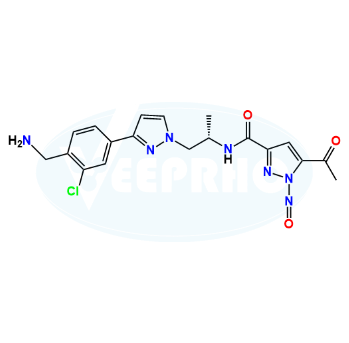
N-Nitroso Darolutamide Amine Impurity
● Report Available Immediately
| Catalogue No.: | VE0027832 |
|---|---|
| CAS No.: | N/A |
| Mol. Formula: | C19H20ClN7O3 |
| Mol. Weight: | 429.86 g/mol |
For laboratory use only: analytical, development and regulatory purposes. Supplied in mg quantities. Not for human or veterinary use.
Request a quote for a set
- Request quote for this set
All nitrosamine impurities of Darolutamide
14 productsSee the 14 products
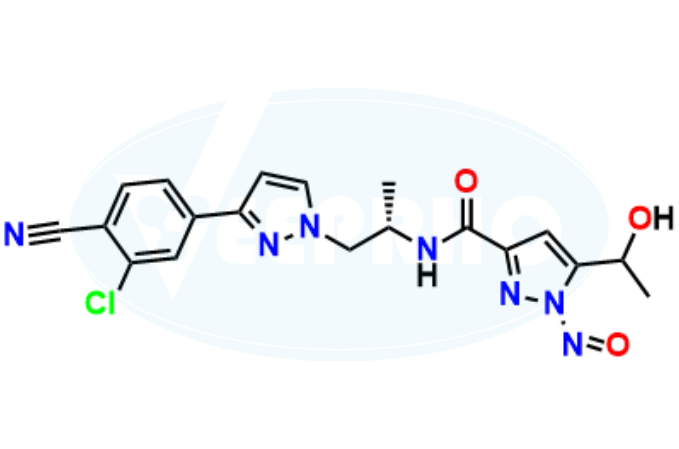
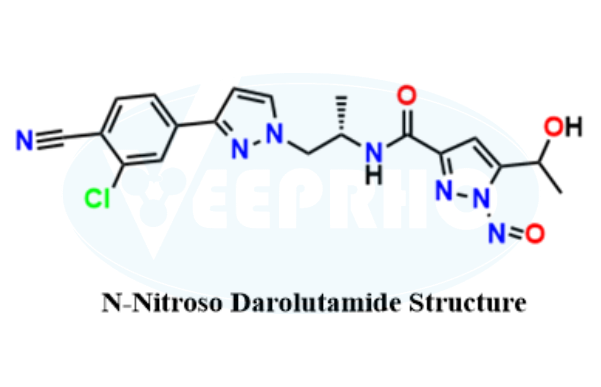
- N-Nitroso Darolutamide VE0027833
- N-Nitroso Darolutamide; Synthesis Attempts and Failure Report (NAP Test) VE0027871
- N-Nitroso Darolutamide Amide Impurity VE0027831
- N-Nitroso Darolutamide Amide Impurity; Synthesis Attempts and Failure Report (NAP Test) VE0027873
- N-Nitroso Darolutamide Amine Impurity VE0027832
- N-Nitroso Darolutamide Amine Impurity; Synthesis Attempts and Failure Report (NAP Test) VE0027878
- N-Nitroso Darolutamide Benzamide Impurity VE0027835
- N-Nitroso Darolutamide Benzamide Impurity; Synthesis Attempts and Failure Report (NAP Test) VE0027876
- N-Nitroso Darolutamide Impurity 1 VE0027836
- N-Nitroso Darolutamide Impurity 1; Synthesis Attempts and Failure Report (NAP Test) VE0027879
- (S)-N-(1-(3-(3-chloro-4-cyanophenyl)-1H-pyrazol-1-yl)propan-2-yl)-5-(hydroxymethyl)-1-nitroso-1,6-dihydropyridazine-3-carboxamide VE0010234
- N-Nitroso Darolutamide Pyrazole Benzonitrile Impurity VE0024847
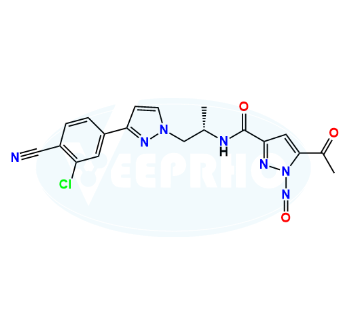
- 5-acetyl-1-nitroso-1H-pyrazole-3-carboxylic acid VE0027834
- 5-acetyl-1-nitroso-1H-pyrazole-3-carboxylic acid; Synthesis Attempts and Failure Report (NAP Test) VE0027875
- Request quote for this set
This impurity and its failure report
2 productsSee the 2 products
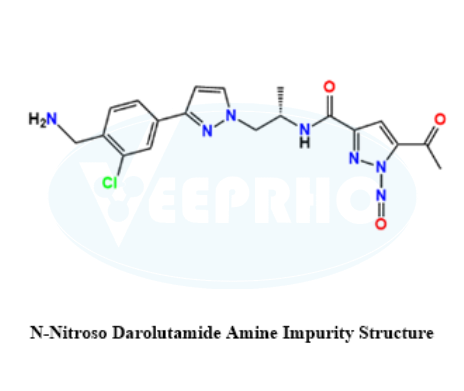
Additional information on N-Nitroso Darolutamide Amine Impurity
| Parent drug | Darolutamide |
|---|---|
| Product type | Impurity standards, Nitroso impurities |
| IUPAC name | (S)-5-acetyl-N-(1-(3-(4-(aminomethyl)-3-chlorophenyl)-1H-pyrazol-1-yl)propan-2-yl)-1-nitroso-1H-pyrazole-3-carboxamide |
| SMILES | ClC1=C(CN)C=CC(C2=NN(C=C2)C[C@H](C)NC(C3=NN(N=O)C(C(C)=O)=C3)=O)=C1 |
| InChI | InChI=1S/C19H20ClN7O3/c1-11(22-19(29)17-8-18(12(2)28)27(24-17)25-30)10-26-6-5-16(23-26)13-3-4-14(9-21)15(20)7-13/h3-8,11H,9-10,21H2,1-2H3,(H,22,29)/t11-/m0/s1 |
| InChIKey | QYAVHEGQPHFGIH-NSHDSACASA-N |
| CHNS Ratio (%) (calculated) | C 53.09 · H 4.69 · N 22.81 · S 0.00 |
| Description | N-Nitroso Darolutamide Amine Impurity is a nitrosamine-related degradant formed by nitrosation of darolutamide's amine moiety, raising genotoxicity and regulatory concern. Chemically characterized by an N-nitroso functional group, the impurity can arise during synthesis, purification or storage when nitrosating agents, nitrites or acidic conditions are present. Analytical control relies on sensitive LC-MS/MS and GC-MS methods with sample enrichment, stable isotope dilution and validated limits of detection. Risk mitigation includes raw material screening, control of nitrite levels, pH management, scavengers and optimized workup, coupled with forced degradation studies and stability testing to support specification setting and batch release decisions. |
Request a Quote
"*" indicates required fields