
- 100% accuracy of data
- 24/7 scientific support
- 0% tolerance in quality of product
Mutagenicity assessment (ICH M7)
Potentially mutagenic impurity (ICH M7 Class 1–3).
N-nitroso compound: ICH M7 cohort of concern.Stock Locations
- New Jersey, USA
- Czech Republic, EU
* Stock subject to availability.
Documentation
Includes: HPLC, MASS/LC-MS, 1H NMR, FT-IR, Potency, Structure Elucidation Report (SER), and additional analytical data depending on the product.
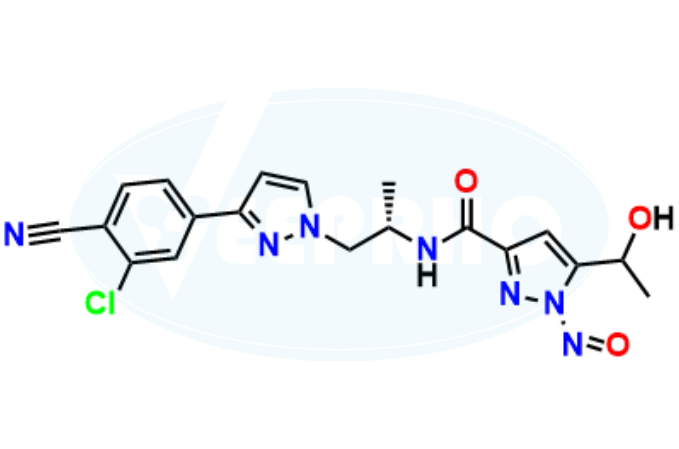
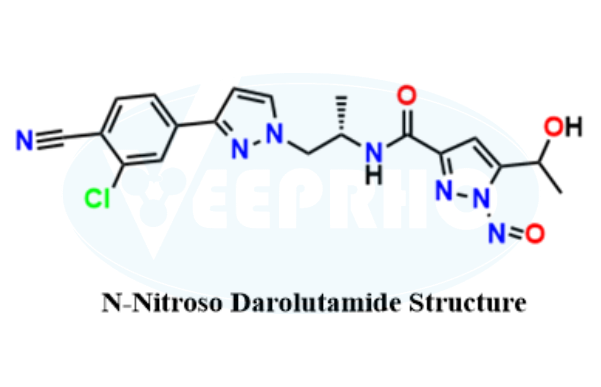
N-Nitroso Darolutamide
● Report Available Immediately
| Catalogue No.: | VE0027833 |
|---|---|
| CAS No.: | N/A |
| Mol. Formula: | C19H18ClN7O3 |
| Mol. Weight: | 427.84 g/mol |
For laboratory use only: analytical, development and regulatory purposes. Supplied in mg quantities. Not for human or veterinary use.
Request a quote for a set
- Request quote for this set
All nitrosamine impurities of Darolutamide
14 productsSee the 14 products
- N-Nitroso Darolutamide VE0027833
- N-Nitroso Darolutamide; Synthesis Attempts and Failure Report (NAP Test) VE0027871
- N-Nitroso Darolutamide Amide Impurity VE0027831
- N-Nitroso Darolutamide Amide Impurity; Synthesis Attempts and Failure Report (NAP Test) VE0027873
- N-Nitroso Darolutamide Amine Impurity VE0027832
- N-Nitroso Darolutamide Amine Impurity; Synthesis Attempts and Failure Report (NAP Test) VE0027878
- N-Nitroso Darolutamide Benzamide Impurity VE0027835
- N-Nitroso Darolutamide Benzamide Impurity; Synthesis Attempts and Failure Report (NAP Test) VE0027876
- N-Nitroso Darolutamide Impurity 1 VE0027836
- N-Nitroso Darolutamide Impurity 1; Synthesis Attempts and Failure Report (NAP Test) VE0027879
- (S)-N-(1-(3-(3-chloro-4-cyanophenyl)-1H-pyrazol-1-yl)propan-2-yl)-5-(hydroxymethyl)-1-nitroso-1,6-dihydropyridazine-3-carboxamide VE0010234
- N-Nitroso Darolutamide Pyrazole Benzonitrile Impurity VE0024847
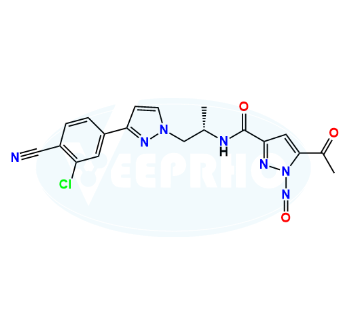
- 5-acetyl-1-nitroso-1H-pyrazole-3-carboxylic acid VE0027834
- 5-acetyl-1-nitroso-1H-pyrazole-3-carboxylic acid; Synthesis Attempts and Failure Report (NAP Test) VE0027875
- Request quote for this set
This impurity and its failure report
2 productsSee the 2 products
Additional information on N-Nitroso Darolutamide
| Parent drug | Darolutamide |
|---|---|
| Product type | Impurity standards, Nitroso impurities |
| IUPAC name | N-((S)-1-(3-(3-chloro-4-cyanophenyl)-1H-pyrazol-1-yl)propan-2-yl)-5-(1-hydroxyethyl)-1-nitroso-1H-pyrazole-3-carboxamide |
| SMILES | O=C(C(C=C1C(O)C)=NN1N=O)N[C@@H](C)CN2N=C(C3=CC=C(C#N)C(Cl)=C3)C=C2 |
| InChI | InChI=1S/C19H18ClN7O3/c1-11(22-19(29)17-8-18(12(2)28)27(24-17)25-30)10-26-6-5-16(23-26)13-3-4-14(9-21)15(20)7-13/h3-8,11-12,28H,10H2,1-2H3,(H,22,29)/t11-,12?/m0/s1 |
| InChIKey | QCHUEGVVFSGUNP-PXYINDEMSA-N |
| CHNS Ratio (%) (calculated) | C 53.34 · H 4.24 · N 22.92 · S 0.00 |
| Description | N-Nitroso Darolutamide impurity is a nitrosamine-related degradation and synthetic byproduct of darolutamide that presents a genotoxic risk requiring trace-level control. Formation pathways include nitrosation of secondary amines in the presence of nitrite or nitrosating reagents during synthesis, workup, or storage. Analytical monitoring relies on highly sensitive LC-MS/MS or GC-MS methodologies with validated limits of quantitation in the low ppb range and orthogonal confirmation. Effective control strategies encompass precursor restriction, nitrite control, solvent selection, pH management, scavengers and optimized purification to achieve adequate purge factors. Stability testing, batch-wise release testing and risk-based specification setting align with current regulatory expectations for nitrosamine impurities. |
Request a Quote
"*" indicates required fields