
- 100% accuracy of data
- 24/7 scientific support
- 0% tolerance in quality of product
Mutagenicity assessment (ICH M7)
Potentially mutagenic impurity (ICH M7 Class 1–3).
N-nitroso compound: ICH M7 cohort of concern.Stock Locations
- New Jersey, USA
- Czech Republic, EU
* Stock subject to availability.
Documentation
Includes: HPLC, MASS/LC-MS, 1H NMR, FT-IR, Potency, Structure Elucidation Report (SER), and additional analytical data depending on the product.
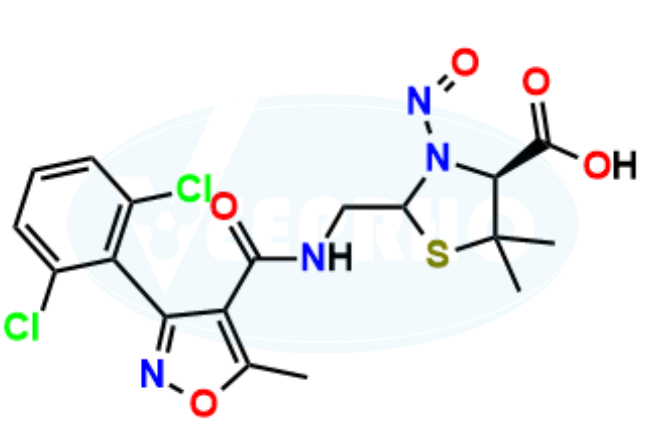
N-Nitroso-Dicloxacillin Penilloic Acid
● In Stock
| Catalogue No.: | VE0026073 |
|---|---|
| CAS No.: | N/A |
| Mol. Formula: | C18H18Cl2N4O5S |
| Mol. Weight: | 473.33 g/mol |
For laboratory use only: analytical, development and regulatory purposes. Supplied in mg quantities. Not for human or veterinary use.
Request a quote for a set
- Request quote for this set
All nitrosamine impurities of Dicloxacillin Sodium
2 productsSee the 2 products
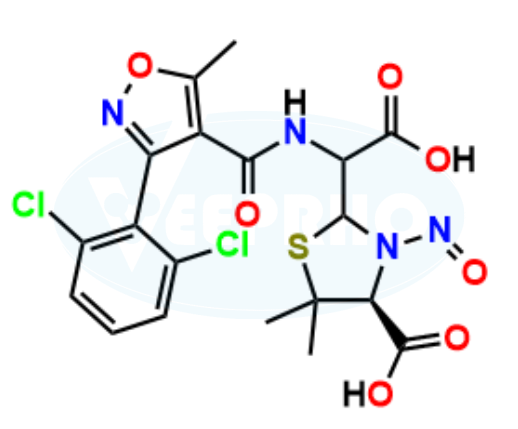
- N-Nitroso-Dicloxacillin Penicilloic Acid VE0026071
- N-Nitroso-Dicloxacillin Penilloic Acid VE0026073
Additional information on N-Nitroso-Dicloxacillin Penilloic Acid
| Parent drug | Dicloxacillin |
|---|---|
| Product type | Impurity standards, Nitroso impurities |
| IUPAC name | (4S)-2-((3-(2,6-dichlorophenyl)-5-methylisoxazole-4-carboxamido)methyl)-5,5-dimethyl-3-nitrosothiazolidine-4-carboxylic acid |
| SMILES | CC1=C(C(NCC2SC(C)(C)[C@H](C(O)=O)N2N=O)=O)C(C3=C(Cl)C=CC=C3Cl)=NO1 |
| InChI | InChI=1S/C18H18Cl2N4O5S/c1-8-12(14(22-29-8)13-9(19)5-4-6-10(13)20)16(25)21-7-11-24(23-28)15(17(26)27)18(2,3)30-11/h4-6,11,15H,7H2,1-3H3,(H,21,25)(H,26,27)/t11?,15-/m0/s1 |
| InChIKey | RBLHYMULWKWQHI-MHTVFEQDSA-N |
| CHNS Ratio (%) (calculated) | C 45.68 · H 3.83 · N 11.84 · S 6.77 |
| Description | N-Nitroso-Dicloxacillin Penilloic Acid is a nitrosamine-class impurity encountered in dicloxacillin degradation and manufacturing impurity profiles; it is characterized by a polar, low molecular weight structure and is monitored due to potential genotoxicity risks. Analytical control relies on trace-level quantitation using validated high-sensitivity techniques such as LC-MS/MS with appropriate sample preparation and stable isotope internal standards for accuracy. Inclusion in stability studies and impurity profiling supports specification setting, root-cause investigation, and regulatory compliance with ICH and EMA guidance. Certified reference material typically includes purity assessment, chromatographic behaviour, and recommended reporting limits to facilitate robust risk assessment and batch release testing. |
Request a Quote
"*" indicates required fields