
- 100% accuracy of data
- 24/7 scientific support
- 0% tolerance in quality of product
Mutagenicity assessment (ICH M7)
Potentially mutagenic impurity (ICH M7 Class 1–3).
N-nitroso compound: ICH M7 cohort of concern.EMA100 ng/dayAppendix 1 Rev. 14
Stock Locations
- New Jersey, USA
- Czech Republic, EUIn stock
* Stock subject to availability.
Documentation
Batch COA on file. The batch COA includes HPLC, MASS/LC-MS, 1H NMR, FT-IR, Potency, and Structure Elucidation Report (SER)..
3033377-17-9
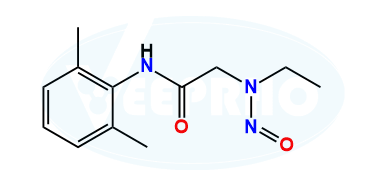
N-Nitroso Lidocaine EP Impurity D
● In Stock
| Catalogue No.: | VE0017293 |
|---|---|
| CAS No.: | 3033377-17-9 |
| Mol. Formula: | C12H17N3O2 |
| Mol. Weight: | 235.28 g/mol |
For laboratory use only: analytical, development and regulatory purposes. Supplied in mg quantities. Not for human or veterinary use.
Request a quote for a set
- Request quote for this set
All nitrosamine impurities of Lidocaine
8 productsSee the 8 products
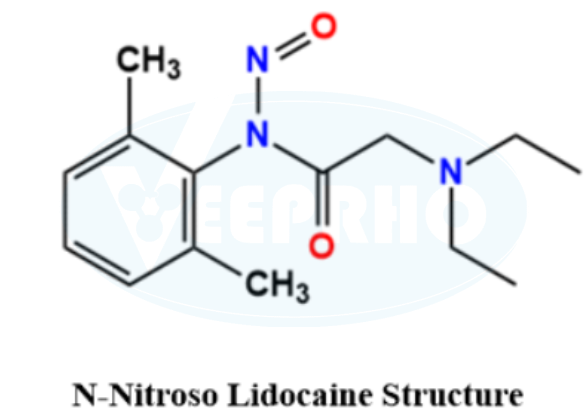
- N-Nitroso Lidocaine VE0024811
- N-Nitroso Lidocaine; Synthesis Attempts and Failure Report (NAP Test) VE0028705
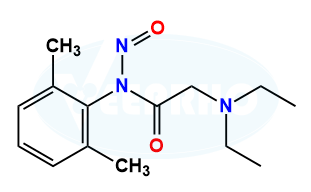
- N-Nitroso Lidocaine EP Impurity C VE0025007
CAS 86756-31-2 - N-Nitroso Lidocaine EP Impurity D VE0017293
CAS 3033377-17-9 - N-Nitroso Lidocaine EP Impurity E VE0017294
- N-Nitroso Lidocaine EP Impurity G VE0017297
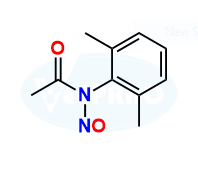
- N-Nitroso Lidocaine Impurity 1 VE007838
- N2-Nitroso-N2-Desethyl Lidocaine EP Impurity I VE0025008
Additional information on CAS 3033377-17-9
| Parent drug | Lidocaine |
|---|---|
| Product type | Impurity standards, Nitroso impurities |
| IUPAC name | N-(2,6-dimethylphenyl)-2-(ethyl(nitroso)amino)acetamide |
| Other Synonyms | N-Nitroso N-desethyl Lidocaine |
| SMILES | O=C(NC1=C(C)C=CC=C1C)CN(CC)N=O |
| InChI | InChI=1S/C12H17N3O2/c1-4-15(14-17)8-11(16)13-12-9(2)6-5-7-10(12)3/h5-7H,4,8H2,1-3H3,(H,13,16) |
| InChIKey | LXGSIIROBBPXOV-UHFFFAOYSA-N |
| CHNS Ratio (%) (calculated) | C 61.26 · H 7.28 · N 17.86 · S 0.00 |
| Shipping condition | Ambient Temperature |
| References | - |
| Additional characterisation data | QNMR, D2O Exchange, 13C NMR, 13C APT, COSY NMR, NOESY NMR, 15N NMR, HSQC NMR, HMQC NMR, and HMBC NMR. These are available upon request and may be free or subject to additional charges. |
| Description | N-Nitroso Lidocaine EP Impurity D, also described as N-Nitroso N-desethyl Lidocaine, is a nitrosamine-related process and degradation impurity of lidocaine derivatives, assigned CAS 3033377-17-9. With molecular formula C12H17N3O2 and molecular weight 235.28 g/mol, it contains the characteristic N-nitroso functionality associated with class-based concern for mutagenic and genotoxic risk under ICH M7 principles. Formation may arise during nitrosation of tertiary or secondary amine precursors, or from downstream conversion of desethylated intermediates. Trace-level determination typically requires LC-MS/MS or, where appropriate, GC-MS with selective ion monitoring and validated low-level impurity methodology. |
Request a Quote
"*" indicates required fields
Other products related to Lidocaine and Nitroso impurities
| Impurity structure | Name of Impurity | Catalogue No. |
|---|---|---|
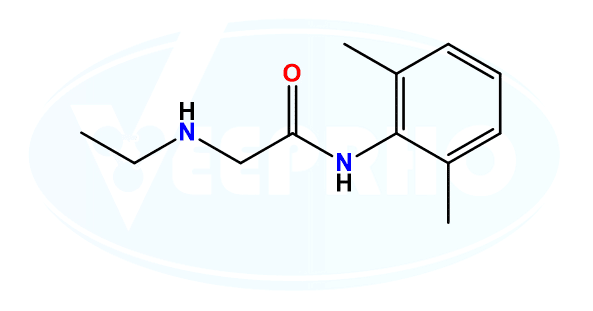 | Lidocaine BP Impurity D | VL1040004 |
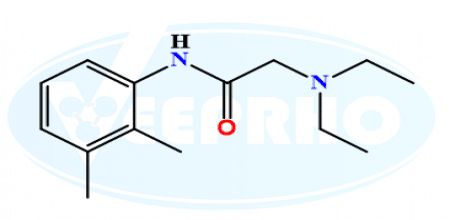 | Lidocaine BP Impurity F | VL1040020 |
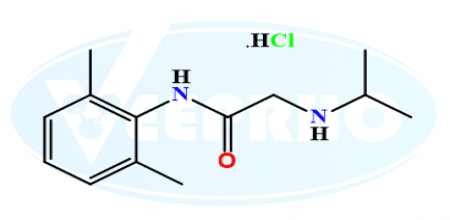 | Lidocaine BP Impurity G | VL1040007 |
| Lidocaine BP Impurity K | VL1040019 | |
| Lidocaine EP Impurity A | VL1040001 | |
| Lidocaine EP Impurity B | VL1040002 | |
| Lidocaine EP Impurity C | VL1040003 | |
| Lidocaine EP Impurity D (HCl Salt) | VE0010174 | |
| Lidocaine EP Impurity E | VL1040005 | |
| Lidocaine EP Impurity E (HCl Salt) | VE0022727 | |
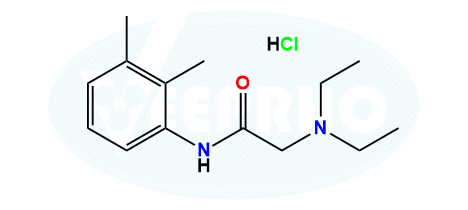 | Lidocaine EP Impurity F | VE0016064 |
| Lidocaine EP Impurity G | VE0016063 |
Show all related products N-Nitroso Lidocaine impurities (7)