
- 100% accuracy of data
- 24/7 scientific support
- 0% tolerance in quality of product
Stock Locations
- New Jersey, USA
- Czech Republic, EU
* Stock subject to availability.
Documentation
Includes: HPLC, MASS/LC-MS, 1H NMR, FT-IR, Potency, Structure Elucidation Report (SER), and additional analytical data depending on the product.
1416402-13-5
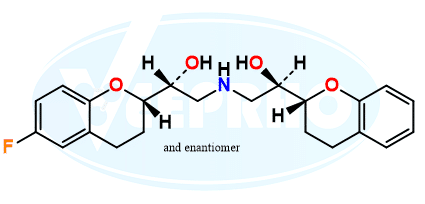
Nebivolol EP Impurity A
● In Stock
| Catalogue No.: | VE0011504 |
|---|---|
| CAS No.: | 1416402-13-5 |
| Mol. Formula: | C22H26FNO4 |
| Mol. Weight: | 387.44 g/mol |
For laboratory use only: analytical, development and regulatory purposes. Supplied in mg quantities. Not for human or veterinary use.
Request a quote for a set
- Request quote for this set
All EP impurities of Nebivolol
6 productsSee the 6 products
- Benzalkonium Chloride EP Impurity A VL3850030
CAS 100-51-6 - Nebivolol EP Impurity A VE0011504
CAS 1416402-13-5 - Nebivolol EP Impurity B VE0011506
CAS 99200-09-6 - Nebivolol EP Impurity C VE0011505
- Nebivolol EP Impurity D VE009079
CAS 119365-22-9 - rac N-Benzyl Nebivolol VE007764
CAS 929706-85-4
- Benzalkonium Chloride EP Impurity A VL3850030


Additional information on CAS 1416402-13-5
| Parent drug | Nebivolol |
|---|---|
| Product type | Impurity standards |
| IUPAC name | (1RS)-1-[(2RS)-3,4-dihydro-2H-1-Benzopyran-2-yl]-2-[[(2RS)-2-[(2SR)-6-fluoro-3,4-dihydro-2H-1-benzopyran-2-yl]-2-hydroxyethyl]amino]ethan-1-ol |
| EP name | Nebivolol EP Impurity A |
| SMILES | O[C@H](CNC[C@@H](O)[C@H]1CCc2ccccc2O1)[C@@H]1CCc2cc(F)ccc2O1 |
| InChIKey | JMAVJQLYDMPPMQ-YHBROIRLSA-N |
| CHNS Ratio (%) (calculated) | C 68.20 · H 6.76 · N 3.62 · S 0.00 |
| Description | Nebivolol EP Impurity A (CAS 1416402-13-5) is a structurally defined process-related related substance of nebivolol, corresponding to the molecular formula C22H26FNO4 and molecular weight 387.44 g/mol. Its composition indicates a fluorinated aromatic beta-blocker derivative bearing the characteristic ether and alcohol functionalities of the parent scaffold, consistent with a synthetic intermediate, side product, or transformation product arising during preparation or storage. Because such trace impurities can influence impurity profiling under pharmacopeial and ICH control strategies, characterization typically relies on LC-MS/MS, high-resolution LC-MS, and impurity-resolved HPLC with UV or PDA detection, with NMR used for structural confirmation. |
Request a Quote
"*" indicates required fields
Other products related to Nebivolol impurities
| Impurity structure | Name of Impurity | Catalogue No. |
|---|---|---|
| Nebivolol EP Impurity B | VE0011506 | |
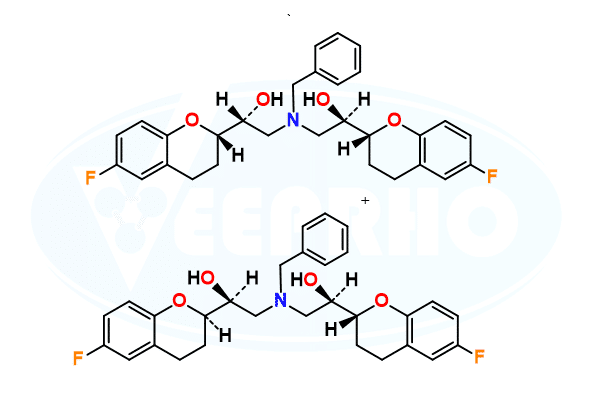 | Nebivolol EP Impurity C | VE0011505 |
| Nebivolol EP Impurity D | VE009079 | |
| Nebivolol Related Compound A | VL490001 | |
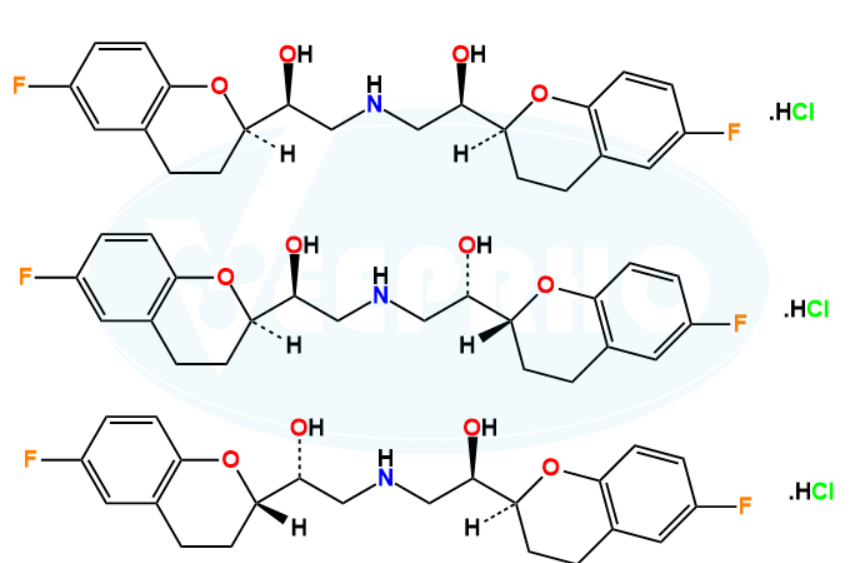 | Nebivolol Related Compound A (HCl salt) | VE0021510 |
 | Nebivolol Related Compound A (RSSR + SRRS) | VE0011620 |
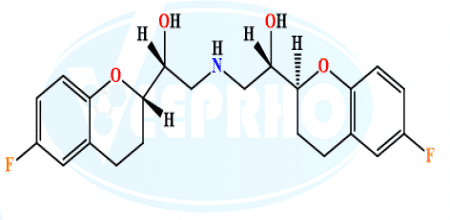 | Nebivolol Related Compound B | VL490002 |
| Nebivolol Related Compound C | VE006876 | |
| Nebivolol Related Compound D | VE006877 | |
| (2S, 2’S)-6-Fluoro-2-(2’-oxiranyl)chromane | VE008863 | |
| (2S)-2-(6-Fluorochroman-2-yl)-2-Hydroxyethyl Acetate | VE0025579 | |
| (R)-1-((S)-Chroman-2-yl)-2-(((R)-2-((R)-6-fluorochroman-2-yl)-2-hydroxyethyl)amino)ethan-1-ol Hydrochloride | VE0021616 |
Show all related products N-Nitroso Nebivolol impurities (2)