
- 100% accuracy of data
- 24/7 scientific support
- 0% tolerance in quality of product
Stock Locations
- New Jersey, USA
- Czech Republic, EU
* Stock subject to availability.
Documentation
Includes: HPLC, MASS/LC-MS, 1H NMR, FT-IR, Potency, Structure Elucidation Report (SER), and additional analytical data depending on the product.
119365-22-9
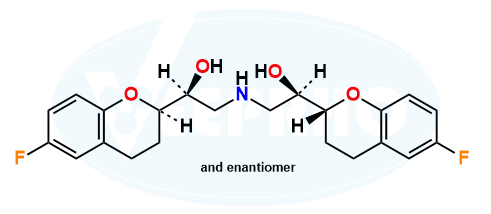
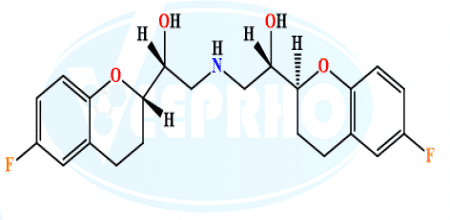
Nebivolol EP Impurity D
● In Stock
| Catalogue No.: | VE009079 |
|---|---|
| CAS No.: | 119365-22-9 |
| Mol. Formula: | C22H25F2NO4 |
| Mol. Weight: | 405.4 g/mol |
For laboratory use only: analytical, development and regulatory purposes. Supplied in mg quantities. Not for human or veterinary use.
Request a quote for a set
- Request quote for this set
All EP impurities of Nebivolol
6 productsSee the 6 products
- Benzalkonium Chloride EP Impurity A VL3850030
CAS 100-51-6 - Nebivolol EP Impurity A VE0011504
CAS 1416402-13-5 - Nebivolol EP Impurity B VE0011506
CAS 99200-09-6 - Nebivolol EP Impurity C VE0011505
- Nebivolol EP Impurity D VE009079
CAS 119365-22-9 - rac N-Benzyl Nebivolol VE007764
CAS 929706-85-4
- Benzalkonium Chloride EP Impurity A VL3850030


Additional information on CAS 119365-22-9
| Parent drug | Nebivolol |
|---|---|
| Product type | Impurity standards |
| IUPAC name | (1RS)-1-[(2RS)-6-fluoro-3,4-dihydro-2H-1-benzopyran-2-yl]-2-[[(2SR)-2-[(2RS)-6-fluoro-3,4-dihydro-2H-1-benzopyran-2-yl]-2-hydroxyethyl]amino]ethan-1-ol |
| EP name | Nebivolol EP Impurity D |
| SMILES | O[C@H](CNC[C@H](O)[C@H]1CCc2cc(F)ccc2O1)[C@H]1CCc2cc(F)ccc2O1 |
| InChIKey | KOHIRBRYDXPAMZ-GMQQQROESA-N |
| CHNS Ratio (%) (calculated) | C 65.17 · H 6.22 · N 3.45 · S 0.00 |
| References | - |
| Description | Nebivolol EP Impurity D (CAS 119365-22-9) is a defined process-related impurity associated with the nebivolol scaffold and is structurally represented by C22H25F2NO4, molecular weight 405.4 g/mol. Its polar aryloxypropanolamine framework and difluorophenyl substitution indicate origin from incomplete coupling, side-chain rearrangement, or stereochemical drift during multistep synthesis. In regulatory impurity profiling, such species are assessed in the context of ICH Q3A and related impurity control expectations. Detection and quantification typically require orthogonal techniques, including LC-MS/MS for trace-level assignment and HPLC with diode-array or charged aerosol detection, with NMR used for structural confirmation when needed. |
Request a Quote
"*" indicates required fields
Other products related to Nebivolol impurities
| Impurity structure | Name of Impurity | Catalogue No. |
|---|---|---|
| Nebivolol EP Impurity A | VE0011504 | |
| Nebivolol EP Impurity B | VE0011506 | |
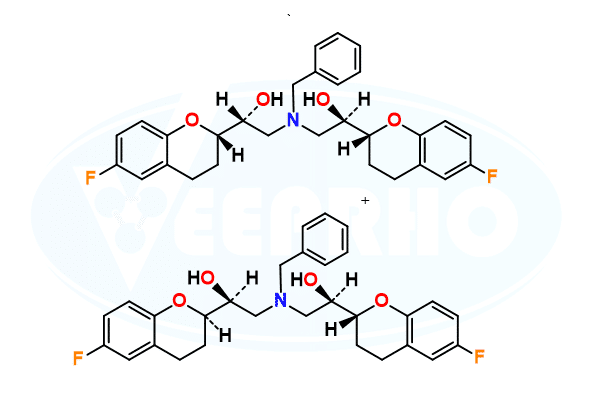 | Nebivolol EP Impurity C | VE0011505 |
| Nebivolol Related Compound A | VL490001 | |
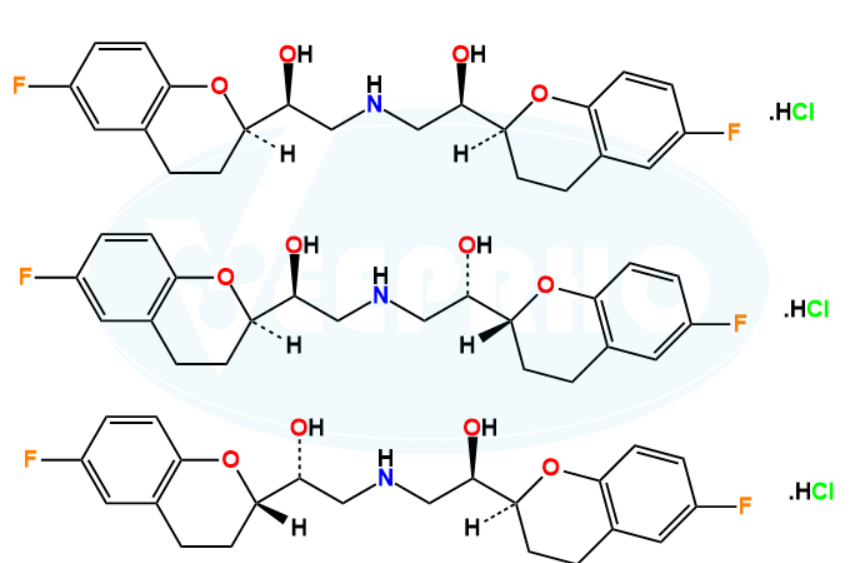 | Nebivolol Related Compound A (HCl salt) | VE0021510 |
 | Nebivolol Related Compound A (RSSR + SRRS) | VE0011620 |
 | Nebivolol Related Compound B | VL490002 |
| Nebivolol Related Compound C | VE006876 | |
| Nebivolol Related Compound D | VE006877 | |
| (2S, 2’S)-6-Fluoro-2-(2’-oxiranyl)chromane | VE008863 | |
| (2S)-2-(6-Fluorochroman-2-yl)-2-Hydroxyethyl Acetate | VE0025579 | |
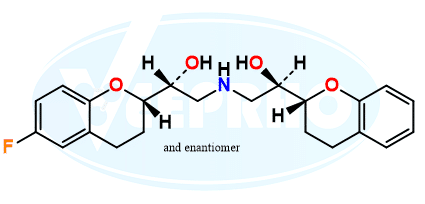
| (R)-1-((S)-Chroman-2-yl)-2-(((R)-2-((R)-6-fluorochroman-2-yl)-2-hydroxyethyl)amino)ethan-1-ol Hydrochloride | VE0021616 |
Show all related products N-Nitroso Nebivolol impurities (2)