
- 100% accuracy of data
- 24/7 scientific support
- 0% tolerance in quality of product
Mutagenicity assessment (ICH M7)
Treated as a potentially non-mutagenic impurity (ICH M7 Class 4–5).
Computational (in silico) assessmentStock Locations
- New Jersey, USA
- Czech Republic, EU
* Stock subject to availability.
Documentation
Includes: HPLC, MASS/LC-MS, 1H NMR, FT-IR, Potency, Structure Elucidation Report (SER), and additional analytical data depending on the product.
887196-30-7
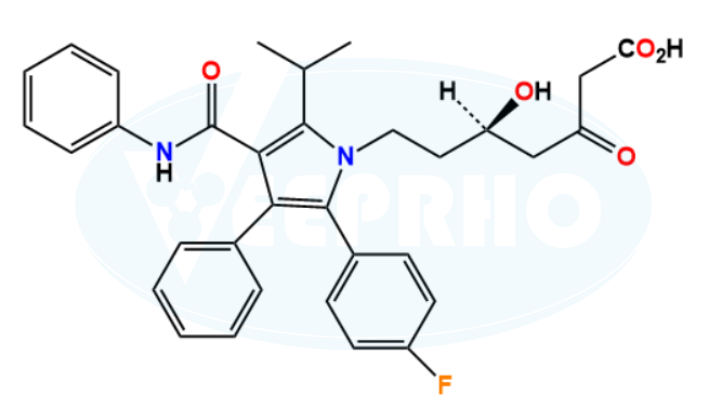
Atorvastatin EP Impurity O (Free Base)
● In Stock
| Catalogue No.: | VE009989 |
|---|---|
| CAS No.: | 887196-30-7 |
| Mol. Formula: | C33H33FN2O5 |
| Mol. Weight: | 556.62 g/mol |
For laboratory use only: analytical, development and regulatory purposes. Supplied in mg quantities. Not for human or veterinary use.
Request a quote for a set
- Request quote for this set
All EP impurities of Atorvastatin
28 productsSee the 28 products
- Atorvastatin EP Impurity A VE008745
CAS 433289-84-0 - Atorvastatin EP Impurity A (Ca salt) VL10004
CAS 433289-83-9 - Atorvastatin EP Impurity B (Free Base) VE009319
CAS 842103-12-2 - Atorvastatin EP Impurity C VE008906
CAS 693794-20-6 - Atorvastatin EP Impurity C (Na Salt) VE0012975
CAS 1807481-00-0 - Atorvastatin EP Impurity D (Impurity D1) VL10003
CAS 148146-51-4 - Atorvastatin EP Impurity E (Ca Salt) VL10006
CAS 1105067-88-6 - Atorvastatin EP Impurity E (Free Base) VE0012984
CAS 501121-34-2 - Atorvastatin EP Impurity E (Na Salt) VE009244
CAS 1428118-38-0 - Atorvastatin EP Impurity F (Ca Salt) VL10011
CAS 1105067-87-5 - Atorvastatin EP Impurity F (Free Base) VE006369
CAS 887196-24-9 - Atorvastatin EP Impurity F (sodium salt) VE006021
CAS 1371615-56-3 - Atorvastatin EP Impurity G VL10010
CAS 887196-29-4 - Atorvastatin EP Impurity G VE009827
CAS 887324-53-0 - Atorvastatin EP Impurity G VE0017910
- Atorvastatin EP Impurity H VL10002
CAS 125995-03-1 - Atorvastatin EP Impurity J VE008374
CAS 1105067-93-3 - Atorvastatin EP Impurity K VL10009
CAS 345891-62-5 - Atorvastatin EP Impurity N (Free Base) VL10013
CAS 134395-00-9 - Atorvastatin EP Impurity O (Free Base) VE009989
CAS 887196-30-7 - Atorvastatin EP Impurity O (Na Salt) VL10007
CAS 1391052-00-8 - Atorvastatin EP Impurity P (Free Base) VE006450
CAS 581772-29-4 - Atorvastatin Ethyl Ester VL10024
CAS 1146977-93-6 - Atorvastatin Pyrrolidone Analog (Free Base) VE006732
CAS 906552-18-9 - Atorvastatin Related Compound B VL10001
CAS 887196-25-0 - Atorvastatin Related Compound C (Ca Salt) VL10005
CAS 693793-53-2 - Atorvastatin Related Compound I VL10012
CAS 125971-95-1 - Atorvastatin Sodium Pyrrolidone Analog VL10019
CAS 148217-40-7
- Atorvastatin EP Impurity A VE008745


Additional information on CAS 887196-30-7
| Parent drug | Atorvastatin |
|---|---|
| Product type | Impurity standards |
| IUPAC name | (5R)-7-[2-(4-fluorophenyl)-3-phenyl-4-(phenylcarbamoyl)-5-(propan-2-yl)-1H-pyrrol-1-yl]-5-hydroxy-3-oxoheptanoic acid |
| EP name | Atorvastatin EP Impurity O |
| SMILES | CC(C)c1c(C(=O)Nc2ccccc2)c(-c2ccccc2)c(-c2ccc(F)cc2)n1CC[C@@H](O)CC(=O)CC(=O)O |
| InChIKey | JVFCMPKBFPIOON-AREMUKBSSA-N |
| CHNS Ratio (%) (calculated) | C 71.21 · H 5.98 · N 5.03 · S 0.00 |
| References | - |
| Description | Atorvastatin EP Impurity O, also designated 3-Oxo Atorvastatin Acid Impurity (Free Base), CAS 887196-30-7, is an oxidative degradant of the atorvastatin side-chain acid motif rather than a heterocyclic process impurity. With molecular formula C33H33FN2O5 and molecular weight 556.62 g/mol, it reflects ketone formation at the 3-position of the heptanoic acid segment while preserving the pyrrole and fluorophenyl pharmacophore. Its occurrence is typically associated with oxidative stress during synthesis, storage, or forced degradation. Characterization and assay generally require LC-MS/MS and orthogonal HPLC with UV or diode-array detection, with NMR confirmation when impurity profiling is needed. |
Request a Quote
"*" indicates required fields
Other products related to Atorvastatin impurities
| Impurity structure | Name of Impurity | Catalogue No. |
|---|---|---|
| Atorvastatin EP Impurity A | VE008745 | |
| Atorvastatin EP Impurity A (Ca salt) | VL10004 | |
 | Atorvastatin EP Impurity A (Na Salt) | VE0020562 |
| Atorvastatin EP Impurity B (Free Base) | VE009319 | |
| Atorvastatin EP Impurity C | VE008906 | |
 | Atorvastatin EP Impurity C (Na Salt) | VE0012975 |
| Atorvastatin EP Impurity D (Impurity D1) | VL10003 | |
 | Atorvastatin EP Impurity D (Mixture of D1 & D2) | VE0022694 |
| Atorvastatin EP Impurity E (Ca Salt) | VL10006 | |
| Atorvastatin EP Impurity E (Free Base) | VE0012984 | |
| Atorvastatin EP Impurity E (Na Salt) | VE009244 | |
| Atorvastatin EP Impurity F (Ca Salt) | VL10011 |
Show all related products N-Nitroso Atorvastatin impurities (14)