

- 100% accuracy of data
- 24/7 scientific support
- 0% tolerance in quality of product
Mutagenicity assessment (ICH M7)
Treated as a potentially non-mutagenic impurity (ICH M7 Class 4–5).
Computational (in silico) assessmentStock Locations
- New Jersey, USA
- Czech Republic, EUIn stock
* Stock subject to availability.
Documentation
Includes: HPLC, MASS/LC-MS, 1H NMR, FT-IR, Potency, Structure Elucidation Report (SER), and additional analytical data depending on the product.
581772-29-4
Atorvastatin EP Impurity P (Free Base)
● In Stock
| Catalogue No.: | VE006450 |
|---|---|
| CAS No.: | 581772-29-4 |
| Mol. Formula: | C36H39FN2O5 |
| Mol. Weight: | 598.70 g/mol |
For laboratory use only: analytical, development and regulatory purposes. Supplied in mg quantities. Not for human or veterinary use.
Request a quote for a set
- Request quote for this set
All EP impurities of Atorvastatin
28 productsSee the 28 products
- Atorvastatin EP Impurity A VE008745
CAS 433289-84-0 - Atorvastatin EP Impurity A (Ca salt) VL10004
CAS 433289-83-9 - Atorvastatin EP Impurity B (Free Base) VE009319
CAS 842103-12-2 - Atorvastatin EP Impurity C VE008906
CAS 693794-20-6 - Atorvastatin EP Impurity C (Na Salt) VE0012975
CAS 1807481-00-0 - Atorvastatin EP Impurity D (Impurity D1) VL10003
CAS 148146-51-4 - Atorvastatin EP Impurity E (Ca Salt) VL10006
CAS 1105067-88-6 - Atorvastatin EP Impurity E (Free Base) VE0012984
CAS 501121-34-2 - Atorvastatin EP Impurity E (Na Salt) VE009244
CAS 1428118-38-0 - Atorvastatin EP Impurity F (Ca Salt) VL10011
CAS 1105067-87-5 - Atorvastatin EP Impurity F (Free Base) VE006369
CAS 887196-24-9 - Atorvastatin EP Impurity F (sodium salt) VE006021
CAS 1371615-56-3 - Atorvastatin EP Impurity G VL10010
CAS 887196-29-4 - Atorvastatin EP Impurity G VE009827
CAS 887324-53-0 - Atorvastatin EP Impurity G VE0017910
- Atorvastatin EP Impurity H VL10002
CAS 125995-03-1 - Atorvastatin EP Impurity J VE008374
CAS 1105067-93-3 - Atorvastatin EP Impurity K VL10009
CAS 345891-62-5 - Atorvastatin EP Impurity N (Free Base) VL10013
CAS 134395-00-9 - Atorvastatin EP Impurity O (Free Base) VE009989
CAS 887196-30-7 - Atorvastatin EP Impurity O (Na Salt) VL10007
CAS 1391052-00-8 - Atorvastatin EP Impurity P (Free Base) VE006450
CAS 581772-29-4 - Atorvastatin Ethyl Ester VL10024
CAS 1146977-93-6 - Atorvastatin Pyrrolidone Analog (Free Base) VE006732
CAS 906552-18-9 - Atorvastatin Related Compound B VL10001
CAS 887196-25-0 - Atorvastatin Related Compound C (Ca Salt) VL10005
CAS 693793-53-2 - Atorvastatin Related Compound I VL10012
CAS 125971-95-1 - Atorvastatin Sodium Pyrrolidone Analog VL10019
CAS 148217-40-7
- Atorvastatin EP Impurity A VE008745

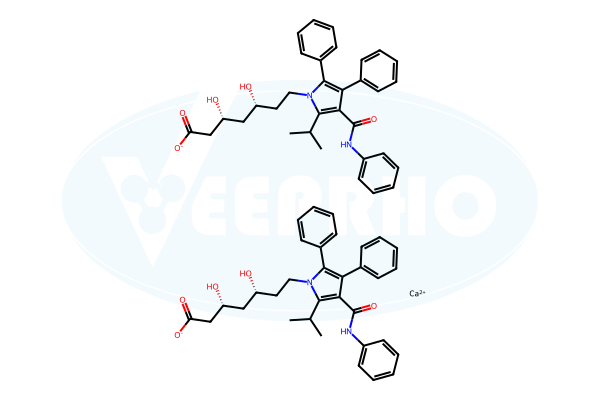

Additional information on CAS 581772-29-4
| Parent drug | Atorvastatin |
|---|---|
| Product type | Impurity standards |
| IUPAC name | [(4R,6R)-6-[2-[2-(4-fIuorophenyI)-3-phenyI-4-(phenyIcarbamoyI)-5-(propan-2-yI)-1H-pyrroI-1-yI]ethyI]-2,2- dimethyI-1,3-dioxan-4-yI]acetic acid |
| EP name | Atorvastatin EP Impurity P |
| Other Synonyms | Atorvastatin Acetonide Impurity; Atorvastatin Impurity 2 |
| SMILES | O=C(O)C[C@@H]1OC(C)(C)O[C@H](CCN2C(C3=CC=C(F)C=C3)=C(C4=CC=CC=C4)C(C(NC5=CC=CC=C5)=O)=C2C(C)C)C1 |
| InChI | InChI=1S/C36H39FN2O5/c1-23(2)33-32(35(42)38-27-13-9-6-10-14-27)31(24-11-7-5-8-12-24)34(25-15-17-26(37)18-16-25)39(33)20-19-28-21-29(22-30(40)41)44-36(3,4)43-28/h5-18,23,28-29H,19-22H2,1-4H3,(H,38,42)(H,40,41)/t28-,29-/m1/s1 |
| InChIKey | YFMKJVDVNPLQFO-FQLXRVMXSA-N |
| CHNS Ratio (%) (calculated) | C 72.22 · H 6.57 · N 4.68 · S 0.00 |
| References | - |
| Description | Atorvastatin EP Impurity P, also designated Atorvastatin Acetonide or Atorvastatin Impurity-2, CAS 581772-29-4, is a structurally related synthetic process impurity of atorvastatin bearing an acetonide-protected diol motif within the side chain. Its molecular formula is C36H39FN2O5 with a molecular weight of 598.70 g/mol. The impurity is generally associated with incomplete deprotection or side reactions during semi-synthetic manufacture rather than oxidative degradation. Because of close structural similarity to the API, characterization commonly relies on LC-MS/MS, HPLC with diode-array detection, and, where needed, NMR for site-specific assignment. It is evaluated within impurity profiling frameworks rather than as a genotoxic alert species. |
Request a Quote
"*" indicates required fields
Other products related to Atorvastatin impurities
| Impurity structure | Name of Impurity | Catalogue No. |
|---|---|---|
| Atorvastatin EP Impurity A | VE008745 | |
| Atorvastatin EP Impurity A (Ca salt) | VL10004 | |
 | Atorvastatin EP Impurity A (Na Salt) | VE0020562 |
| Atorvastatin EP Impurity B (Free Base) | VE009319 | |
| Atorvastatin EP Impurity C | VE008906 | |
 | Atorvastatin EP Impurity C (Na Salt) | VE0012975 |
| Atorvastatin EP Impurity D (Impurity D1) | VL10003 | |
 | Atorvastatin EP Impurity D (Mixture of D1 & D2) | VE0022694 |
| Atorvastatin EP Impurity E (Ca Salt) | VL10006 | |
| Atorvastatin EP Impurity E (Free Base) | VE0012984 | |
| Atorvastatin EP Impurity E (Na Salt) | VE009244 | |
| Atorvastatin EP Impurity F (Ca Salt) | VL10011 |
Show all related products N-Nitroso Atorvastatin impurities (14)