
- 100% accuracy of data
- 24/7 scientific support
- 0% tolerance in quality of product
Mutagenicity assessment (ICH M7)
Potentially mutagenic impurity (ICH M7 Class 1–3).
N-nitroso compound: ICH M7 cohort of concern.Stock Locations
- New Jersey, USA
- Czech Republic, EU
* Stock subject to availability.
Documentation
Includes: HPLC, MASS/LC-MS, 1H NMR, FT-IR, Potency, Structure Elucidation Report (SER), and additional analytical data depending on the product.
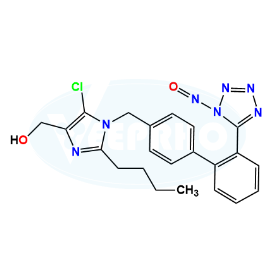
N-Nitroso Losartan EP Impurity C
● Under Development
| Catalogue No.: | VE0027959 |
|---|---|
| CAS No.: | N/A |
| Mol. Formula: | C22H22ClN7O2 |
| Mol. Weight: | 451.91 g/mol |
For laboratory use only: analytical, development and regulatory purposes. Supplied in mg quantities. Not for human or veterinary use.
Request a quote for a set
- Request quote for this set
All nitrosamine impurities of Losartan
12 productsSee the 12 products
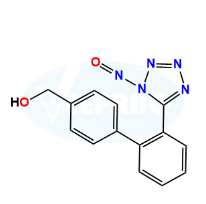
- N-Nitroso Losartan EP Impurity B VE0027958
- N-Nitroso Losartan EP Impurity C VE0027959
- N-Nitroso Losartan EP Impurity E VE0027960
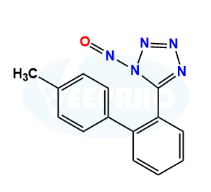
- N-Nitroso Losartan EP Impurity F VE0027961
- N-Nitroso Losartan EP Impurity I VE0027962
- N-Nitroso Losartan EP Impurity J VE0027963
- N-Nitroso Losartan EP Impurity K VE0027964
- N-Nitroso Losartan EP Impurity L VE0027968
- N-Nitroso Losartan EP Impurity M VE0027970
- N-Nitrosodiethylamine (NDEA) VL3850024
CAS 55-18-5 - N-Nitrosodimethylamine (NDMA) VL3850010
CAS 62-75-9 - Nitroso BCFI Impurity VE007670
Additional information on N-Nitroso Losartan EP Impurity C
| Parent drug | Losartan |
|---|---|
| Product type | Impurity standards, Nitroso impurities |
| IUPAC name | (2-butyl-5-chloro-1-((2'-(1-nitroso-1H-tetrazol-5-yl)-[1,1'-biphenyl]-4-yl)methyl)-1H-imidazol-4-yl)methanol |
| SMILES | O=NN1N=NN=C1C2=C(C=CC=C2)C3=CC=C(C=C3)CN4C(Cl)=C(CO)N=C4CCCC |
| InChI | InChI=1S/C22H22ClN7O2/c1-2-3-8-20-24-19(14-31)21(23)29(20)13-15-9-11-16(12-10-15)17-6-4-5-7-18(17)22-25-26-27-30(22)28-32/h4-7,9-12,31H,2-3,8,13-14H2,1H3 |
| InChIKey | QJVNDQWPXKDTKP-UHFFFAOYSA-N |
| CHNS Ratio (%) (calculated) | C 58.47 · H 4.91 · N 21.70 · S 0.00 |
| Description | N-Nitroso Losartan EP Impurity C is a genotoxic nitroso impurity observed in losartan syntheses and aging studies. This impurity arises from nitrosation of the losartan precursor under exposure to nitrosating agents, acidic conditions or elevated temperature. Analytical characterization typically employs LC-MS, GC-MS and 1H/13C NMR with validated HPLC methods for routine quantification in stability and release testing. Risk control focuses on raw material quality, elimination of nitrosating reagents, pH control, scavengers and validated cleaning procedures. Establishing a qualified analytical standard, setting appropriate specification limits and conducting forced degradation studies are essential for regulatory compliance and patient safety. |
Request a Quote
"*" indicates required fields
Other products related to Losartan and Nitroso impurities
| Impurity structure | Name of Impurity | Catalogue No. |
|---|---|---|
| Losartan EP Impurity A | VL214023 | |
 | Losartan EP Impurity B | VL214009 |
| Losartan EP Impurity B (Potassium Salt) | VE0021367 | |
| Losartan EP Impurity C | VL214022 | |
| Losartan EP Impurity D | VL214017 | |
| Losartan EP Impurity E | VL214012 | |
| Losartan EP Impurity E (Potassium Salt) | VE0021368 | |
| Losartan EP Impurity F | VL214021 | |
| Losartan EP Impurity H | VL214025 | |
| Losartan EP Impurity I | VL214014 | |
| Losartan EP Impurity J | VL214004 | |
| Losartan EP Impurity K | VL214019 |
Show all related products N-Nitroso Losartan impurities (12)