
- 100% accuracy of data
- 24/7 scientific support
- 0% tolerance in quality of product
Mutagenicity assessment (ICH M7)
Potentially mutagenic impurity (ICH M7 Class 1–3).
N-nitroso compound: ICH M7 cohort of concern.Stock Locations
- New Jersey, USA
- Czech Republic, EU
* Stock subject to availability.
Documentation
Includes: HPLC, MASS/LC-MS, 1H NMR, FT-IR, Potency, Structure Elucidation Report (SER), and additional analytical data depending on the product.
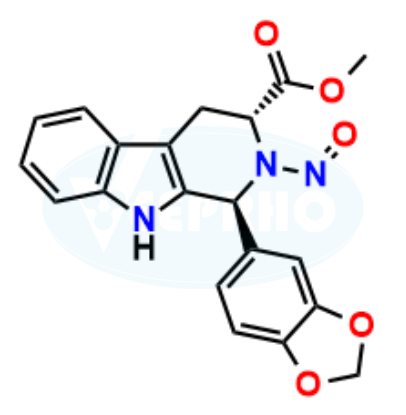
N-nitroso-trans-carboline
● Report Available Immediately
| Catalogue No.: | VE0027357 |
|---|---|
| CAS No.: | N/A |
| Mol. Formula: | C20H17N3O5 |
| Mol. Weight: | 379.37 g/mol |
For laboratory use only: analytical, development and regulatory purposes. Supplied in mg quantities. Not for human or veterinary use.
Request a quote for a set
- Request quote for this set
All nitrosamine impurities of Carboline
2 productsSee the 2 products
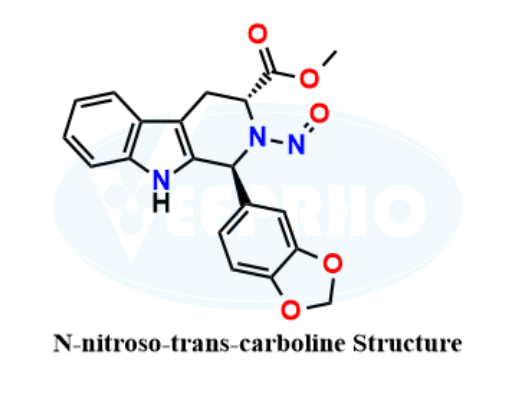
Additional information on N-nitroso-trans-carboline
| Parent drug | Carboline |
|---|---|
| Product type | Impurity standards, Nitroso impurities |
| IUPAC name | (1S,3R)-methyl 1-(benzo[d][1,3]dioxol-5-yl)-2-nitroso-2,3,4,9-tetrahydro-1H-pyrido[3,4-b]indole-3-carboxylate |
| SMILES | O=C([C@H]1CC2=C([C@H](C3=CC=C(OCO4)C4=C3)N1N=O)NC5=C2C=CC=C5)OC |
| InChI | InChI=1S/C20H17N3O5/c1-26-20(24)15-9-13-12-4-2-3-5-14(12)21-18(13)19(23(15)22-25)11-6-7-16-17(8-11)28-10-27-16/h2-8,15,19,21H,9-10H2,1H3/t15-,19+/m1/s1 |
| InChIKey | IDIDSKNYNGOEEK-BEFAXECRSA-N |
| CHNS Ratio (%) (calculated) | C 63.32 · H 4.52 · N 11.08 · S 0.00 |
| Description | N-nitroso-trans-carboline impurity is a nitrosamine-class contaminant of concern in synthetic routes that involve trans-carboline scaffolds. It can form via nitrosation of secondary amine precursors in the presence of nitrite under acidic conditions and exhibits characteristics of a genotoxic impurity, requiring stringent risk assessment and control strategies. Detection and quantification typically rely on highly sensitive techniques such as LC-MS/MS or GC-HRMS with validated sample preparation and low ng/kg limits of quantitation. Control measures include limiting nitrite and nitrosating species, pH management, scavengers, optimized purification and in-process monitoring. Stability profiling and documented mitigation are essential for regulatory compliance and product safety. |
Request a Quote
"*" indicates required fields