
- 100% accuracy of data
- 24/7 scientific support
- 0% tolerance in quality of product
Stock Locations
- New Jersey, USA
- Czech Republic, EU
* Stock subject to availability.
Documentation
Includes: HPLC, MASS/LC-MS, 1H NMR, FT-IR, Potency, Structure Elucidation Report (SER), and additional analytical data depending on the product.
118058-74-5
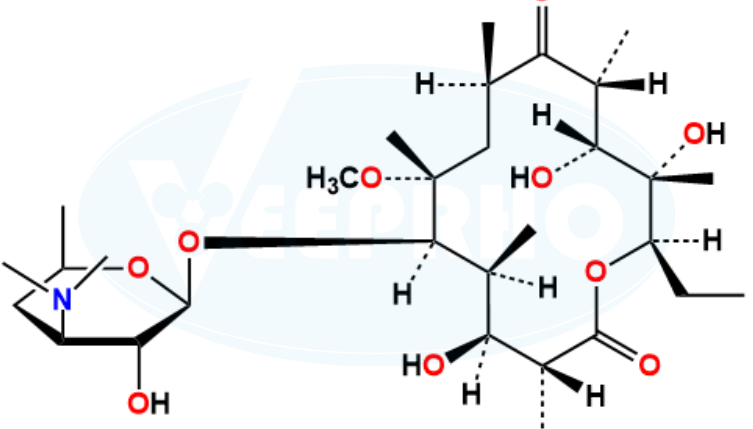
Clarithromycin Impurity I
● In Stock
| Catalogue No.: | VL740007 |
|---|---|
| CAS No.: | 118058-74-5 |
| Mol. Formula: | C30H55NO10 |
| Mol. Weight: | 589.76g/mol |
For laboratory use only: analytical, development and regulatory purposes. Supplied in mg quantities. Not for human or veterinary use.
Request a quote for a set
- Request quote for this set
All EP impurities of Clarithromycin
16 productsSee the 16 products
- Clarithromycin EP Impurity A VL740014
CAS 124412-58-4 - Clarithromycin EP Impurity B VE009557
CAS 299409-85-1 - Clarithromycin EP Impurity C VL740001
CAS 127253-06-9 - Clarithromycin EP Impurity D VL740002
CAS 101666-68-6 - Clarithromycin EP Impurity E VL740009
CAS 81103-14-2 - Clarithromycin EP Impurity F VL740004
CAS 128940-83-0 - Clarithromycin EP Impurity H VL740006
CAS 127140-69-6 - Clarithromycin EP Impurity J VL740012
CAS 111321-02-9 - Clarithromycin EP Impurity K VL740010
CAS 127157-35-1 - Clarithromycin EP Impurity M VL740003
CAS 127182-43-8 - Clarithromycin EP Impurity O VL740015
CAS 127252-80-6 - Clarithromycin EP Impurity P VL740016
CAS 123967-58-8 - Clarithromycin EP Impurity Q VL740013
CAS 118074-07-0 - Clarithromycin Impurity G VL740008
CAS 127182-44-9 - Clarithromycin Impurity I VL740007
CAS 118058-74-5 - Clarithromycin Impurity N VL740011
CAS 144604-03-5
- Clarithromycin EP Impurity A VL740014
- Request quote for this set
All USP impurities of Clarithromycin
17 productsSee the 17 products
- Clarithromycin EP Impurity A VL740014
CAS 124412-58-4 - Clarithromycin EP Impurity B VE009557
CAS 299409-85-1 - Clarithromycin EP Impurity C VL740001
CAS 127253-06-9 - Clarithromycin EP Impurity D VL740002
CAS 101666-68-6 - Clarithromycin EP Impurity E VL740009
CAS 81103-14-2 - Clarithromycin EP Impurity F VL740004
CAS 128940-83-0 - Clarithromycin EP Impurity H VL740006
CAS 127140-69-6 - Clarithromycin EP Impurity J VL740012
CAS 111321-02-9 - Clarithromycin EP Impurity K VL740010
CAS 127157-35-1 - Clarithromycin EP Impurity L VL740005
CAS 127253-05-8 - Clarithromycin EP Impurity M VL740003
CAS 127182-43-8 - Clarithromycin EP Impurity O VL740015
CAS 127252-80-6 - Clarithromycin EP Impurity P VL740016
CAS 123967-58-8 - Clarithromycin EP Impurity Q VL740013
CAS 118074-07-0 - Clarithromycin Impurity G VL740008
CAS 127182-44-9 - Clarithromycin Impurity I VL740007
CAS 118058-74-5 - Clarithromycin Impurity N VL740011
CAS 144604-03-5
- Clarithromycin EP Impurity A VL740014

Additional information on CAS 118058-74-5
| Parent drug | Clarithromycin |
|---|---|
| Product type | Impurity standards |
| IUPAC name | 3-O-Decladinosyl-6-O-methylerythromycin A |
| EP name | Clarithromycin EP Impurity I |
| USP name | Clarithromycin Impurity I; Decladinosyl Clarithromycin |
| SMILES | C[C@@](OC)(C[C@H](C([C@@H]1C)=O)C)[C@@H]([C@H]([C@@H]([C@H](C(O[C@H](CC)[C@@](C)(O)[C@@H]1O)=O)C)O)C)O[C@@](O[C@H](C)C[C@@H]2N(C)C)([H])[C@@H]2O |
| InChI | InChI=1S/C30H55NO10/c1-12-21-30(8,37)25(35)17(4)22(32)15(2)14-29(7,38-11)26(18(5)23(33)19(6)27(36)40-21)41-28-24(34)20(31(9)10)13-16(3)39-28/h15-21,23-26,28,33-35,37H,12-14H2,1-11H3/t15-,16-,17+,18+,19-,20+,21-,23+,24-,25-,26-,28+,29-,30-/m1/s1 |
| InChIKey | QTLYNHBYTKOXTE-FNAMOMDESA-N |
| CHNS Ratio (%) (calculated) | C 61.10 · H 9.40 · N 2.38 · S 0.00 |
| References | - |
| Description | Clarithromycin EP Impurity I, also termed des(cladinosyl) clarithromycin or decladinosyl clarithromycin, is the 3-O-cladinosyl-deglycosylated macrolide analogue of clarithromycin, representing a structural degradation or biotransformation product rather than a process-related genotoxic impurity. CAS 118058-74-5 corresponds to the neutral molecule with formula C30H55NO10 and molecular weight 589.76 g/mol. Loss of the cladinose residue alters the desosamine-bearing 14-membered lactone framework and may arise under acidic hydrolysis or enzymatic cleavage. Identification typically requires high-resolution LC-MS, LC-MS/MS, and orthogonal chromatographic separation, with UV and NMR confirmation for structural assignment. |
Request a Quote
"*" indicates required fields
Other products related to Clarithromycin impurities
| Impurity structure | Name of Impurity | Catalogue No. |
|---|---|---|
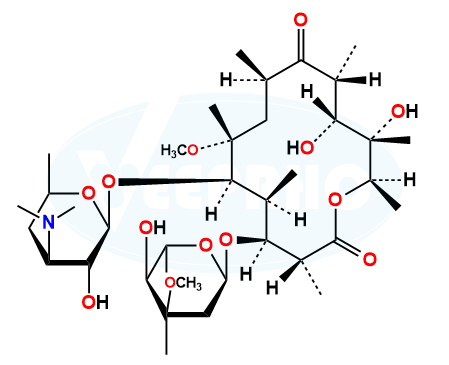
 | Clarithromycin EP Impurity A | VL740014 |
| Clarithromycin EP Impurity B | VE009557 | |
| Clarithromycin EP Impurity C | VL740001 | |
| Clarithromycin EP Impurity D | VL740002 | |
| Clarithromycin EP Impurity E | VL740009 | |
| Clarithromycin EP Impurity F | VL740004 | |
| Clarithromycin EP Impurity H | VL740006 | |
| Clarithromycin EP Impurity J | VL740012 | |
 | Clarithromycin EP Impurity K | VL740010 |
 | Clarithromycin EP Impurity L | VL740005 |
| Clarithromycin EP Impurity M | VL740003 | |
 | Clarithromycin EP Impurity O | VL740015 |