

- 100% accuracy of data
- 24/7 scientific support
- 0% tolerance in quality of product
Stock Locations
- New Jersey, USA
- Czech Republic, EU
* Stock subject to availability.
Documentation
Includes: HPLC, MASS/LC-MS, 1H NMR, FT-IR, Potency, Structure Elucidation Report (SER), and additional analytical data depending on the product.
127157-35-1
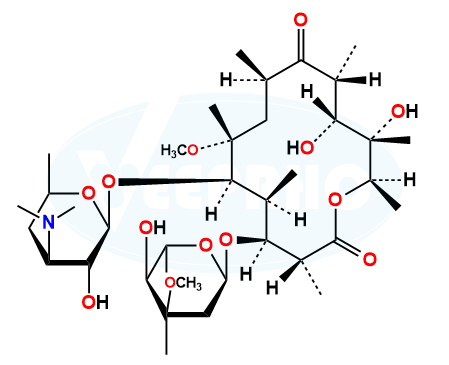
Clarithromycin EP Impurity K
● In Stock
| Catalogue No.: | VL740010 |
|---|---|
| CAS No.: | 127157-35-1 |
| Mol. Formula: | C30H51NO8 |
| Mol. Weight: | 553.73 g/mol |
For laboratory use only: analytical, development and regulatory purposes. Supplied in mg quantities. Not for human or veterinary use.
Request a quote for a set
- Request quote for this set
All EP impurities of Clarithromycin
16 productsSee the 16 products
- Clarithromycin EP Impurity A VL740014
CAS 124412-58-4 - Clarithromycin EP Impurity B VE009557
CAS 299409-85-1 - Clarithromycin EP Impurity C VL740001
CAS 127253-06-9 - Clarithromycin EP Impurity D VL740002
CAS 101666-68-6 - Clarithromycin EP Impurity E VL740009
CAS 81103-14-2 - Clarithromycin EP Impurity F VL740004
CAS 128940-83-0 - Clarithromycin EP Impurity H VL740006
CAS 127140-69-6 - Clarithromycin EP Impurity J VL740012
CAS 111321-02-9 - Clarithromycin EP Impurity K VL740010
CAS 127157-35-1 - Clarithromycin EP Impurity M VL740003
CAS 127182-43-8 - Clarithromycin EP Impurity O VL740015
CAS 127252-80-6 - Clarithromycin EP Impurity P VL740016
CAS 123967-58-8 - Clarithromycin EP Impurity Q VL740013
CAS 118074-07-0 - Clarithromycin Impurity G VL740008
CAS 127182-44-9 - Clarithromycin Impurity I VL740007
CAS 118058-74-5 - Clarithromycin Impurity N VL740011
CAS 144604-03-5
- Clarithromycin EP Impurity A VL740014
- Request quote for this set
All USP impurities of Clarithromycin
17 productsSee the 17 products
- Clarithromycin EP Impurity A VL740014
CAS 124412-58-4 - Clarithromycin EP Impurity B VE009557
CAS 299409-85-1 - Clarithromycin EP Impurity C VL740001
CAS 127253-06-9 - Clarithromycin EP Impurity D VL740002
CAS 101666-68-6 - Clarithromycin EP Impurity E VL740009
CAS 81103-14-2 - Clarithromycin EP Impurity F VL740004
CAS 128940-83-0 - Clarithromycin EP Impurity H VL740006
CAS 127140-69-6 - Clarithromycin EP Impurity J VL740012
CAS 111321-02-9 - Clarithromycin EP Impurity K VL740010
CAS 127157-35-1 - Clarithromycin EP Impurity L VL740005
CAS 127253-05-8 - Clarithromycin EP Impurity M VL740003
CAS 127182-43-8 - Clarithromycin EP Impurity O VL740015
CAS 127252-80-6 - Clarithromycin EP Impurity P VL740016
CAS 123967-58-8 - Clarithromycin EP Impurity Q VL740013
CAS 118074-07-0 - Clarithromycin Impurity G VL740008
CAS 127182-44-9 - Clarithromycin Impurity I VL740007
CAS 118058-74-5 - Clarithromycin Impurity N VL740011
CAS 144604-03-5
- Clarithromycin EP Impurity A VL740014

Additional information on CAS 127157-35-1
| Parent drug | Clarithromycin |
|---|---|
| Product type | Impurity standards |
| IUPAC name | (1S,2R,5R,6S,7S,8R,9R,11Z)-2-Ethyl-6-hydroxy-9-methoxy-1,5,7,9,11,13-hexamethyl-8-[[3,4,6-trideoxy-3-(dimethylamino)-β-D-xylo-hexopyranosyl]oxy]-3,15-dioxabicyclo[10.2.1]pentadeca-11,13-dien-4-one |
| EP name | Clarithromycin EP Impurity K |
| USP name | Clarithromycin Impurity K |
| CHNS Ratio (%) (calculated) | C 65.07 · H 9.28 · N 2.53 · S 0.00 |
| References | MORIMOTO, SHIGEO, et al. “Chemical Modification of Erythromycins. VI. Structure and Antibacterial Activity of Acid Degradation Products of 6-O-Methylerythromycins A.†The Journal of Antibiotics, vol. 43, no. 5, 1990, pp. 570–73, https://doi.org/10.7164/antibiotics.43.570. ‌“Erythromycin Is a Motilin Receptor Agonist | American Journal of Physiology-Gastrointestinal and Liver Physiology.†American Journal of Physiology-Gastrointestinal and Liver Physiology, 2020, journals.physiology.org/doi/abs/10.1152/ajpgi.1989.257.3.g470. ‌ |
| Description | Clarithromycin EP Impurity K (CAS 127157-35-1) is a defined macrolide-related process impurity associated with the 14-membered erythromycin-derived scaffold of clarithromycin. With molecular formula C30H51NO8 and molecular weight 553.73 g/mol, it represents a structurally modified oxygenated analog rather than a simple counterion or residual solvent. Such impurities may arise during semisynthetic conversion, oxidative transformation, or incomplete side-chain elaboration. Characterization generally relies on orthogonal LC-MS/MS, high-resolution mass spectrometry, and impurity profiling by HPLC with UV detection. In a regulatory setting, its occurrence is assessed under compendial impurity control frameworks and related stability-indicating studies. |
Request a Quote
"*" indicates required fields
Other products related to Clarithromycin impurities
| Impurity structure | Name of Impurity | Catalogue No. |
|---|---|---|
 | Clarithromycin EP Impurity A | VL740014 |
| Clarithromycin EP Impurity B | VE009557 | |
| Clarithromycin EP Impurity C | VL740001 | |
| Clarithromycin EP Impurity D | VL740002 | |
| Clarithromycin EP Impurity E | VL740009 | |
| Clarithromycin EP Impurity F | VL740004 | |
| Clarithromycin EP Impurity H | VL740006 | |
| Clarithromycin EP Impurity J | VL740012 | |
 | Clarithromycin EP Impurity L | VL740005 |
| Clarithromycin EP Impurity M | VL740003 | |
 | Clarithromycin EP Impurity O | VL740015 |
| Clarithromycin EP Impurity P | VL740016 |